15 Fall Business Casual Outfits, Placed on a Sliding Scale From Relaxed to Polished
A friend switched jobs from a creative agency to a law firm and asked me to help her repack her closet. She kept saying “business casual” like it was one fixed thing, but the truth is her old office’s business casual and her new office’s business casual were nearly different dress codes entirely. One allowed dark jeans and sneakers. The other expected blazers most days and treated jeans as a special Friday exception.
That is the real problem with most business casual guides. They treat it as a single outfit formula, when it is actually a wide spectrum, and the right point on that spectrum depends entirely on your specific office. So instead of quietly assuming one definition, I built this post as a slider. Fifteen outfits, arranged from position 1, the most relaxed end of business casual, to position 15, the most polished end just short of a full suit. Find roughly where your office sits, and choose outfits from that zone, with a nearby range on either side for flexibility.
The Slider
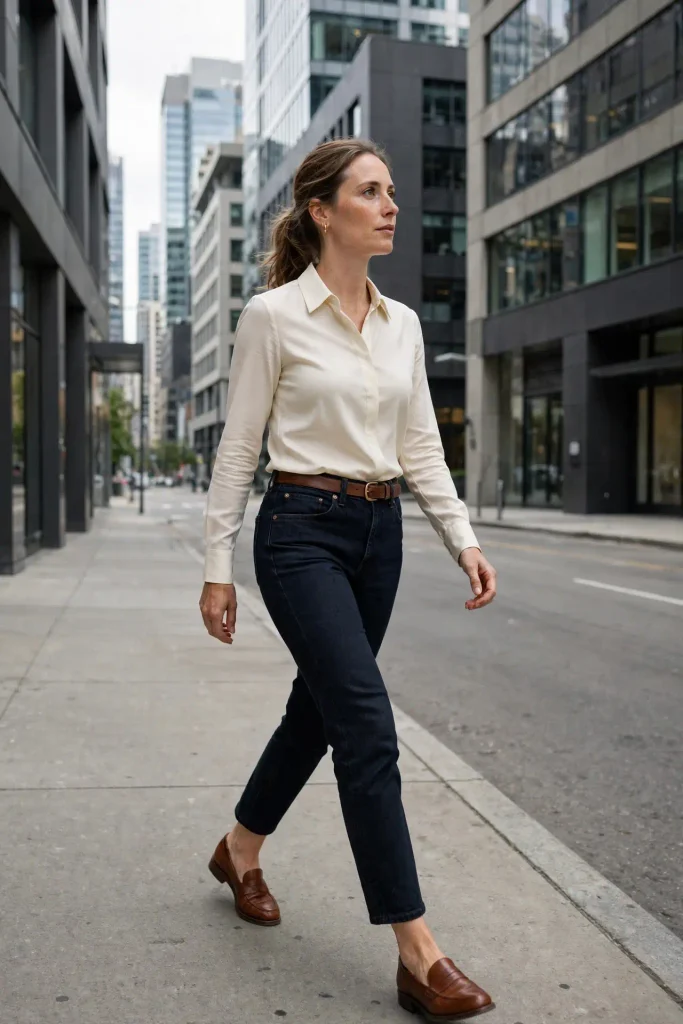
Position 1, Most Relaxed. Dark Jeans and a Structured Top.
Dark, unripped straight-leg jeans, a fitted blouse tucked in, loafers.
Dial it up: swap the jeans for tailored trousers and add a blazer.
Dial it down: this is close to the floor of business casual, but you could swap loafers for clean white sneakers if your office genuinely allows it.
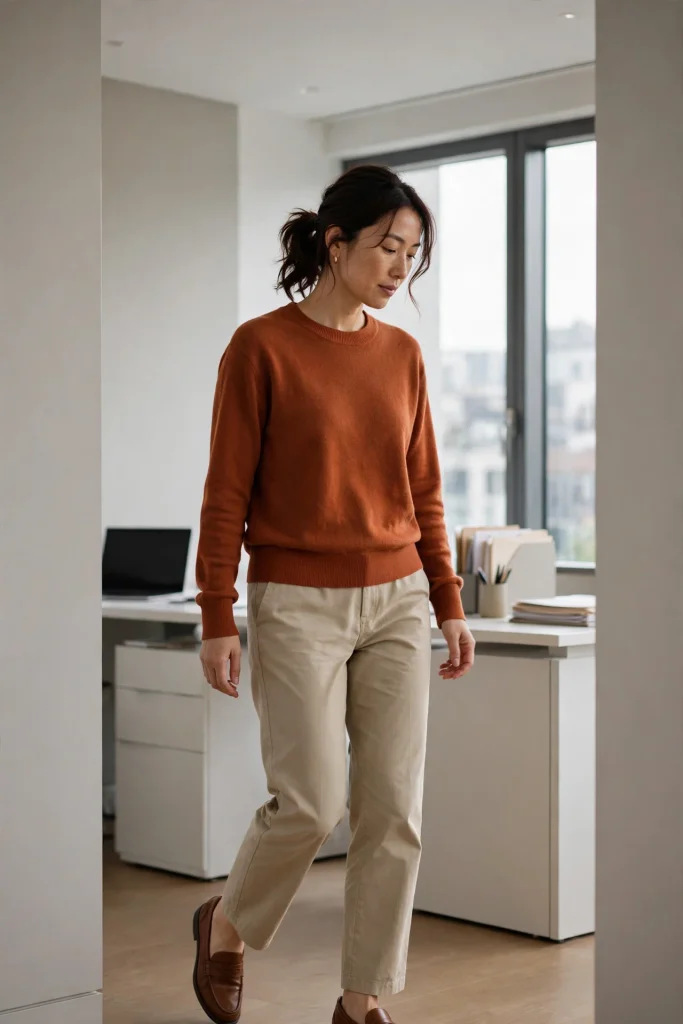
Position 2. The Elevated Casual Sweater.
A quality crewneck sweater in rust or olive, straight-leg trousers, loafers.
Dial it up: layer a collared shirt underneath with the collar and cuffs peeking out.
Dial it down: swap trousers for dark jeans.
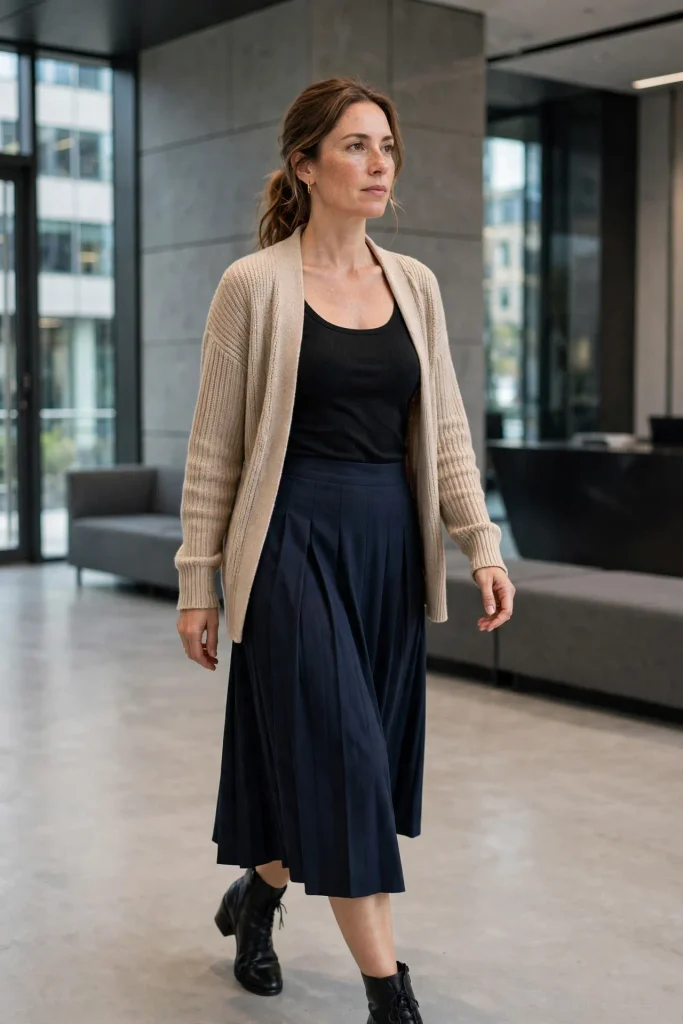
Position 3. The Cardigan and Midi Skirt.
An open cardigan over a fitted tank, a midi skirt in a solid color, ankle boots.
Dial it up: button the cardigan and add a thin belt at the waist for more structure.
Dial it down: swap the midi skirt for straight-leg jeans.
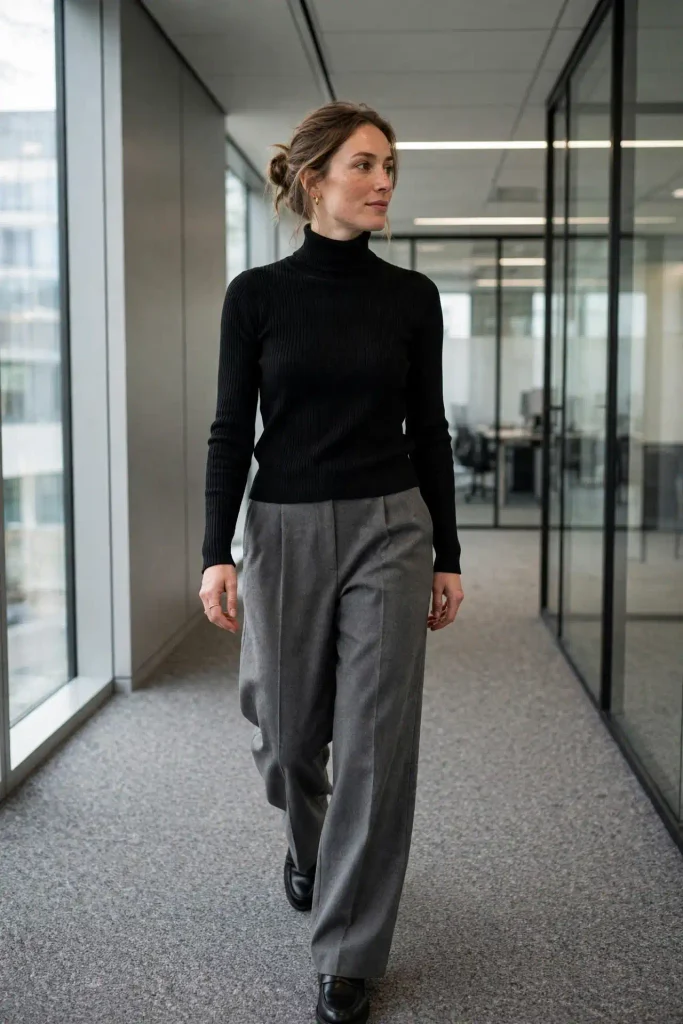
Position 4. The Turtleneck Base.
A fine ribbed turtleneck, wide-leg trousers, loafers.
Dial it up: add a blazer over the turtleneck for an instant formality jump.
Dial it down: swap the trousers for dark, straight denim.
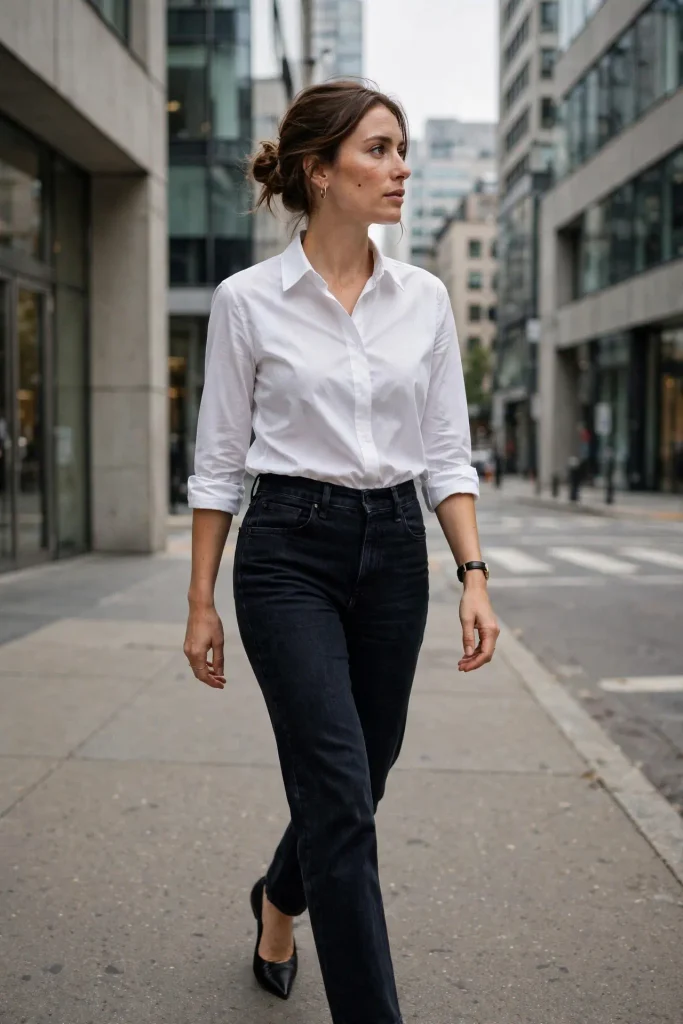
Dark, trouser-cut jeans with a crisp, flat front rather than a casual five-pocket cut, a tucked blouse, pointed flats.
Dial it up: add a fitted blazer.
Dial it down: swap the blouse for a soft knit top.
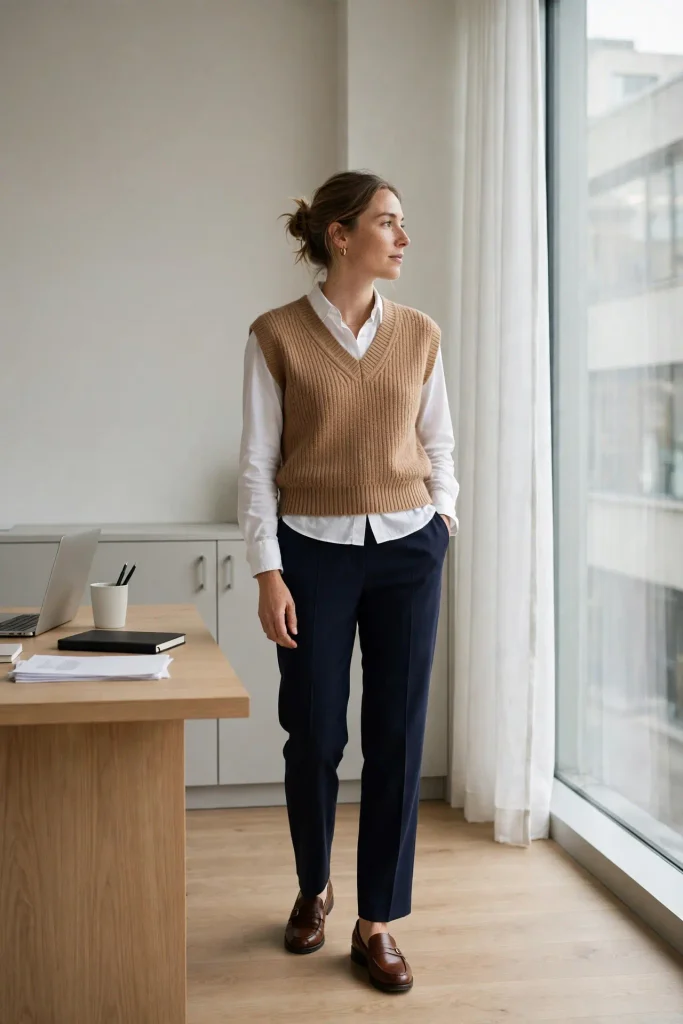
Position 6. The Sweater Vest Layer.
A sweater vest over a button-up blouse, straight trousers, loafers.
Dial it up: swap loafers for a low pump and add small gold jewelry.
Dial it down: leave the blouse untucked and swap the loafers for clean sneakers.
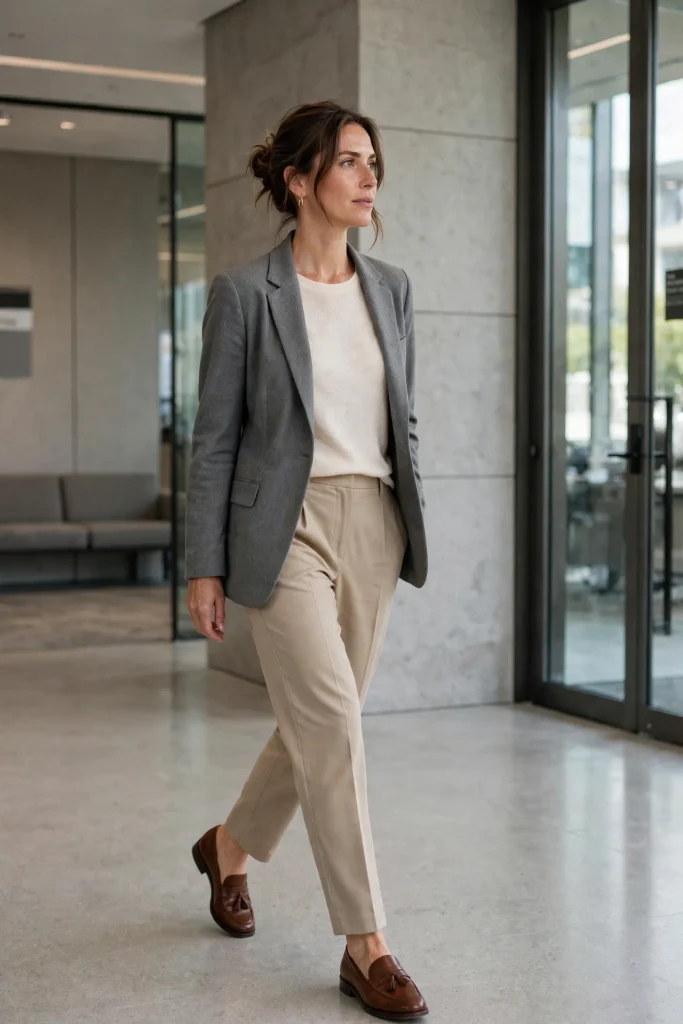
Position 7, The True Middle. The Blazer and Trouser Set, Unmatched.
A blazer in one neutral color, trousers in a slightly different but complementary neutral, a simple knit top underneath, loafers.
Dial it up: match the blazer and trouser exactly as a set for a more formal, coordinated look. Dial it down: remove the blazer entirely and let the top and trousers stand alone.
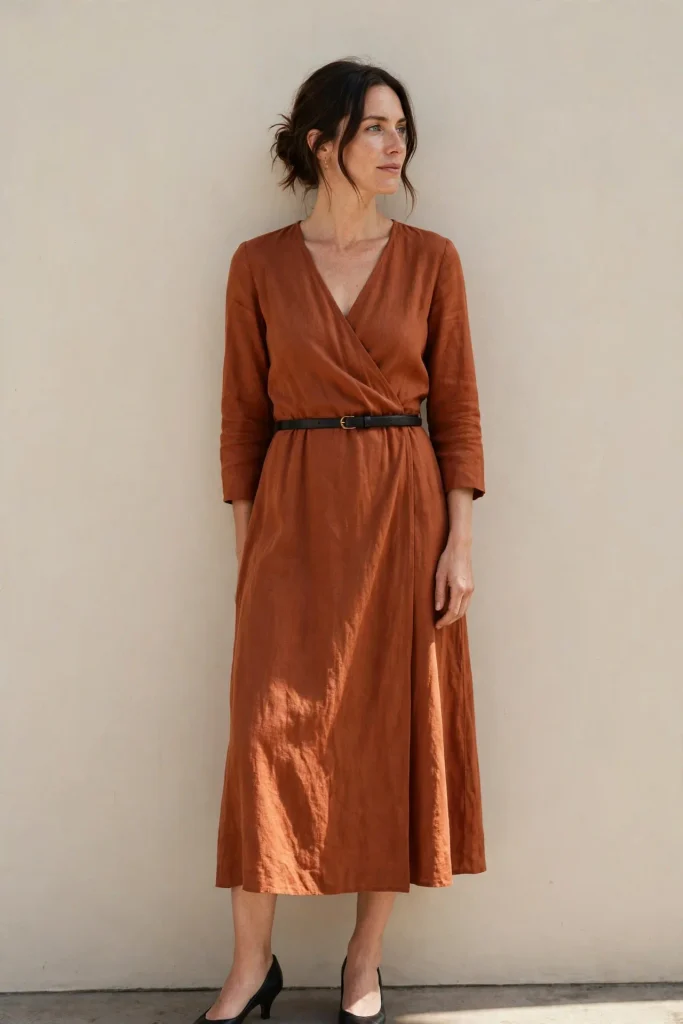
Position 8. The Wrap Dress.
A wrap-style midi dress in a solid rust or navy, worn with a thin belt already built into the tie, low heels.
Dial it up: add a blazer over it and swap to a pointed pump.
Dial it down: swap heels for loafers and add a cardigan instead of a blazer.
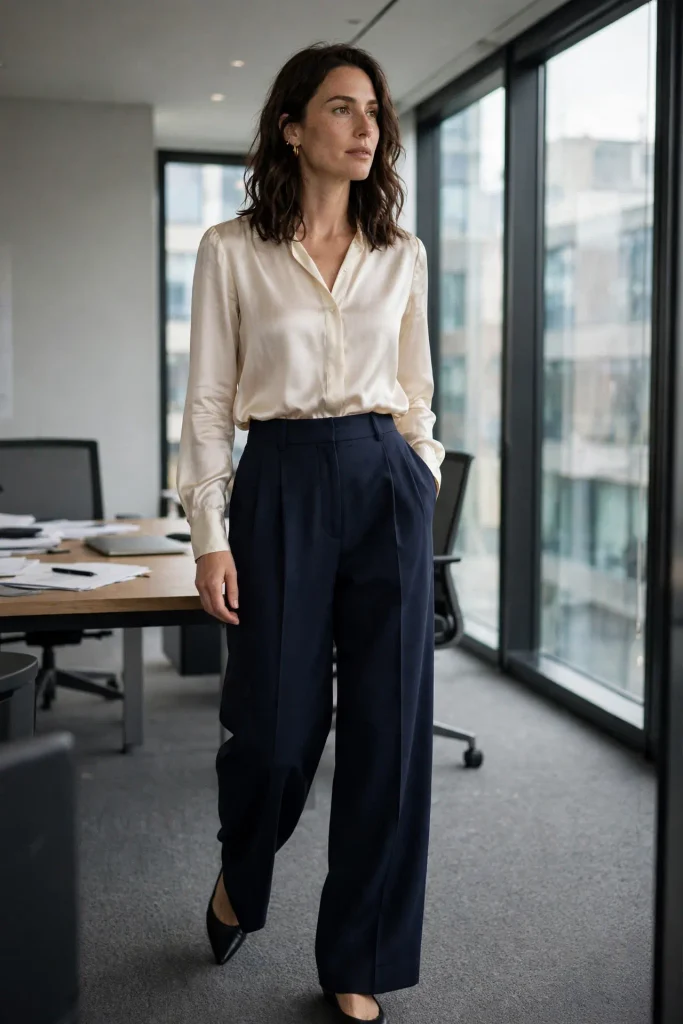
Position 9. The Silk Blouse and Wide-Leg Trouser.
A silk or silk-blend blouse tucked into high-waisted wide-leg trousers, pointed flats.
Dial it up: add a blazer and swap flats for a low heel.
Dial it down: swap the silk blouse for a cotton button-up.
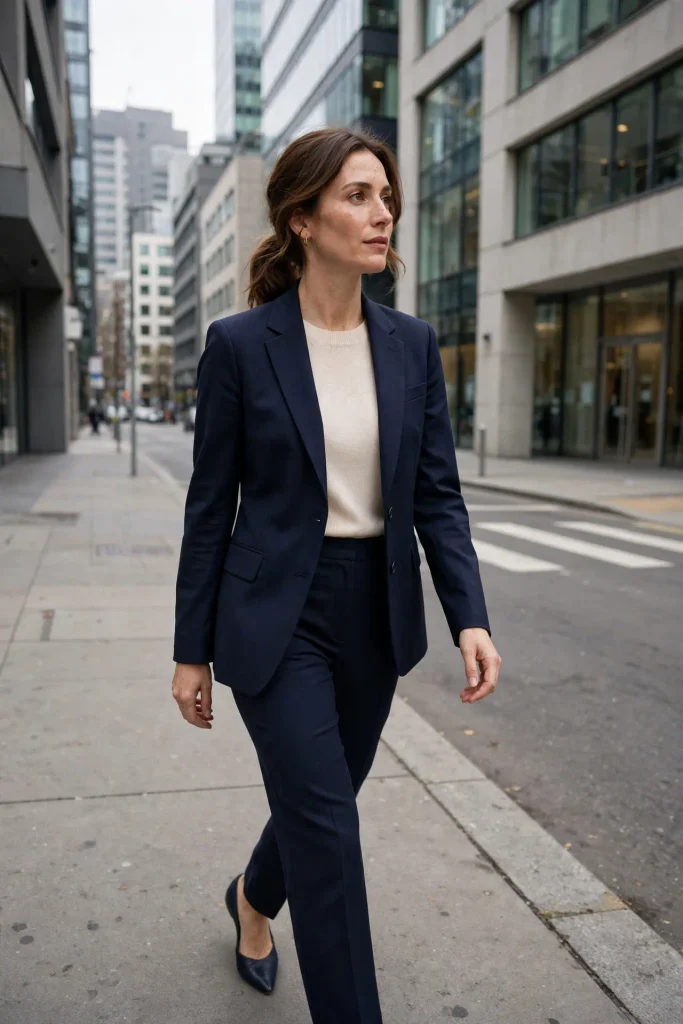
Position 10. The Matching Trouser Set.
A blazer and trouser cut from the same fabric and color, worn as a coordinated set, with a simple knit or camisole underneath, pointed flats or a low heel.
Dial it up: swap the knit top for a silk camisole and add a statement earring.
Dial it down: leave the blazer unbuttoned and roll the sleeves slightly.
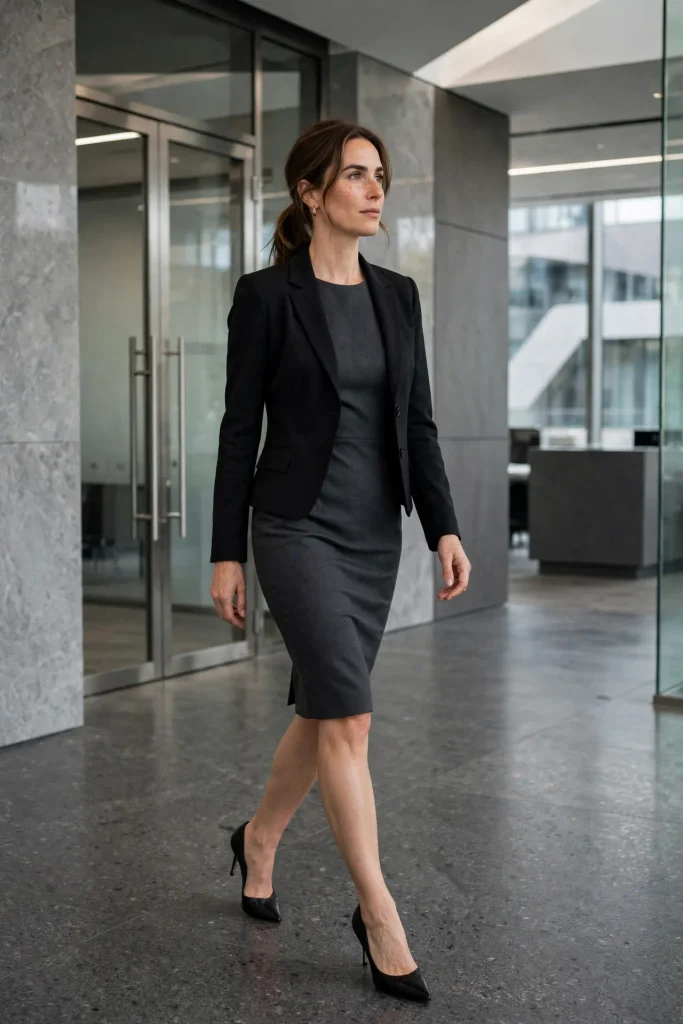
Position 11. The Sheath Dress and Blazer.
A fitted sheath dress in a solid neutral, a cropped or waist-length blazer over it, pointed pumps.
Dial it up: swap to a longer blazer and add tights and a more structured heel.
Dial it down: remove the blazer and let the dress stand alone with a cardigan instead.
Position 12. The Structured Skirt Suit, Softened.
A pencil skirt and matching blazer, but worn with a soft knit top instead of a blouse, to keep it from tipping into full formal-suit territory, pointed flats or a low heel.
Dial it up: swap the knit top for a silk blouse and add heels.
Dial it down: swap the pencil skirt for wide-leg trousers in the same fabric.

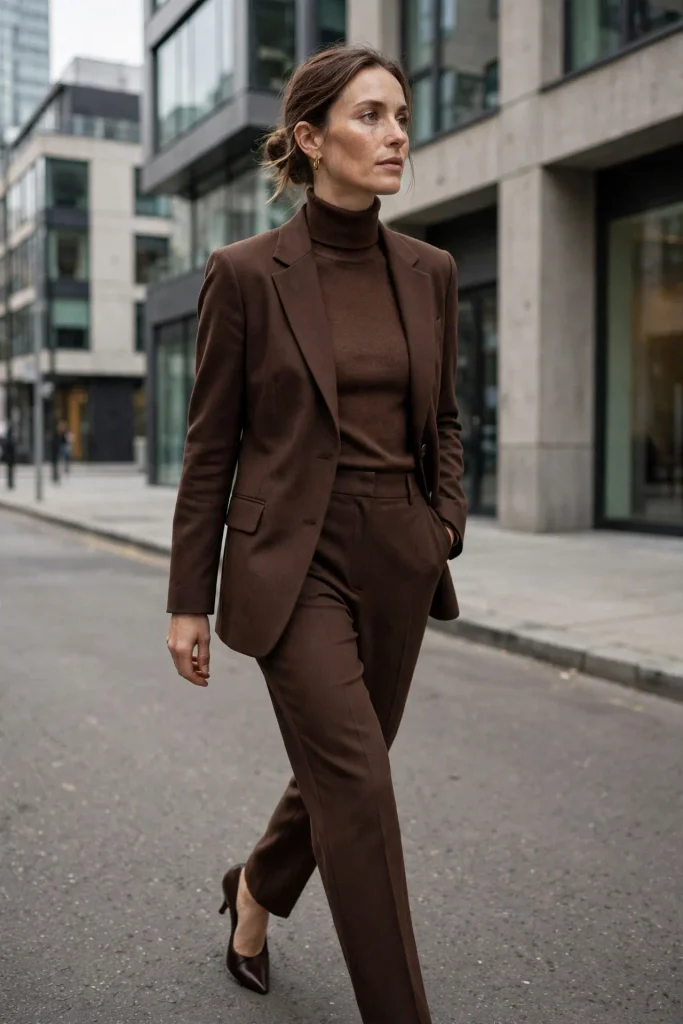
Position 13. The Monochrome Power Look.
One color family from top to bottom, a chocolate brown turtleneck, matching trousers, and a slightly darker or lighter brown blazer, pointed heels.
Dial it up: add a structured bag and tonal jewelry for a fully composed look.
Dial it down: swap the blazer for a cardigan in the same color family.
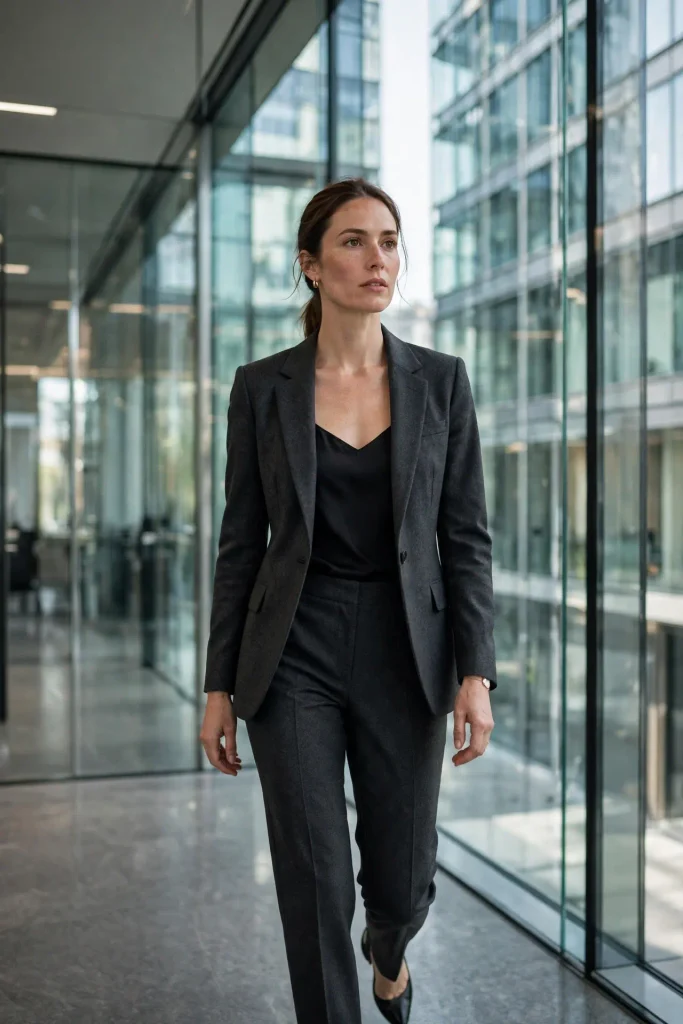
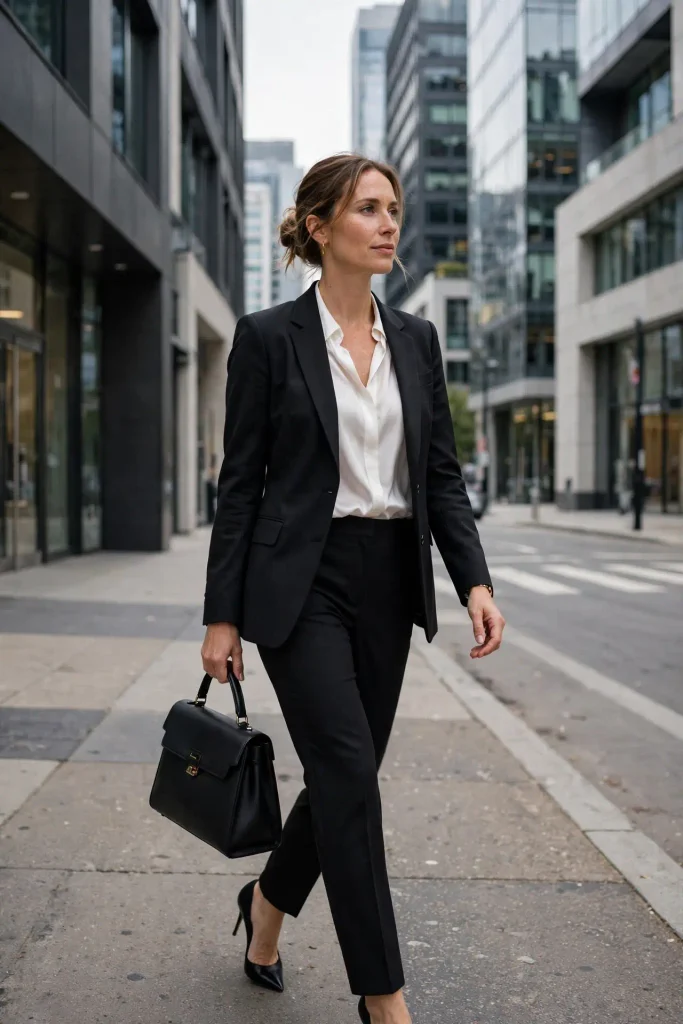
Position 14. The Full Coordinated Suiting.
A tailored trouser suit in wool or a wool-blend, worn with a fitted camisole and no blouse underneath the blazer, pointed heels.
Dial it up: this is close to the top of the business casual range and edges toward full formal business wear as is.
Dial it down: unbutton the blazer and remove the jacket entirely for meetings, keeping only the trouser and camisole.
Position 15, Most Polished. The Full Structured Suit with Silk Blouse.
A matched trouser or skirt suit, a silk blouse with a defined collar, pointed heels, structured bag.
Dial it up: this is effectively the ceiling of business casual before it becomes formal business wear.
Dial it down: for a client-facing but slightly less formal day, remove the blouse’s top button and swap the structured bag for a softer tote.
Something New: The Industry Translator
Because “business casual” means something different depending on the field, here is a rough translation of where different industries typically sit on the slider.
Creative agencies and startups usually sit around positions 1 through 5, where dark denim and structured knitwear are genuinely acceptable most days, with blazers reserved for client meetings specifically. Education and nonprofit work often sits around positions 3 through 8, comfortable enough for movement and standing all day, but expected to look intentional rather than purely casual. Corporate and finance-adjacent offices typically sit around positions 8 through 12, where a full jeans day is rare and blazers are a near-daily expectation even without client contact. Law firms and client-facing consulting often sit around positions 11 through 15, where the gap between business casual and full formal wear is genuinely narrow most days.
If you are new to an office, spend the first week observing roughly where colleagues at your level sit on this slider before committing to your own wardrobe at one end or the other.
The Fabric Formality Chart
Fabric changes the formality reading of an outfit almost as much as the cut does, which is worth understanding separately from the slider itself.
| Fabric | Formality Reading | Best Slider Range |
|---|---|---|
| Dark, rigid denim | Casual | Positions 1 to 5 |
| Cotton jersey knit | Casual to relaxed | Positions 1 to 6 |
| Ribbed fine knit | Relaxed to middle | Positions 2 to 9 |
| Cotton twill or poplin | Middle | Positions 5 to 11 |
| Silk or silk-blend | Middle to polished | Positions 8 to 15 |
| Ponte knit | Middle to polished | Positions 6 to 12 |
| Wool or wool-blend suiting | Polished | Positions 10 to 15 |
A wide-leg trouser in denim reads far more casually than the identical cut in wool-blend suiting, even though the silhouette is nearly the same, so when you’re unsure whether an item pushes your outfit up or down the slider, check the fabric first.
Layering Physics for Temperature Swings
Fall offices swing between a cold morning commute, a warm midday, and a cold, over-air-conditioned conference room, all in the same day, so the outfits above are built around thin, stackable layers rather than one medium-weight piece for exactly this reason.
A fine turtleneck under a removable blazer or cardigan adjusts across roughly a ten-degree range without changing the outfit’s slider position at all, since removing or adding the outer layer barely shifts the overall formality reading. A silk blouse alone, without another layer, has almost no adjustment range, which is why positions higher on the slider, where silk blouses appear more often, also tend to include a blazer as a built-in temperature buffer rather than an optional add-on.
Keep one thin, foldable layer, a cardigan or light scarf, in a bag or drawer specifically for the conference room that runs cold regardless of the season, since this single habit solves more daily discomfort than any single outfit choice does.
The “One Meeting Away” Test
Before finalizing an outfit for the day, ask whether you are one unexpected meeting away from being underdressed. If a client call or a meeting with leadership could plausibly appear on your calendar with little warning, choose an outfit positioned at least two or three slots higher on the slider than your office’s daily baseline, or keep a blazer within arm’s reach at your desk specifically for this scenario.
This single question resolves most of the daily anxiety around business casual dressing, since it reframes the decision from “what feels right this morning” to “what covers me if the day changes.”
Accessorizing Across the Slider
Jewelry, bags, and shoes can shift an outfit’s position on the slider almost as effectively as changing the clothing itself. A structured, top-handle bag reads more polished than a slouchy tote, regardless of the outfit underneath it, and can pull a position 4 outfit visually toward position 7 or 8. A pointed heel or flat reads more polished than a rounded loafer or a sneaker. Delicate gold jewelry reads more polished than chunky, statement pieces, though this varies more by personal style than the clothing rules above.
If you own only one or two higher-formality accessories, a structured bag and a pair of pointed flats, you can effectively shift almost any outfit on this list two or three positions up the slider without owning additional clothing at all.
Building a Capsule Across the Slider
Rather than buying fifteen entirely separate outfits, most people find it easier to build a smaller wardrobe that can move up and down a specific range of the slider using the dial it up and dial it down modifications built into each outfit above.
If your office sits around position 5 to 8, focus your closet on turtlenecks, wide-leg trousers, one or two blazers, and a wrap dress, since these pieces can be modified up toward position 10 or down toward position 3 depending on the day, covering the widest practical range with the fewest actual garments.
Quick Answers
What is the actual difference between business casual and business formal?
Business formal generally requires a matched suit and closed-toe heels with minimal exception, while business casual spans a much wider range, from dark jeans with a structured top up to a near-suit level, depending on the specific office.
How do I figure out where my office sits on the slider?
Observe what colleagues at or slightly above your level wear for the first week or two before committing your own wardrobe to one end of the range.
What’s the single most useful piece across the whole slider?
A well-fitted blazer in a neutral color, since it can dial nearly any outfit on this list up by two or three positions in seconds.
Should I dress at the top or bottom of my office’s range?
Slightly above the daily baseline is generally safer than slightly below it, particularly on days when your calendar could change with little warning.
One Last Thing
Business casual was never meant to be a single, fixed outfit, and treating it that way is usually what makes it feel confusing or stressful to dress for. It is a range, and the goal is knowing roughly where your specific office sits on that range, then building a small wardrobe that can slide up or down within it as your actual day demands.
Find your office’s rough position on the slider, build outfits from that zone and the two or three positions nearby, and keep one blazer within arm’s reach for the days that change without warning.
Where does your office actually sit on the slider: relaxed, the true middle, or the polished end? Save this article for your next Sunday planning session, and send it to a friend who keeps saying “business casual” like it’s the same thing everywhere she’s worked.