17 Summer Ombre Nails So Smooth You’ll Stare
Ombre is the gradient that never gets old — color melting into color with no line, no edge, just pure blend. It’s the most hypnotic effect in nail art: the eye follows the fade and can’t find where one shade ends and the next begins.
These seventeen ideas are organized by direction — because ombre isn’t just top-to-bottom. Vertical fades, horizontal blends, multi-color melts, and ombre as pure art. Seventeen ways to disappear into the blend.

Vertical Fades: Top to Bottom
The classic direction — color flowing from cuticle to tip. Timeless for a reason.
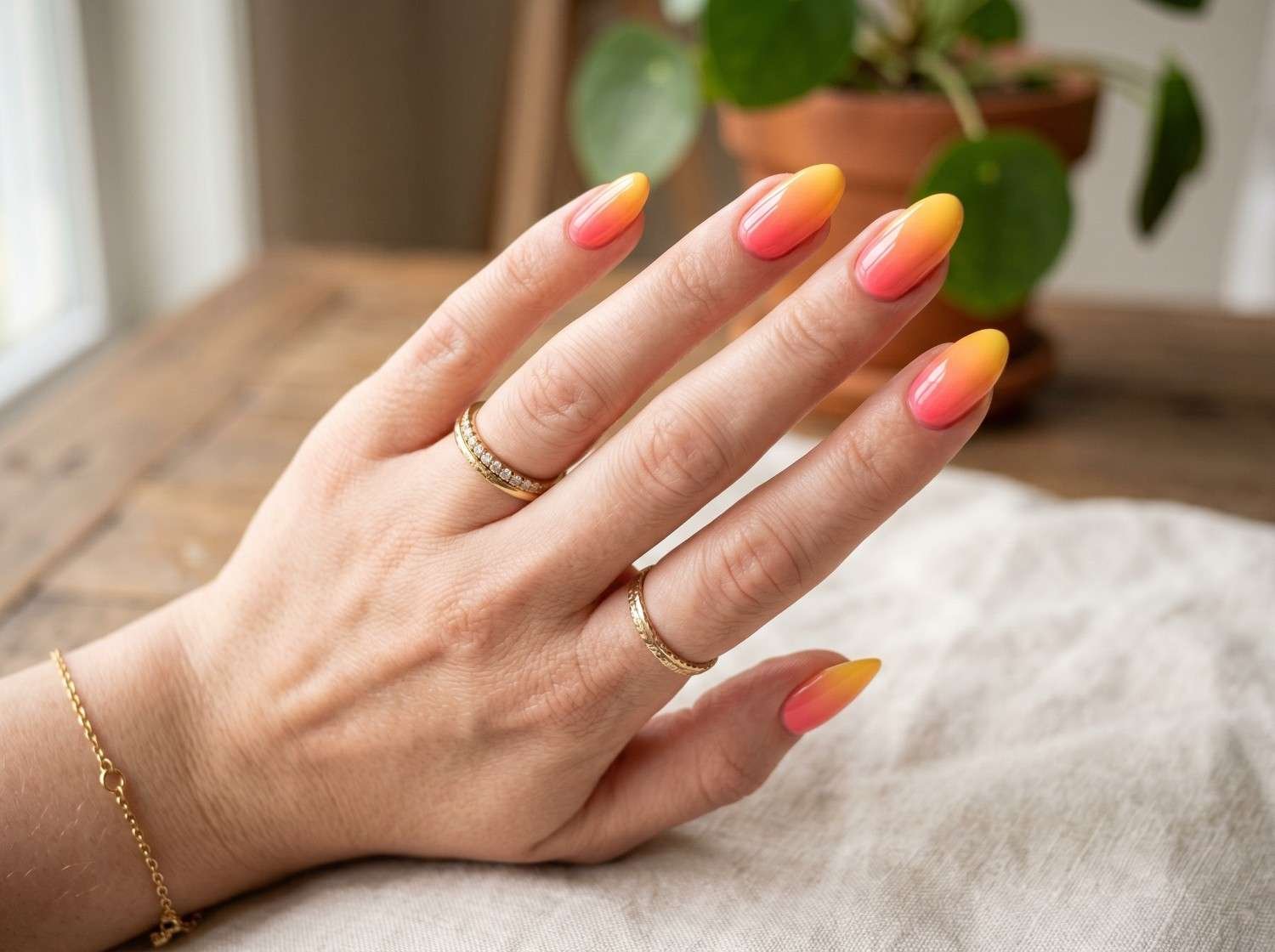
1. Sunset Fade

Pink melting into orange from cuticle to tip — the sunset in its most classic ombre form. The blend should be seamless: no line where pink becomes orange, just a smooth, glowing transition.
The key is the middle — that coral zone where the colors merge is the prettiest part. Sponge in light layers, building gradually; rushing creates harsh lines.
The blend rule: the middle third is the masterpiece — spend your blending effort there. Fade it for: golden-hour lovers; this is the sunset’s own gradient.
2. Ocean Dip

Deep blue at the cuticle fading to pale aqua at the tip — like diving into the ocean. The dark-to-light flow mimics water depth: mysterious at the base, clear at the surface.
The contrast makes it striking — the dark base grounds, the light tip lifts. It’s the ocean’s own ombre: depth becoming clarity.
The blend rule: dark-to-light reads as depth — it’s the most natural gradient direction. Fade it for: ocean souls; this is the sea’s vertical story.
3. Peach Sorbet Fade

Soft peach fading to creamy white — the sweetest vertical ombre. It’s delicate, fresh, and delicious: summer dessert in gradient form.
The paleness keeps it wearable — it’s ombre for those who find bright gradients too loud. The peach-to-cream is subtle but beautiful.
The blend rule: pale gradients need extra blending — light colors show lines more than darks. Fade it for: soft-girl summer; this is sweetness, faded.
4. Purple Haze Fade

Deep plum at the cuticle melting into soft lavender at the tip — purple’s full range in one nail. It’s moody and dreamy at once: darkness dissolving into light.
The purple family blends beautifully — the colors are naturally harmonious. It’s the most effortless dramatic ombre: the shades do the work.
The blend rule: analogous colors (neighbors) blend easiest — purple-on-purple is foolproof. Fade it for: purple lovers; this is the color’s full spectrum.
5. Sunrise Fade
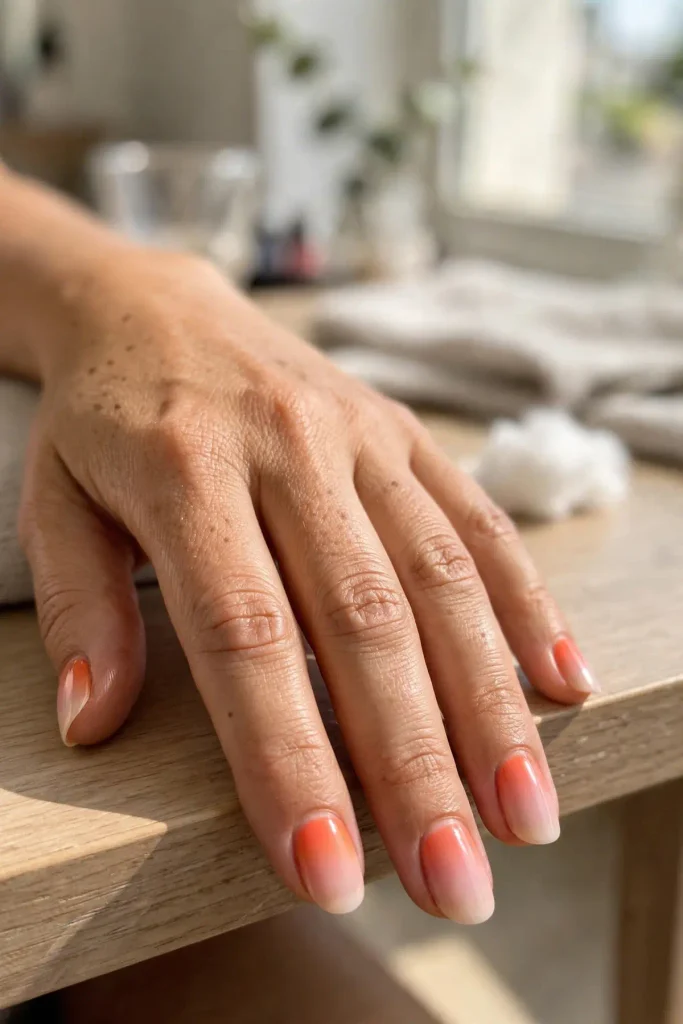
Warm yellow at the cuticle blooming into soft pink at the tip — morning light in ombre form. It’s the gentlest bright gradient: warm, hopeful, and fresh.
The yellow-to-pink is sunrise’s own palette — it radiates optimism. Keep the yellow soft; neon yellow would break the dawn illusion.
The blend rule: warm gradients glow — they radiate in a way cool gradients don’t. Fade it for: morning people; this is dawn on your nails.
Horizontal Blends: Side to Side
Ombre’s unexpected direction — color flowing across the nail instead of along it.
6. Side-to-Side Sunset

Pink on one side blending to orange on the other — the sunset, sideways. It’s the same beloved gradient in an unexpected orientation: familiar colors, surprising direction.
The horizontal blend feels modern — it breaks the ombre rules, which makes it interesting. The eye travels across instead of along.
The blend rule: horizontal blends need wider nails to shine — they need room to travel sideways. Fade it for: rule-breakers; this is ombre, rotated.
7. Mermaid Horizontal

Teal blending into deep blue across the nail — the ocean, sideways. It’s the mermaid’s gradient: fluid, shifting, and full of underwater mystery.
The horizontal flow mimics water’s movement — waves travel sideways, after all. It’s the most natural horizontal ombre: the direction matches the subject.
The blend rule: match direction to subject — water flows sideways, so should its ombre. Fade it for: mermaid moods; this is the tide’s own blend.
8. Cotton Candy Blend

Pink blending into baby blue — the carnival treat in ombre form. It’s sweet, nostalgic, and playful: the gradient of childhood summers.
The pink-to-blue is the most charming horizontal blend — it’s unexpected and delightful. Keep both colors pastel; the softness is the sweetness.
The blend rule: pastels blend most forgivingly — their softness hides transition lines. Fade it for: the young at heart; this is nostalgia, blended.
9. Diagonal Slash Ombre
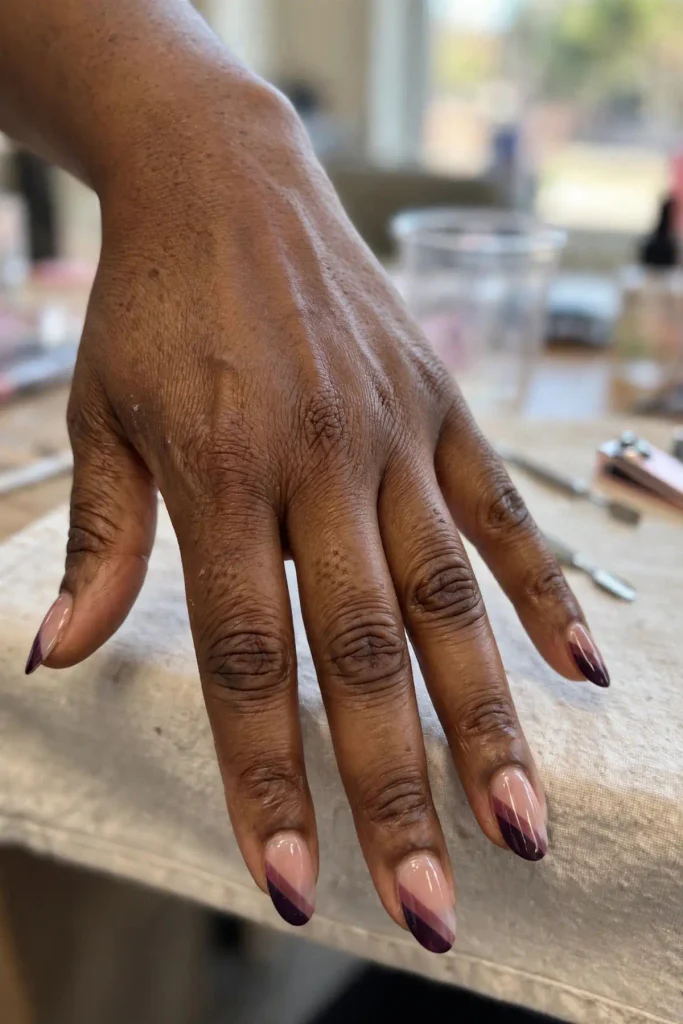
A diagonal gradient — color sweeping from one corner to the opposite. It’s the most dynamic ombre: the angle adds energy that straight gradients lack.
The diagonal should sweep consistently — same angle on every nail for cohesion. It’s modern and graphic: ombre with a point of view.
The blend rule: diagonals energize — the angle implies motion that straight fades don’t. Fade it for: the bold; this is ombre with attitude.
Multi-Color Melts: Three or More
Two colors are classic — three or more are spectacular.
10. Rainbow Melt

All the colors — red, orange, yellow, green, blue, purple — melting into each other down the nail. It’s the most joyful ombre: the full spectrum in a single fade.
The key is order — rainbow sequence (ROYGBIV) keeps it harmonious; random order becomes chaos. Each color gets a small zone; the blends between them are the magic.
The blend rule: follow the rainbow order — nature’s sequence is naturally harmonious. Fade it for: Pride, festivals, and maximum joy.
11. Tropical Trio

Three tropical brights — coral, turquoise, and sunny yellow — melting together. It’s the vacation gradient: bold, happy, and full of island energy.
Three colors are the sweet spot — enough for complexity, not so many it becomes muddy. The tropical palette keeps it cohesive: they’re all sunshine colors.
The blend rule: three is the magic number — two is simple, four risks mud, three is perfect. Fade it for: tropical getaways; this is paradise, blended.
12. Pastel Melt

Three pastels — lavender, mint, and baby pink — dissolving into each other. It’s the softest multi-color ombre: dreamy, gentle, and utterly wearable.
Pastels are forgiving — their lightness hides blend lines that brights would show. It’s the multi-color ombre for those who fear commitment to brights.
The blend rule: pastels forgive — their softness is the beginner’s best friend. Fade it for: dreamers; this is the gentlest rainbow.
13. Neon Melt

Three neons — hot pink, electric lime, vivid orange — blazing into each other. It’s the loudest ombre: pure voltage in gradient form.
Neons need white underneath for true payoff — without it, the melt goes dull. With it, the gradient ignites: it’s the most eye-catching ombre here.
The blend rule: neon melts need white bases — the brightness comes from below, not just within. Fade it for: nights out; this is electricity, faded.
Ombre Art: Beyond the Gradient
Ombre as a medium, not just a technique — creative applications that start with the blend.
14. Glitter Ombre
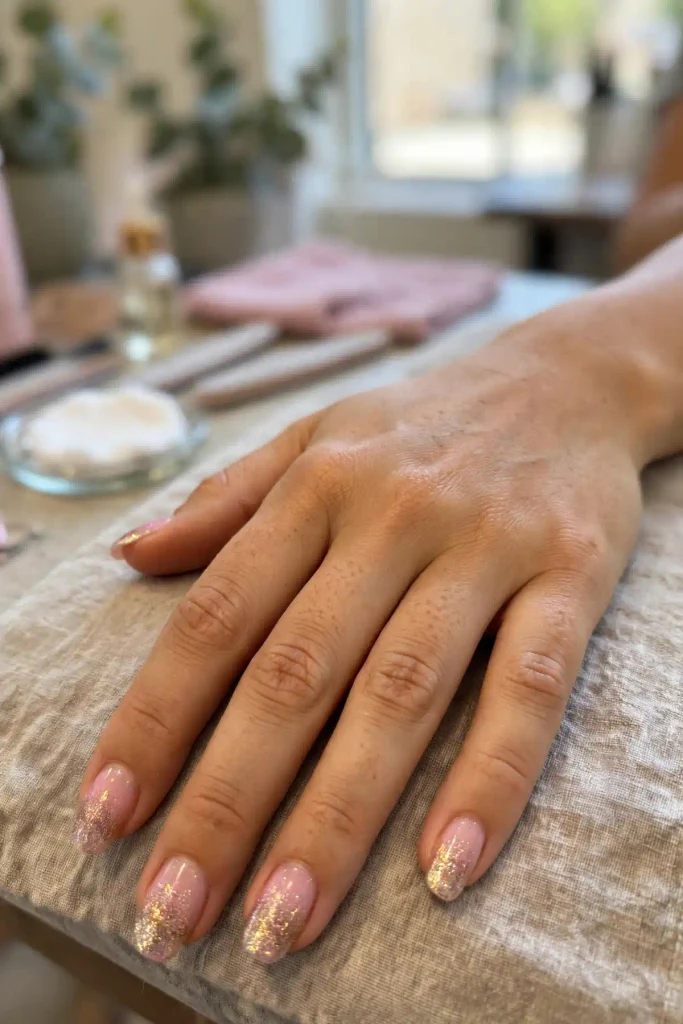
Glitter density fading from tip to base — sparkle dissolving into nude. It’s the most popular ombre art: glamorous, wearable, and endlessly flattering.
The glitter should be densest at the tip, fading to nothing — the gradient is in the sparkle, not the color. It’s the party nail that works everywhere.
The blend rule: the fade is in the density — more glitter at the tip, less toward the base. Fade it for: celebrations; this is glamour, graduated.
15. Ombre French
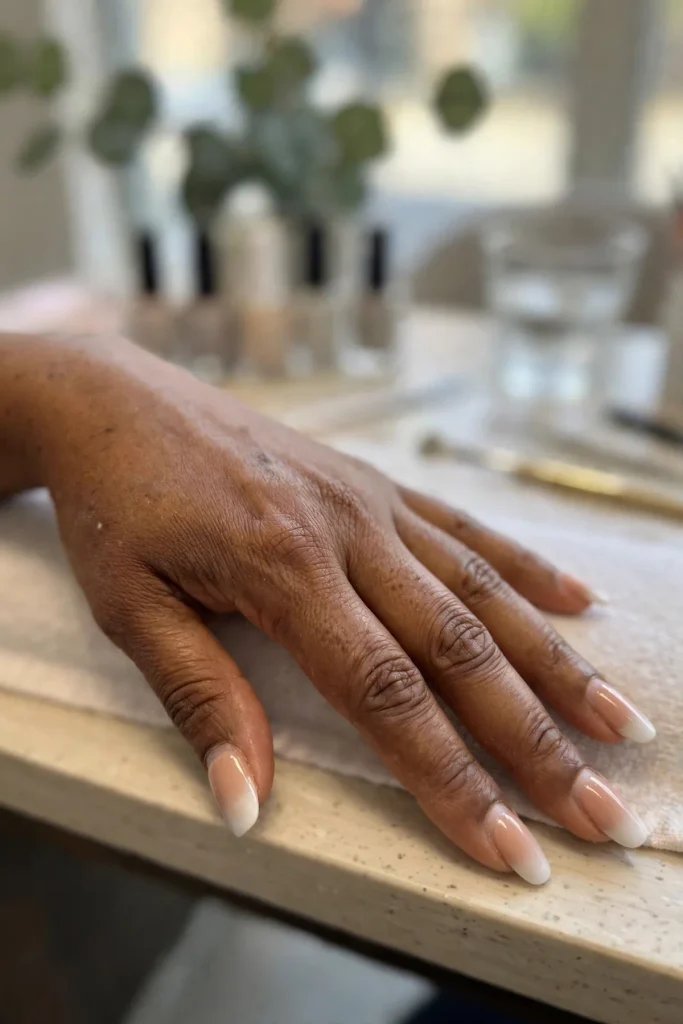
A French manicure with faded tips — white dissolving into nude instead of a crisp line. It’s the French, softened: classic structure, dreamy execution.
The fade replaces the smile line — there’s no edge, just white becoming skin. It’s the most elegant ombre art: tradition, melted.
The blend rule: the fade should be gradual — a harsh fade defeats the French’s purpose. Fade it for: brides and minimalists; this is the softest French.
16. Cloud Ombre

White cloud-like puffs blended into a blue gradient base — the sky’s own ombre. The clouds are soft white blooms; the base fades from deep to pale blue.
It’s the most whimsical ombre art — the gradient becomes the sky, the blooms become clouds. Dreamy and delightful.
The blend rule: soft blooms on smooth gradients — the textures should match in softness. Fade it for: daydreamers; this is the sky, wearable.
17. Chrome Ombre

Chrome powder faded from tip to base over color — metallic melting into matte. It’s the most futuristic ombre: mirror dissolving into color.
The chrome should be densest at the tip — the metallic fade is the drama. It’s two trends in one: the gradient’s softness, chrome’s hardness.
The blend rule: chrome fades need precise powder control — dense at the tip, whisper at the base. Fade it for: the future; this is metal, melted.
The Sponge Technique, Perfected
The classic ombre method, mastered. The sponge: a wedge makeup sponge — the porous texture creates the blend; dense sponges make harsh lines, airy ones make soft fades. The setup: paint stripes of your colors directly onto the sponge, slightly overlapping — the overlap is where the blend happens. The dab: press (don’t drag) the sponge onto the nail — dabbing deposits color, dragging smears it; 2–3 light dabs beat one heavy press. The layers: build gradually — three sheer layers blend better than one thick one; patience creates smoothness. The cleanup: ombre is messy — liquid latex around the nail or cleanup brush with acetone handles the fallout; don’t skip this step. The seal: top coat melts the gradient together — the blend always looks better sealed; the gloss unifies what the sponge started. The practice: do five test nails before the real thing — sponge pressure is a feel skill; your fifth attempt will embarrass your first.
Ombre Mistakes That Ruin the Blend
Learn from the streaky disasters of others. Too much polish: the number one killer — overloaded sponges deposit thick, unblendable color; thin layers are the whole secret. Rushing the layers: impatience creates harsh lines — each layer needs a moment to set before the next; wet-on-wet becomes mud. Wrong color order: jumping across the color wheel (purple to orange) creates brown in the middle — stay analogous (neighbors) for clean blends. Dragging the sponge: dragging smears instead of blending — dab straight down, lift straight up; lateral motion is the enemy. Skipping the base: ombre over bare nail looks thin and patchy — a base coat in the lightest shade gives the gradient something to grip. One-and-done: expecting perfection in one pass — ombre is built in layers; the first pass always looks rough, the third looks magic. Forgetting top coat: unsealed ombre looks dusty — the top coat is what transforms “sponged” into “blended.”
Ombre Questions, Blended Answers
What’s the easiest ombre for beginners?
Two analogous colors (pink to orange, blue to teal) with a sponge — neighbors blend forgivingly, and the sponge does the work. Start vertical (cuticle to tip); it’s the most natural direction. Three light layers, seal, done.
Why does my ombre look streaky instead of smooth?
Too much polish per layer, or not enough layers — streaks come from thick, single applications. Switch to thin coats, build to three layers, and let each set briefly. The smoothness is in the layering, not the product.
Can I do ombre without a sponge?
Yes — the dry-brush method (a dry fan brush dragged lightly) creates soft blends, and blooming gel creates chemical ombres. But the sponge remains the most reliable for crisp-to-soft control. Each method has its own texture; sponge is the classic for a reason.
How do I ombre on short nails?
Choose closer colors — short nails have less room for the blend, so high-contrast ombres look abrupt. Analogous shades (pink to peach, blue to teal) fade beautifully even in small spaces. Horizontal blends also suit short nails well.
Fade to Gorgeous
Here’s the quiet truth about ombre: it’s the most honest nail art. No hiding behind intricate designs, no distracting with 3D sculptures — just color, becoming other color, in front of your eyes. It’s beautiful because it’s simple, and it’s simple because it’s true.
Colors blend. Light shifts. Nothing stays the same — and that’s not a flaw, it’s the whole point.
So pick your shades, load your sponge, and fade to gorgeous. The blend is waiting.