14 Summer Nails Square Shapes: Geometry Is the Design
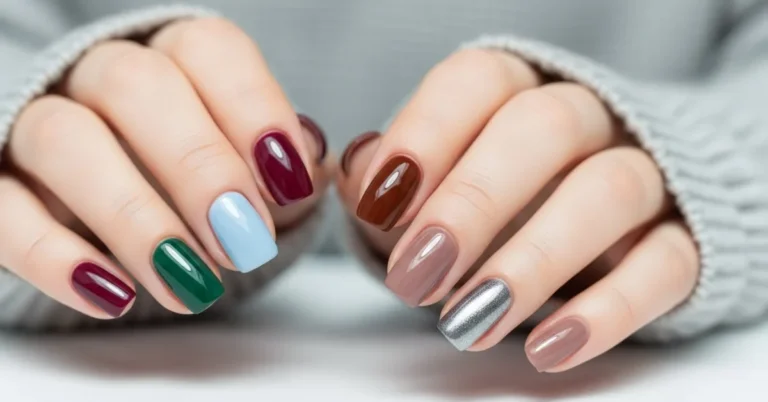
Square nails don’t need decoration — they are decoration. The straight edges and sharp corners are already the boldest thing in the room, which means the best art for square nails works with the geometry instead of fighting it: lines that echo the edges, blocks that mirror the shape, negative space that lets the architecture breathe.
These fourteen ideas are organized by geometric element — lines, blocks, curves, and negative space. Because when your nail is already a perfect rectangle, the smartest designs are the ones that think in shapes.
Lines & Stripes
Straight lines on straight edges. These designs harmonize with the square shape — parallel, perpendicular, and perfectly placed.
1. Horizontal Fine Lines

Multiple thin horizontal lines striped across each nail — like a tiny barcode in summer colors. White lines on coral, gold on teal, black on nude: the contrast does the work. The lines should be evenly spaced and razor-straight, which is what makes the design look expensive rather than doodled.
The square advantage: horizontal lines echo the square’s straight tip edge — the geometry rhymes, and the whole nail looks architecturally intentional. Keep in mind: striping tape is essential here; freehand lines wobble, and wobble ruins the effect.
2. Crosshatch Grid

Fine lines crossing vertically and horizontally to form a precise grid — graph paper, but make it fashion. Usually done in a contrasting color over a solid base: white grid on blue, black on nude. The grid should be even, which means measuring, not eyeballing.
The square advantage: the grid’s right angles mirror the nail’s own corners — it’s the most “square” design possible. Keep in mind: seal between directions (verticals, cure, horizontals) so the lines stay crisp where they cross.
3. Diagonal Slash
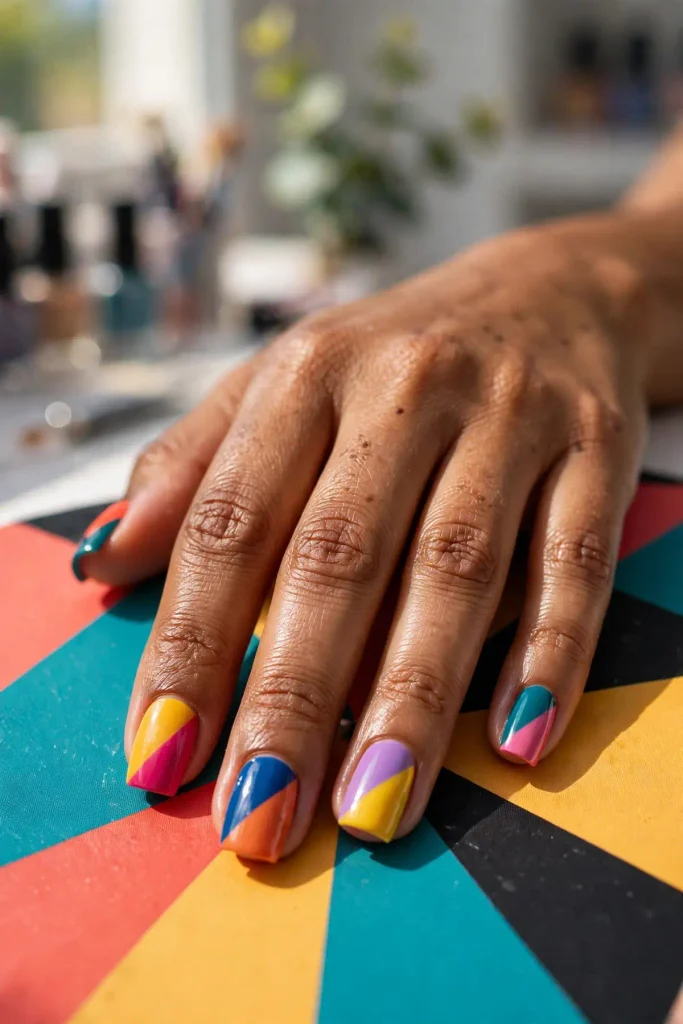
A single bold diagonal stripe slashing across each nail — dynamic, graphic, and energetic. One wide slash in a contrasting color over a solid base, running corner to corner. It’s the most dramatic line design here, and the asymmetry keeps it from feeling rigid.
The square advantage: the diagonal plays against the square’s right angles — contrast creates energy, and the straight edges make the slash look deliberate. Keep in mind: the slash should run the same direction on every nail for cohesion; mixed directions look accidental.
4. Border Frame

A thin colored border tracing the entire perimeter of each nail — like the nail is framed. The center stays bare or sheer, and the frame defines the square shape explicitly. Black frames are graphic, gold frames are luxe, white frames are fresh.
The square advantage: the frame literally outlines the square — it celebrates the shape instead of decorating over it. Keep in mind: the border must be unbroken and even; a wobbly frame draws attention to flaws, so use striping tape or a steady professional hand.
Color Blocks
Bold sections of color that treat the nail like a canvas divided into fields. Graphic, modern, and made for straight edges.
5. Half-and-Half Split

Each nail split vertically into two colors — coral and white, teal and nude, black and gold. The dividing line runs straight down the center, and the two halves should be exactly even. It’s color-blocking at its simplest and most striking.
The square advantage: the straight center divide parallels the nail’s straight sides — everything aligns, and alignment reads as luxury. Keep in mind: tape the divide and paint one half at a time; bleed across the line ruins the whole concept.
6. Quartered Color

Each nail divided into four quadrants, each a different shade — a color quilt. Pastel quadrants are soft and pretty; bright quadrants are bold and playful. The grid lines between quadrants should be clean, which is what separates “art” from “mess.”
The square advantage: four squares on a square nail — the shape multiplies itself, and the symmetry is deeply satisfying. Keep in mind: choose colors with similar intensity; one neon quadrant next to three pastels looks like a mistake.
7. Sunset Bands

Horizontal bands of sunset colors — yellow, orange, pink, purple — stacked across each nail like a tiny horizon. The bands can be even or graduated, but the transitions should be clean stripes rather than blends; this is about bands, not ombré.
The square advantage: horizontal bands stack naturally on the square’s straight form — the shape holds stripes better than any curved nail could. Keep in mind: work from lightest to darkest, curing or drying between bands to prevent dragging.
8. Corner Block

One corner of each nail painted in a bold color, the rest left nude or sheer — asymmetric, modern, and unexpected. The corner block can rotate (top-left, bottom-right) or stay consistent; either way, it’s the smallest possible color statement with maximum graphic impact.
The square advantage: square nails have corners worth highlighting — this design exists because of the shape. Keep in mind: keep the block small (a quarter of the nail max); too big and it just looks like a messy French.
Dots, Curves & Contrast
Not everything has to be straight. These three use curves and dots to play against the square’s angles — contrast is the design.
9. The Oversized Dot

One large dot centered on each nail — mod, bold, and graphic. The dot should be big enough to dominate: think 60% of the nail’s width. White dots on bright bases, black dots on nude, metallic on dark — the single-dot simplicity is what makes it chic.
The square advantage: the circle-against-square contrast is classic design tension — it’s why the combination never gets old. Keep in mind: center the dot precisely; off-center reads as a mistake, not a choice.
10. Curved Color Sweep

A single bold curved shape sweeping across each nail — a wave, a swoop, a crescent — in a contrasting color over a solid base. The curve’s fluidity against the nail’s rigidity is the entire point: soft meets sharp.
The square advantage: curves stand out most against straight edges — on an almond nail this would blend in, on square it pops. Keep in mind: one sweep per nail maximum; the power is in the singularity.
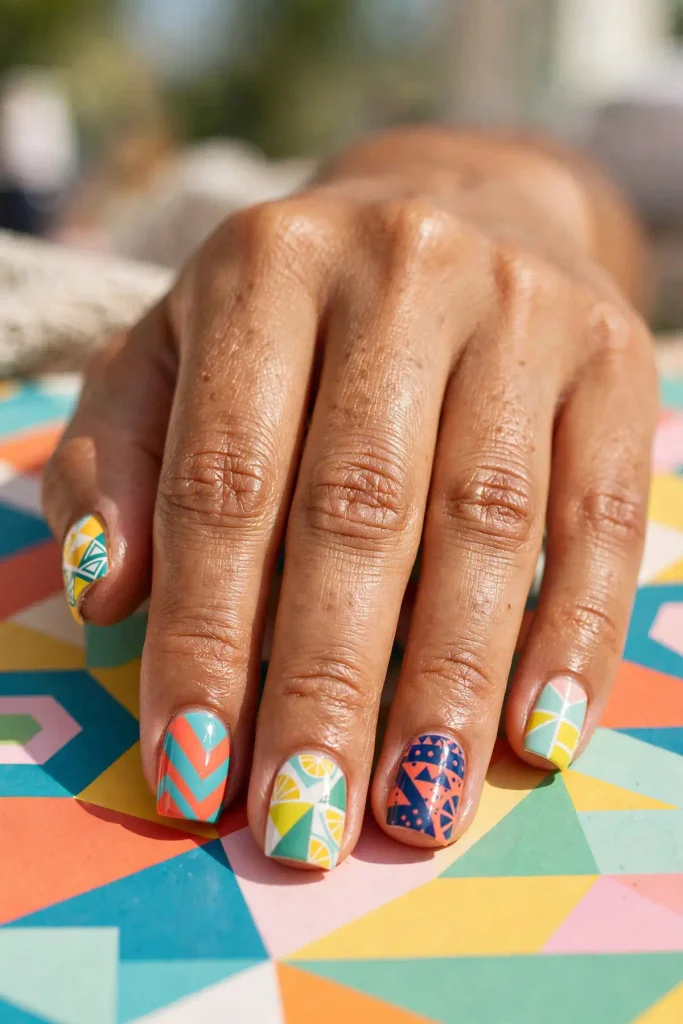
11. Mix-Match Geometry

Each nail gets a different geometric design — stripes on one, dots on another, blocks on a third — unified by a single color palette. It’s curated chaos: the variety keeps it interesting, the shared palette keeps it cohesive.
The square advantage: geometric designs share the square’s DNA, so even mixed designs feel like family — the shape is the unifying thread. Keep in mind: limit the palette to three colors max and repeat each color at least twice across the set.
Negative Space Architecture
The bravest designs: leaving most of the nail bare and letting the square shape plus minimal color do the talking.
12. Bare Frames

The inverse of the border frame: the nail stays completely bare (just base coat), with a colored square frame floating in the center — a frame within the frame. It’s minimalism at its most architectural: two squares, one inside the other, nothing else.
The square advantage: this design only works because the nail is square — the nested squares echo each other perfectly. Keep in mind: the inner frame must be precisely centered; asymmetry here looks like an error, not art.
13. Cut-Out Triangles

Bare triangular sections cut out of solid color — geometric negative space with sharp points. The triangles can sit at the tip, the base, or float in the center. The contrast between the solid color and the bare triangle is stark and modern.
The square advantage: triangles against squares create delicious geometric tension — two shapes in conversation. Keep in mind: mask triangles with tape for sharp points; hand-painted triangles look soft, which defeats the purpose.
14. Floating Tip Bar
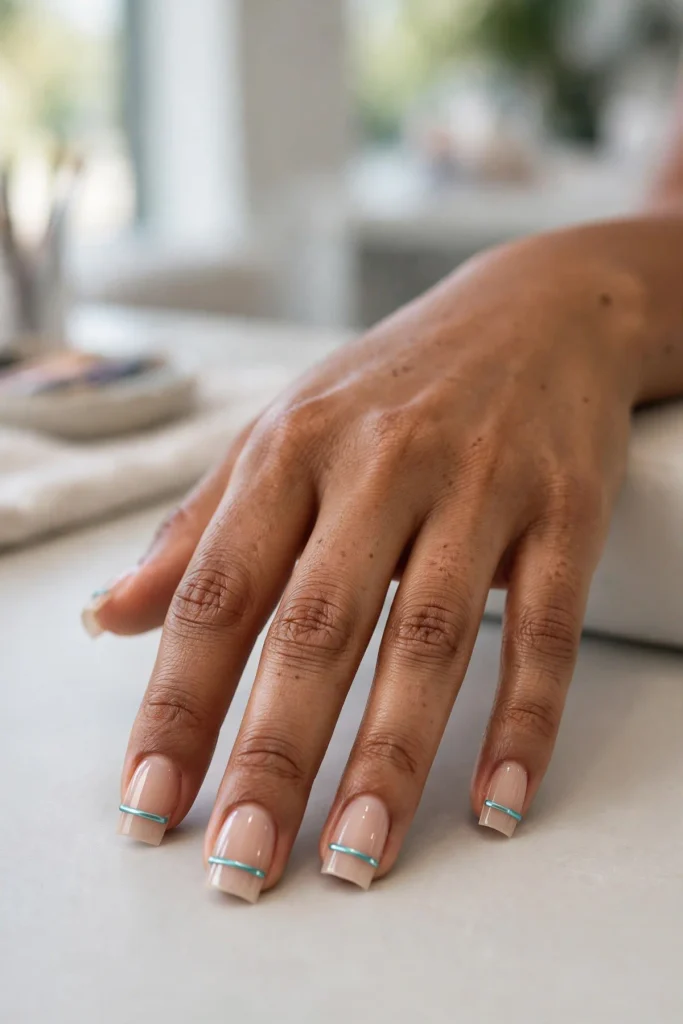
A single horizontal color bar floating near the tip over an otherwise bare nail — like a horizon line. It’s the most minimal design on this list: one bar, bare nail, done. The bar’s straightness against the bare nail is quietly dramatic.
The square advantage: the bar parallels the square tip edge — it’s a miniature echo of the nail’s own architecture. Keep in mind: placement matters enormously; too close to the tip it looks like a failed French, too low it floats oddly — aim for the top third.
Why Square Owns Summer
The shape and the season are a perfect match. Bright colors look bolder on square: the straight edges give vivid shades a graphic frame — neons and brights read more intentional on square than on any curved shape. White and pastels look crisper: the clean lines of square nails make light summer shades look sharp instead of washed out. Short squares are the summer sweet spot: practical for active days, chic for evenings, and the shape keeps even simple polish looking styled. The geometry trend: fashion is in a graphic, architectural phase — square nails are the manicure equivalent of clean lines and bold prints. And the practical bit: square’s straight free edge is strong — it resists the chips and breaks that summer activities (sports, travel, DIY) inflict on more delicate shapes.
Square Nail Maintenance
Sharp corners need upkeep — here’s how to keep them sharp.
File in one direction: sawing back and forth weakens the corners, which is where squares break first; file from the outside toward the center.
Soften microscopically: a truly razor-sharp corner catches on everything — one light pass to take the lethal edge off, no more.
Check symmetry weekly: square shows unevenness mercilessly; if one side grows faster, file to match before it becomes obvious.
Corner chips: when a corner chips, don’t round the whole nail — file the chipped corner straight and slightly shorten to match; you can often save the shape.
Top coat the edges: run top coat along the free edge and slightly around the corners — it seals the most vulnerable points.
The two-week rule: square nails need reshaping every two weeks without fail; grown-out squares just look like wide ovals, which defeats the purpose.
Square vs. Squoval: Which Should You Get?
The eternal debate, settled. Choose true square if: you want maximum graphic impact, you love bold geometric designs (like most of this list), your nails are naturally strong, and you don’t mind maintenance — sharp corners need attention. Choose squoval if: you want 90% of the square look with 50% of the upkeep, your corners chip easily, you type all day (softened corners are kinder to keyboards), or you’re trying square for the first time. The summer verdict: true square for vacations and events (when you’ll maintain them), squoval for daily summer life (when you won’t). Can you switch? Easily — squoval is just square with softened corners, so your tech can adjust in minutes. Many people wear squoval daily and sharpen to square for special occasions.
Square Summer Nail Questions
Do square nails make fingers look shorter?
They can, on very short nails — the straight edge emphasizes width. The fix: keep them at least medium length, or choose squoval (the softened corners elongate slightly). Well-shaped square on medium nails is flattering on almost everyone.
Are square nails still trendy?
Square never really left — it’s a classic shape that cycles in intensity. Right now it’s peaking again thanks to the graphic-design nail trend, which is built for straight edges. It’s not a fad; it’s a foundation.
Can I do these designs on short square nails?
Yes — ideas 4, 5, 8, 9, 12, and 14 all work beautifully on short squares. The geometric designs actually suit short nails well: small canvases make bold graphics look intentional rather than overwhelming.
How do I stop my square corners from breaking?
Keep them slightly softened (never razor sharp), cap the free edge with every layer, avoid using nails as tools, and consider gel over regular polish — gel’s flexibility absorbs impacts that shatter rigid polish. Builder gel on the corners specifically is a pro trick for chronic breakers.
Stay Sharp
Fourteen ideas, four geometric elements, one shape that was already the design. Square summer nails don’t need apology or explanation — the straight edges said everything before the art even started. Whether you’re striping, blocking, dotting, or leaving it bare, the geometry is doing half your work.
So file them straight, keep those corners crisp, and let the square do what squares do: stand out. Summer’s too bright for boring nails — and nothing’s brighter than confidence with corners.
Are you a lines person, a blocks person, or a bare-space minimalist? Save this list for your next square appointment, and send it to the friend who’s been rounding her squares into almonds out of habit — the corners deserve better.