13 Softball Hairstyles Ideas Organized by Position on the Field
A catcher crouching behind the plate in a mask has completely different hair needs than an outfielder tracking a fly ball into bright sun, yet most hairstyle lists treat softball hair as one single category. The truth is a style that works beautifully for a pitcher who needs totally clear peripheral vision might be the wrong choice entirely for an infielder who needs to dive, slide, and pop back up without hair falling into her eyes mid-play.
This list organizes thirteen softball hairstyles by position, since what actually matters on the field, helmet compatibility, sun exposure, sudden movement, and quick reaction time, varies more by where you’re standing than by personal style preference alone.
For Catchers
Catchers deal with a mask and helmet combination that sits closer to the head than any other position’s gear, which rules out anything with bulk at the crown or back.
The Low, Flat Braid

A single braid kept as close and flat to the head as possible, finished low at the nape rather than higher up. This matters specifically for catchers because any bulk at the crown pushes the helmet forward uncomfortably, while a low, flat braid tucks completely underneath without creating pressure points during a long game behind the plate.
Double Low Braids
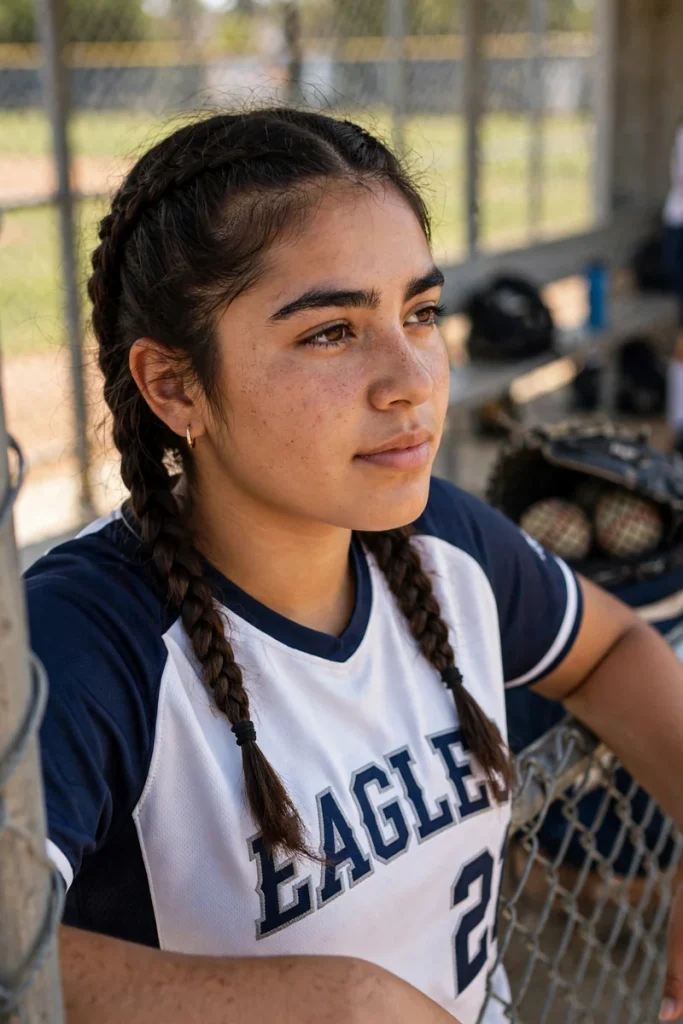
Two braids positioned low, one on each side of the back of the head, distributing hair more evenly under the mask strap than a single thick braid would. This reduces the one-sided pressure some catchers feel from a single braid resting against the mask’s back strap over several innings.
A Tight, Low Bun

For catchers with shorter hair that can’t easily braid, a small, tight bun positioned as low as possible at the nape sits beneath most catcher’s helmets without interference, though it’s worth testing with your actual gear before game day since helmet shapes vary.
For Pitchers
Pitchers need a style that keeps every strand completely out of their field of vision, since even a small flyaway catching the corner of an eye during a windup can throw off an entire pitch.
The Tight French Braid, Starting at the Hairline

A French braid that begins picking up hair from the very edge of the hairline, rather than starting a few inches back, captures flyaways before they have any chance to escape during the pitching motion. This is worth the extra few minutes it takes compared to a looser braid, since pitchers specifically can’t afford any hair-related distraction mid-windup.
A High, Tight Ponytail With a Headband

Combining a high ponytail with a thin, grippy headband underneath catches any shorter pieces around the hairline that the ponytail alone wouldn’t fully secure, giving pitchers an extra layer of confidence that nothing will shift during a crucial pitch.
Double Dutch Braids
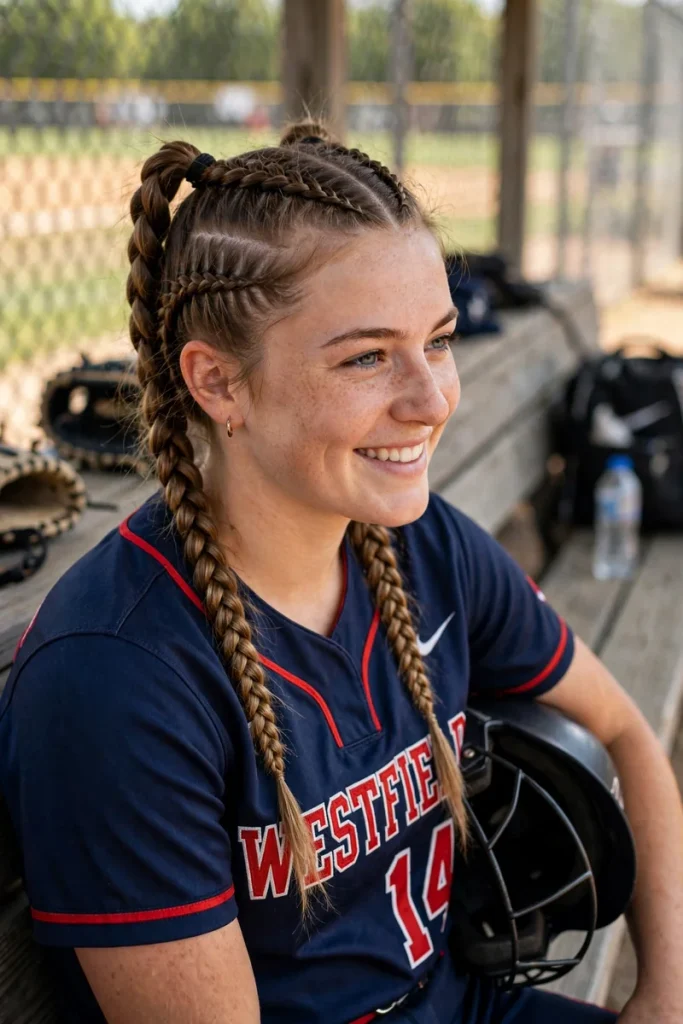
Two tight Dutch braids running from the crown to the nape hold even more securely than a single braid and keep hair completely flat against the head, important for pitchers who often have their heads tilted at various angles during the windup and follow-through.
For Infielders
Infielders need mobility above almost anything else, since they’re diving, crouching, and springing up repeatedly, and any style that shifts or loosens during sudden movement becomes a liability.
The High, Tight Bun
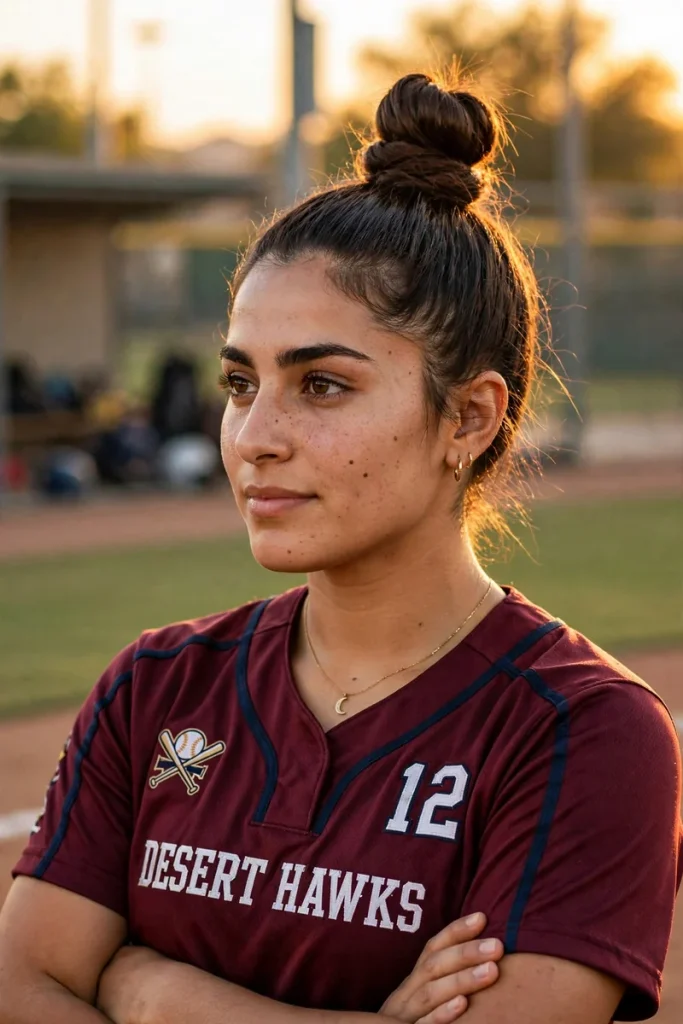
A high bun secured tightly at the crown stays put through diving stops and quick direction changes far better than a ponytail, which can swing and even briefly obstruct vision during a sudden lunge for a ground ball.
Twin Braided Pigtails

Two braids rather than one distribute tension more evenly and tend to hold through repeated sudden movement better than a single center braid, which can work slightly loose on one side after enough diving and twisting.
A Braided Half-Up With the Rest in a Ponytail

The top section braided back and secured, with the remaining length gathered into a ponytail rather than left down, gives infielders the flyaway control of a braid combined with the quick, familiar feel of a ponytail, a reasonable middle ground for players who find a full braid too time-consuming before every game.
For Outfielders
Outfielders spend the most time directly in sun and wind, tracking fly balls while squinting upward, which means sun glare off hair and wind-blown strands crossing the face are genuine, repeated problems specific to this position.
A High Ponytail Threaded Through a Cap
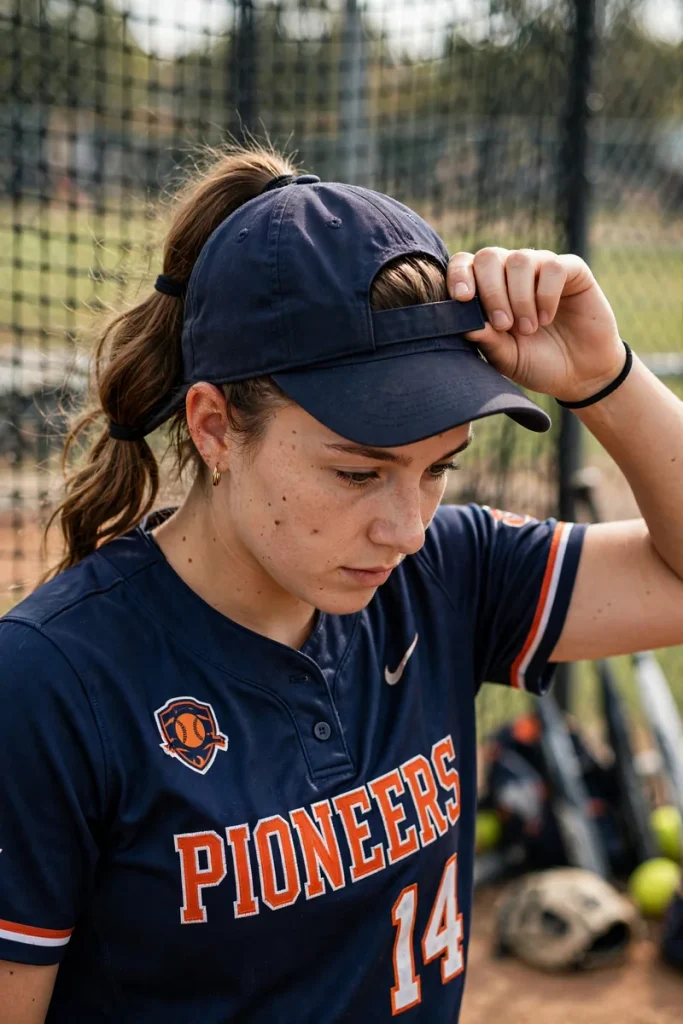
Pulling hair through the back opening of a fitted cap keeps it secured and shaded from direct sun, while the cap brim itself helps cut glare during those crucial moments of looking straight up to track a ball. This combination solves two outfield-specific problems at once that infield and pitching positions don’t deal with nearly as much.
A Low, Tight Braid Under a Visor

For outfielders who prefer a visor to a full cap, a low, tight braid keeps hair contained and off the neck, which matters more in full sun than it does for infielders working in shorter bursts, since outfield positioning often means standing in direct sun for extended stretches between plays.
Space Buns for Shorter Hair

For outfielders with hair too short to braid easily, two small space buns at the crown keep hair off the neck and face while still fitting comfortably under a cap, offering the sun and wind protection of a longer braid without needing the length to create one.
For Players Who Rotate Positions
Many softball players, especially at younger levels, move between positions over the course of a season or even a single game, which calls for one adaptable style rather than switching hair mid-game.
The Versatile Double Dutch Braid
Tight, close to the head, and secure through virtually any movement, double Dutch braids hold up whether you’re crouched behind the plate for one inning or sprinting after a fly ball in the outfield the next. This is genuinely the single most adaptable style across every position on this list, which makes it worth learning well even if you ultimately prefer a different look for your primary position.
Matching Hair Accessories to Position-Specific Gear
Beyond the hairstyle itself, the accessories holding it in place matter differently depending on position. Catchers should avoid anything metal or hard, like decorative clips, that could dig uncomfortably into the scalp under the mask’s pressure over a full game. Pitchers benefit from a grippy, non-slip headband specifically, since even small amounts of sweat during a pitching performance can cause a plain elastic to slip. Outfielders should prioritize UV-protective sport sunscreen applied to the part line and hairline itself, an often-overlooked detail, since that visible strip of scalp along a braid or ponytail part gets significant sun exposure over a season of games.
Handling Sweat and Humidity Mid-Game
Regardless of position, a few habits keep styles holding through a full doubleheader in summer heat. A light application of dry shampoo at the roots before the game, even on freshly washed hair, helps absorb sweat throughout the game and keeps braids and buns from loosening as quickly. Packing a spare set of hair ties and a few extra bobby pins in the equipment bag solves the single most common mid-game hair emergency, a snapped elastic, without needing to borrow from a teammate or play the rest of an inning with hair falling loose.
When a Teammate’s Hair Becomes a Team Issue
In team sports specifically, hair sometimes becomes relevant beyond just one player’s comfort, loose strands near a catcher’s mask snaps, a ponytail that swings into another player’s face during a collision at a base, or long hair that a teammate accidentally steps on during a pileup at home plate. Coaches often have informal expectations around hair being fully secured during games for exactly these reasons, worth checking with your team specifically if you’re unsure whether a looser style like waves worn mostly down would be acceptable, since many teams prefer every player’s hair fully contained regardless of personal preference.
The right softball hairstyle depends far more on what your specific position actually demands during a game than on which braid pattern looks nicest in a mirror beforehand. Think through what your position asks of you, helmet pressure, sun exposure, sudden movement, or constant vision clarity, and choose from the category that matches it rather than picking a style built for a different position entirely.