18 Aesthetic Christmas Tree Ideas That Make Your Home Look Like a Dream
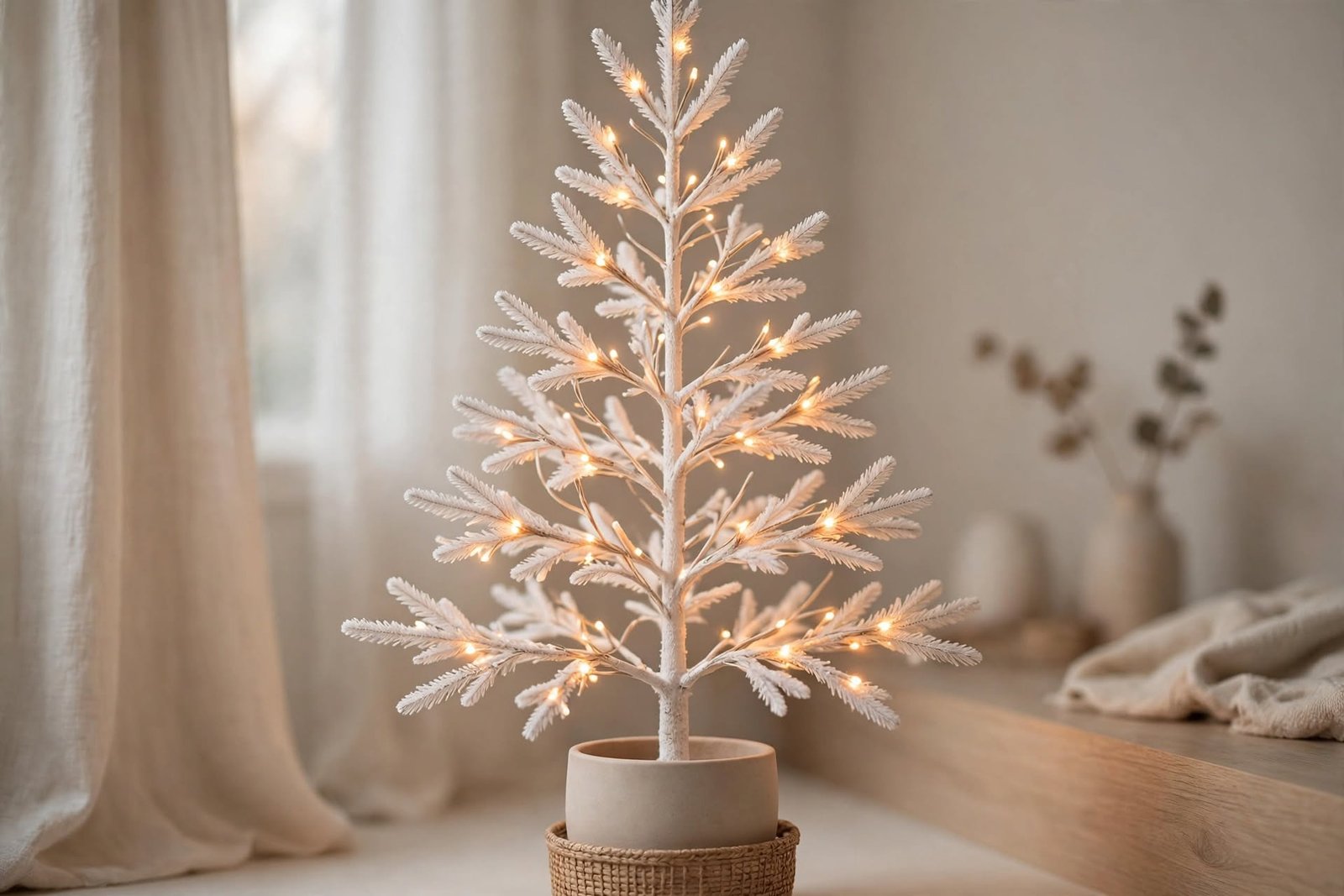
Most Christmas trees shout. An aesthetic Christmas tree does the opposite: fewer colours, softer finishes, and space for the branches to breathe. These eighteen ideas trade the crowded, glittery look for calm palettes that make the whole room feel quieter.

What changed my mind about decorating was taking ornaments off, not adding them. A tree with room between its baubles reads calmer from across the room, and the lights stop fighting the decor. Every idea below follows that one habit: pick a small palette, then stop sooner than feels finished.
Skip This If a Quiet Tree Is Not Your Thing
A calmer tree is a real style choice, and it is not for every house. Read these three honestly before you fall for a palette:
- Skip this if you love a loud, multicolour tree. Every idea here caps the palette at three colours, so rainbow strings and novelty ornaments have nowhere to land.
- Skip this if little hands decorate with you. Restraint lasts about a day in a house where kids hang favourites anywhere they reach; the fuller, cheaper looks (3, 11 and 16) forgive that better.
- Skip this if your room faces bright midday sun. Pale matte baubles show dust and lose their softness in hard light; the deeper palettes (4, 7 and 9) hold up better.
1. Sage and Cream Aesthetic Christmas Tree With Pale Wood Stars

Sage is the colour that calms a green tree instead of fighting it. Matte sage baubles in two sizes sit beside plain cream ceramic ones, and pale wood stars hang on short twine loops where the eye needs a pause. Warm white lights weave deep into the branches, so the glow feels like late afternoon. Money-wise this sits comfortably mid-range: the sage baubles are the one deliberate purchase, the wood stars cost little, and the cream pieces usually come from a basic set you may own already. Spend on the sage, save on everything else.
2. Oatmeal and Taupe Aesthetic Christmas Tree in Pale Warm Neutrals
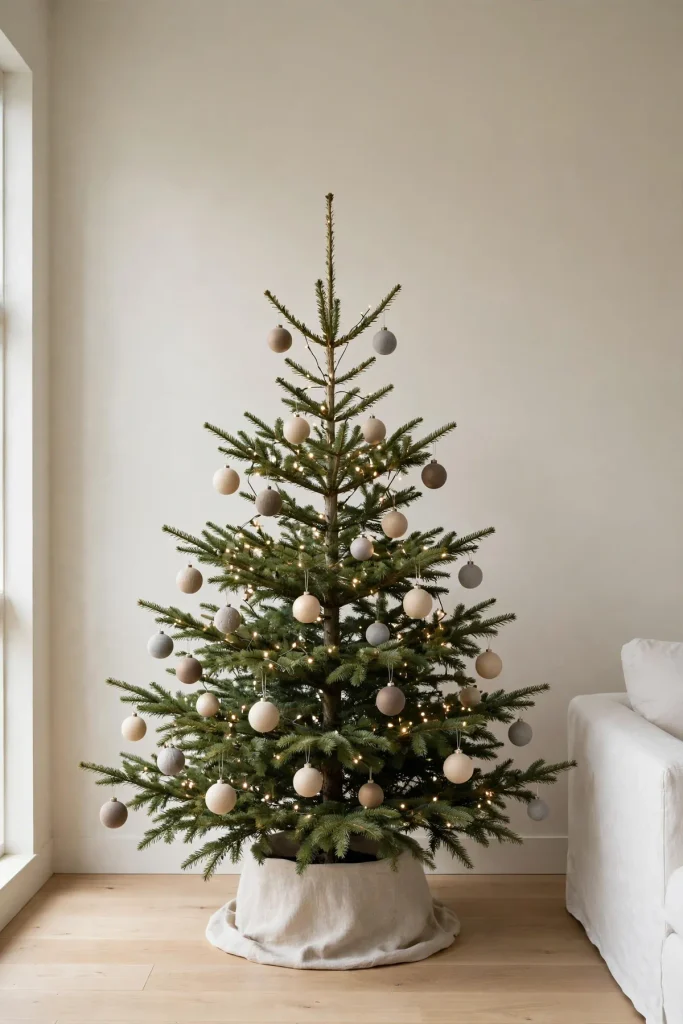
Think of the colours in a bowl of porridge: oatmeal, stone, taupe, a touch of mushroom. Matte baubles in those shades, mixed with unglazed clay pieces, turn the tree into part of the room’s neutral scheme rather than a guest in it. Pale rooms with linen sofas suit it most. This is one of the gentler budgets on the list, because neutral sets turn up in sales all season and clay ornaments are cheap by the bag. Put the slightly larger share into varied sizes; a single size repeated looks like a shop display.
3. Terracotta and Clay Aesthetic Christmas Tree in Warm Earth Tones

Terracotta does for a tree what it does for a plant pot: it warms everything around it. Unglazed clay baubles, matte terracotta balls and a few amber glass pieces glow against the green like embers. A woven basket collar hides the stand and keeps the earthy story going at floor level. The bill stays low if you lean on clay: plain terracotta pieces cost far less than glass, so the amber glass can be a handful of accents rather than a full set. It asks for a warm-toned room; grey walls cool it down.
4. Charcoal and Smoke Aesthetic Christmas Tree With Brushed Silver

Against a dark wall, a tree dressed in charcoal and smoke nearly disappears until the lights come on, and then it glows like coals. Matte charcoal baubles carry the depth, smoky grey glass adds a hint of shine, and brushed silver, dull not mirror, keeps it from going flat. The budget leans higher here, and glass is why: smoky glass costs more than plastic in any colour. Save by mixing: glass on the outer branches where light hits, matte basics deeper inside where nobody looks closely.
5. Champagne and Ivory Aesthetic Christmas Tree With Matte Gold

Champagne is gold with the volume turned down. Pair matte champagne baubles with ivory ceramic and the softest dull gold you can find, and the tree reads like candlelight rather than jewellery. It flatters cream rooms and pale wood. Cost lands in the middle: matte metallic finishes usually sit between basic and glass prices, and ivory ceramic is a save hiding in plain sight. One warning from experience: keep every gold piece matte. A single shiny bauble in this mix looks like it wandered in from another tree.
6. Olive and Antique Brass Aesthetic Christmas Tree With Cream Baubles

Olive is green’s quieter cousin, and on a green tree it creates that layered, tonal look designers charge for. Matte olive baubles melt into the branches, antique brass, the dull aged kind, adds warmth without shine, and cream baubles lift the whole thing where it needs light. Brass is the cost driver in this palette, real or faux, so treat it as the splurge and let olive and cream basics do the quiet bulk work. It suits rooms with oak, leather and warm white walls.
Olive and brass is the palette I reach for when a room already has warm wood — the tree stops decorating the room and starts belonging to it.
7. Cocoa and Copper Aesthetic Christmas Tree in Deep Warm Browns
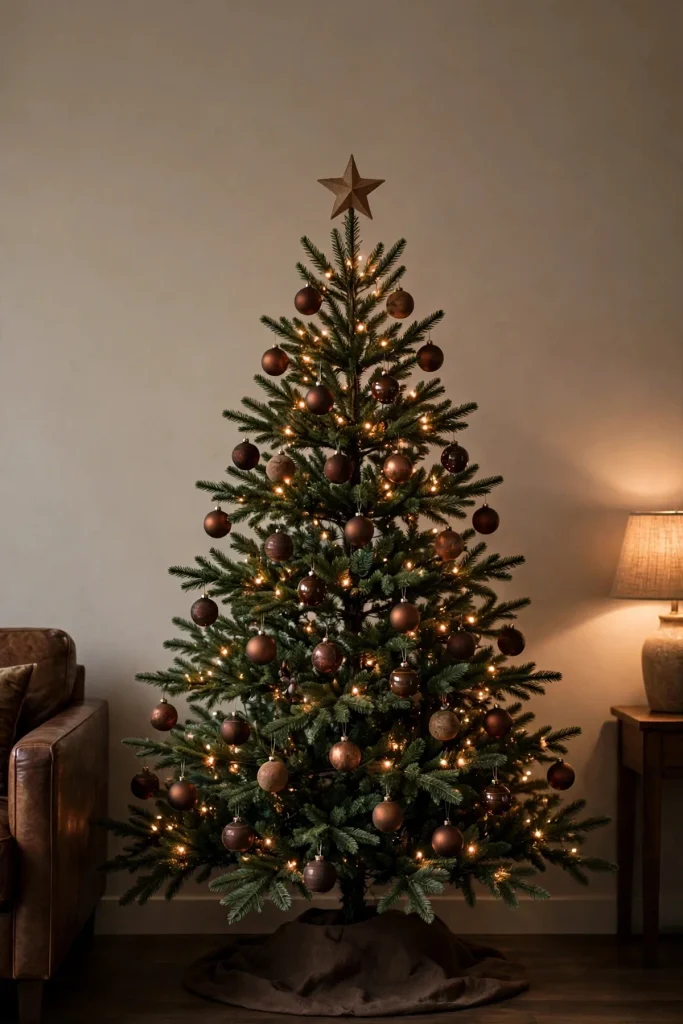
Brown on a Christmas tree sounds like a risk until you see it lit. Cocoa matte baubles, aged copper and dark walnut-toned ceramic build a tree that feels like a library corner: deep, warm, unbothered. Amber-toned lights matter here; cool white turns brown muddy. Copper pushes the price up, so the thrifty route is copper on the front face only, with cocoa basics filling the back and sides — the camera and the sofa see copper, the wall sees brown. Deep palettes like this forgive small rooms, where they read as cosy rather than dark.
8. Dusty Plum and Mauve Aesthetic Christmas Tree With Antique Silver

Plum, handled softly, is the romantic of this list. Keep it dusty, greyed down, almost mauve, and pair it with antique silver that has lost its shine, and the tree feels like dusk in a good way. Anything brighter tips into purple party territory. Budget sits mid-range, with one trap: dusty shades vary wildly between brands, so buy the plum pieces in one place, in one trip, even if it costs a touch more. Mismatched plums are far more expensive to fix than to prevent.
9. Green on Green Aesthetic Christmas Tree in Tonal Matte Finishes

The boldest quiet move on this list: decorate a green tree only in green. Forest, moss and fern baubles, every one matte, layer over the branches until the tree reads as texture first and colour second. From the sofa it looks almost bare; up close it is rich. This is the kindest budget here if you shop by the box — single-colour matte sets are the cheapest way to fill a tree, and you can add a secondhand bundle of green glass for depth without breaking the one-colour rule. Keep the lights warm; cool light turns moss swampy.
Halfway pause: whichever palette you choose, hang the largest baubles first and the smallest last. Calm trees are built big to small, and stopping one handful early is the whole trick.
10. Amber Glass Aesthetic Christmas Tree With a Honey Warm Glow
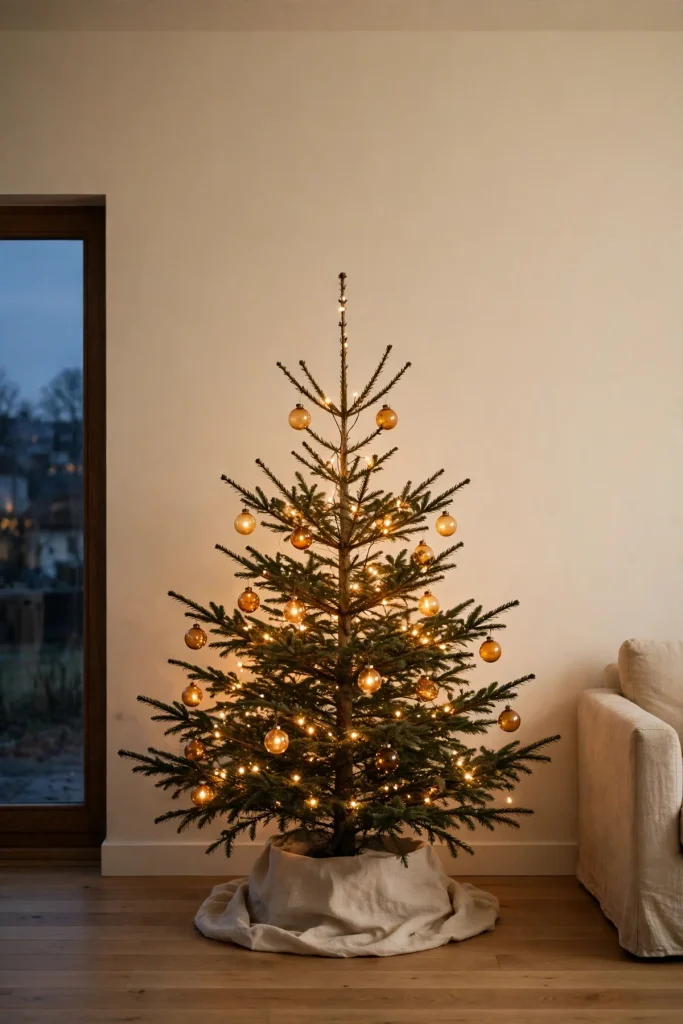
Amber glass does something no paint finish can: it colours the light. Hang amber and honey-toned glass baubles over warm bulbs and the tree throws a soft golden haze onto the wall behind it. Everything else stays plain, bare branches and a simple skirt, so the glass runs the show. Glass sets the budget here, honestly at the upper end, but amber is forgiving: a dozen good pieces spaced wide read richer than thirty crammed together, so buy fewer and hang them proud.
11. Kraft Paper Aesthetic Christmas Tree With Twine and Wooden Beads

Paper is the lightest palette of all, in colour and in cost. Kraft stars, folded paper baubles and plain paper chains hang on jute twine, with a strand of unfinished wooden beads as the only garland. The tree looks handmade in the deliberate way, like a Scandinavian postcard. This is the lowest-spend idea on the list by a wide margin: a roll of kraft paper and a quiet evening cover most of a mid-size tree. The real cost is time, so start the folding before December, not during it.
12. Raw Wood and Linen Aesthetic Christmas Tree in Natural Tones

If colour itself feels loud, take it away. Unpainted wooden baubles, carved wood shapes and strips of undyed linen dress this tree in nothing but texture, and the green branches become the only colour in the scheme. It suits bright rooms where daylight shows the grain. Wood is a slow-grown budget: unfinished pieces are cheap one or two at a time and last for decades, so many readers build this set across two or three Christmases rather than one big shop. That patience is part of the look; nothing here matches too neatly.
13. Aesthetic Christmas Tree With Sparse Matte Black Accents

Black, used like punctuation, makes a calm tree look designed. A small number of matte black baubles, fewer than you think, dotted through the branches sharpen the green and make warm lights look warmer. Nothing else joins in: no silver, no gold, just black and light. The spend is small by design, since the palette fails if you buy a lot of it; one modest box of matte black baubles is the entire ornament budget, and the tree and lights you already own do the rest. Black shows dust, so keep these pieces high, away from little fingers.
Black ornaments scare people, but a dozen matte black baubles on a green tree read as shadow, not darkness — the lights do the talking.
14. Caramel and Toffee Aesthetic Christmas Tree With Bronze Baubles

Caramel is the sweet end of the neutral family: toffee matte baubles, caramel ceramic and a thread of dull bronze through the branches. Lit at night, the whole tree looks gently toasted. It loves cream walls and tan leather. Bronze is where the money goes, and the sensible pattern is bronze as the minority, roughly every fourth ornament, with toffee basics making up the crowd. Buy the bronze in a single finish; mixing bright and aged bronze breaks the calm faster than any colour could.
15. Dried Flower Aesthetic Christmas Tree in Cream and Beige

Dried flowers turn a tree into a winter arrangement. Cream hydrangea heads, beige bunny tails and pale dried grasses tuck into the branches in loose clusters, nothing dyed, nothing bright. It is the softest-looking tree here and the most fragile, so it belongs in a calm corner away from passing sleeves. Dried stems cost little per bunch and less if you dry your own in autumn, which makes this a low-budget look with one hidden price: replacements. Expect a few stems to shed each year, and keep a spare bunch in the storage box.
16. Ochre and Mustard Aesthetic Christmas Tree With Unfinished Wood
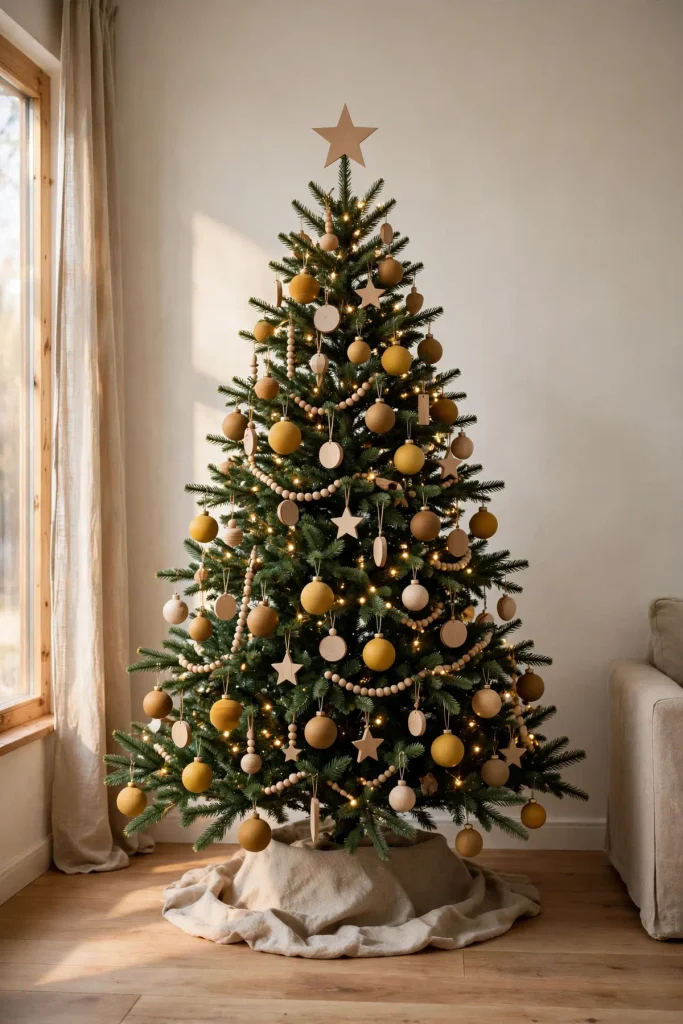
Ochre is yellow with its sleeves rolled down: warm, earthy, calm. Matte ochre and mustard baubles sit against unfinished wood ornaments, and the tree takes on the tone of late-afternoon sun even at noon. It is a forgiving palette for north-facing rooms that need warmth. Ochre baubles are a mid-price buy, but the wood half of the scheme is cheap and nearly unbreakable, which quietly pulls the total down. Skip cream here; the palette wants the contrast of green and gold-brown, nothing paler.
17. Muted Teal and Brass Aesthetic Christmas Tree With Cream
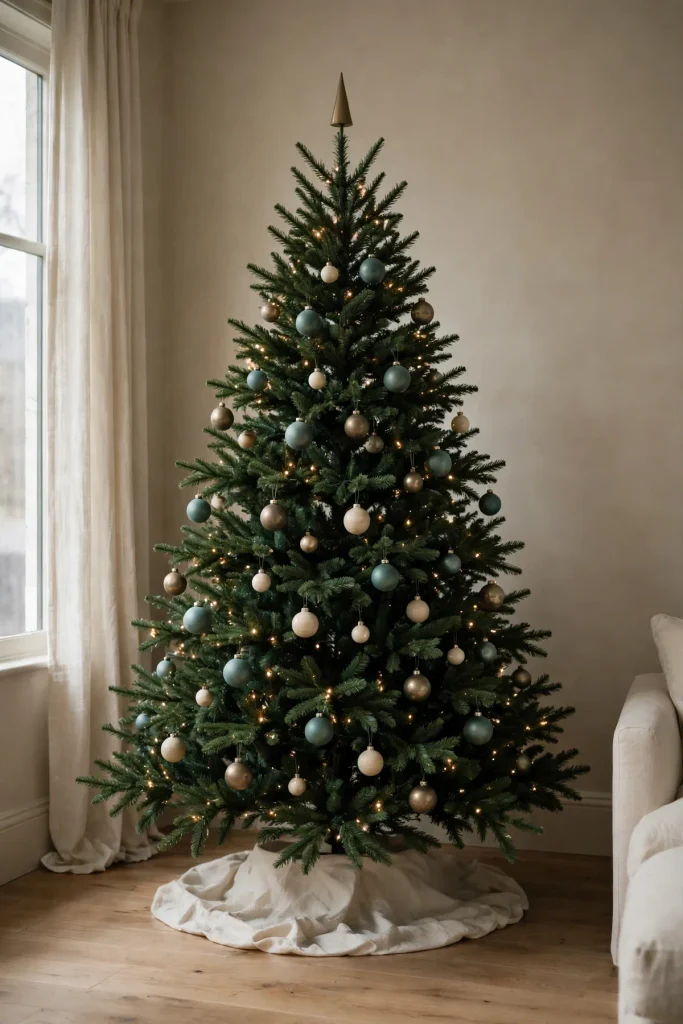
Teal, greyed down until it almost behaves like a neutral, gives a green tree depth you can feel from the doorway. Matte muted-teal baubles carry the colour, dull brass adds a warm edge, and cream keeps the mix from sinking. The tree itself stays green — teal is the ornament palette, not the foliage. Teal finishes vary between shops, so this palette rewards buying the teal pieces together; brass and cream are easy saves, since aged-look brass turns up cheap and cream basics are everywhere.
18. Aesthetic Christmas Tree With Wooden Stars and Lights Only

The last idea is the simplest: one ornament, repeated. Plain wooden stars in two sizes, warm lights, and nothing else — no baubles, no garland, no topper fighting the highest star. The repetition is what makes it look intentional rather than unfinished. Stars are a one-box purchase, often the cheapest ornament on this page per piece, and they store flat and survive drops, so the whole scheme costs less than a single glass set. Size the stars generously; small stars on a big tree read as an afterthought, not a decision.
Start With the Light, End With the Space
Every calm tree in this list was built in the same order. Lights first, wound deep into the branches rather than draped on the surface, because buried lights glow and surface lights glare. Colour second: hang the palette’s main colour evenly, then its partner, then any metal, standing back every few minutes to check the balance from the doorway, which is where the tree actually lives. Space last, and it is a step, not an accident. When the tree looks finished, take three ornaments off. That small subtraction is the difference between decorated and calm, and it costs nothing at all.
The Three-Colour Ceiling: Aesthetic Trees Stay Quiet
Count the colours on any tree in this list and you stop at three, including the green of the branches. That ceiling is the entire method. Two palette colours plus the tree gives the eye a pattern it can rest in; a fourth colour, however pretty, turns rest into scanning. Metals count as colours here, which is why each idea pairs its shade with one metal or none, and why finishes stay in one family — matte with matte, dull with dull. When you fall for an ornament outside your three, the kindest test is the doorway test: hang it, step back, and if your eye goes to it first, it belongs to a louder tree.
Care and Storage for Soft-Coloured Ornaments
Muted palettes show their age faster than bright ones, mostly through dust and fading. Dust matte baubles with a dry cloth before they go back in the box; moisture spots show on pale finishes. Store glass and ceramic in their divided trays, paper and dried pieces in a separate dry box with tissue between layers, and keep the whole lot out of hot lofts, where heat yellows cream and ivory. Wooden ornaments are the easy ones — a cool shelf is all they ask. Wrap the tree itself loosely and store it upright if you can; crushed branches hang unevenly next year and no palette fixes that.
Aesthetic Christmas Tree Questions I Hear Most
What makes a Christmas tree look aesthetic? A limited palette and space. Two colours over the green, one finish family, and gaps between ornaments give that calm, editorial look; the tree itself matters less than the restraint.
How many ornaments does a calm tree need? Fewer than a traditional tree of the same size. Space the pieces so green shows between them on every branch; if you cannot see branches, it is crowded, whatever the count.
Which light colour suits muted palettes? Warm white, almost without exception. Cool white light turns sage grey, plum muddy and cream blueish; warm bulbs keep soft colours soft after dark.
Can an aesthetic tree still feel festive? Yes, because festivity lives in the light, not the ornament count. A simply dressed tree with warm lights deep in the branches glows as festively as a crowded one.
What is the cheapest calm palette to copy? Paper and wood. Kraft paper stars and unfinished wooden pieces cost the least on this list, store flat, and suit almost any room colour you already have.
A Calmer Tree, A Calmer Room
A calm tree is not a bare tree; it is a decided one. Pick the palette that suits your room, hold it to three colours, and stop while the branches still show. The room will feel the difference every evening until January.