15 Cheer Hairstyle Commandments: The Unwritten Rules Every Cheerleader Lives By
I did not learn cheer hair from a tutorial. I learned it from a disaster. My first competition, age fourteen, I walked onto the floor with a ponytail I had styled in eleven minutes flat, one elastic, a prayer, and a bow I had pinned on crooked.
By the second tumbling pass, half my hair was out. By the stunt sequence, my flyer could not see through the curtain of my escaped hair whipping across her face. We survived the routine. Barely. My coach said exactly four words to me afterward: “Never again, sweetheart.” Then she handed me the unwritten rulebook — the commandments every serious cheerleader follows, passed down locker room to locker room like sacred text. What stung most was not the hair failure itself. It was the look on my flyer’s face when my hair hit her mid-toss: pure panic, the split-second realization that something outside her control had just entered her stunt. She caught the moment.
She should never have had to. That is what these commandments are really about — not vanity, not aesthetics, but the promise that your hair will never be the variable that endangers someone else’s safety. I am writing them down for you, because nobody should have to learn them the way I did.

The 15 Commandments
1. Thou Shalt Build on a Gel Base
Every competition style begins long before the bow, with clean, fully dry hair and a strong-hold gel worked through from roots to mid-length. I used to think this step was optional fussiness until I watched a teammate’s entire updo slide off her head mid-routine because she had styled on second-day hair with no base. The gel is not about stiffness. It is about grip — giving every pin, elastic, and braid something to hold onto. Wash, dry completely, gel the base. Skip this commandment and everything built on top of it is a house on sand.

2. Thou Shalt Double-Wrap Thy Elastic
One elastic is a hope. Two is a guarantee. The classic high cheer ponytail gets pulled as high and tight as the scalp can comfortably tolerate, then secured with two strong elastics — one at the base, one an inch up. A gym owner I know changed her entire team’s protocol after watching a single-elastic ponytail fail mid-stunt at a real competition years ago. The pony held through warm-ups, through tumbling, and then let go at the worst possible moment, during a basket toss. Two elastics. It takes four extra seconds. There is no excuse.

3. Thou Shalt Go High or Go Home
The high ponytail is not a fashion choice in cheer. It is engineering. High placement keeps hair off the neck (sweat management), out of the face (visibility), and clear of bases’ hands during catches. I once tried a low pony for a “softer look” at a showcase. Within minutes it was swinging into my face on every jump and my coach was mouthing “never again” from the sidelines. High is not about looking fierce, though it does. High is about function. The ponytail sits at the crown, proud and unmovable, like it owns the arena.

4. Thou Shalt Know the Flyer Distinction
Flyers — the athletes lifted into stunts — follow a slightly different commandment: the half-up build. A section of hair pulled up while the rest stays controlled keeps hair from falling fully into a base’s face during a lift or catch. A flyer on my college team told me she did not understand this rule until her first season, when her full ponytail whipped across her base’s face during a toss and nearly caused a drop. The base could not see. The catch was blind luck. After that, flyers got the half-up, no exceptions. Different positions, different rules. Know yours.

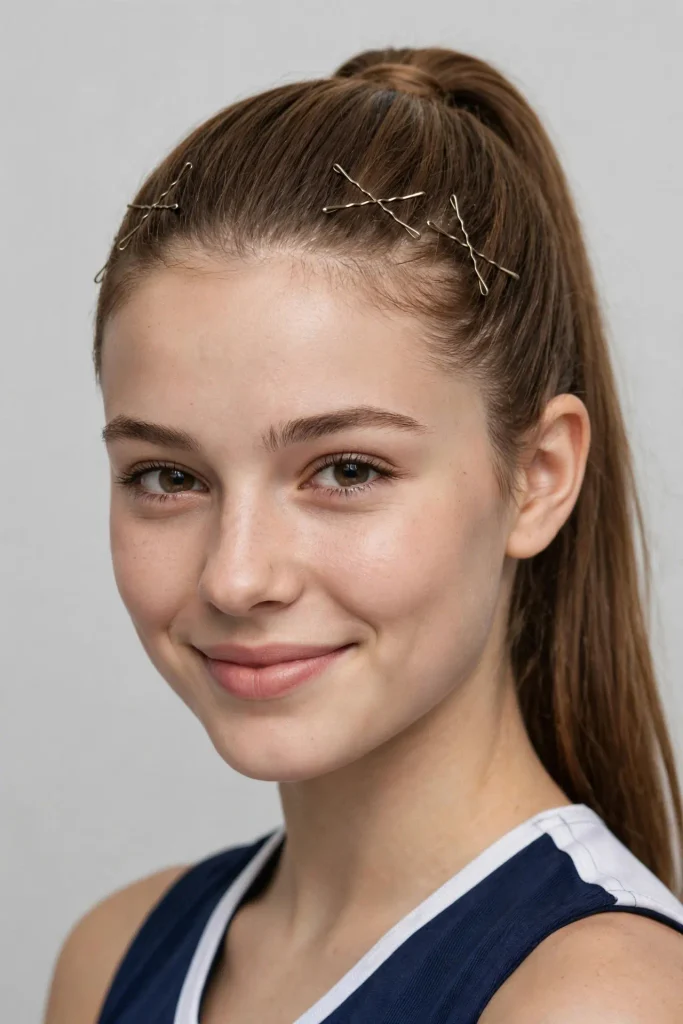
5. Thou Shalt Pin in the X Pattern
The hairline is where rebellions start. Flyaways escape here first, during the highest-impact movement, and one loose strand can genuinely distract a base mid-catch. The commandment: bobby pins crossed in an X pattern along the front hairline, non-negotiable. My coach checked every athlete’s hairline personally before warm-ups, running her finger along the front like a general inspecting troops. X-pattern pinning holds twice as well as parallel pinning — the crossed pins lock each other in place. It is the smallest detail with the biggest payoff.
6. Thou Shalt Layer Thy Hairspray
One heavy coat of hairspray is a rookie mistake. It gets sticky, attracts loose hair, and collapses under sweat. The commandment is layers: several light passes, letting each one set before the next. A stylist who works competition season told me layered spray forms a flexible net instead of a brittle shell — it moves with the hair instead of cracking. I spray, wait thirty seconds, spray again, and finish with a final pass right before we leave the locker room. Three light layers outlast one heavy drenching every single time.

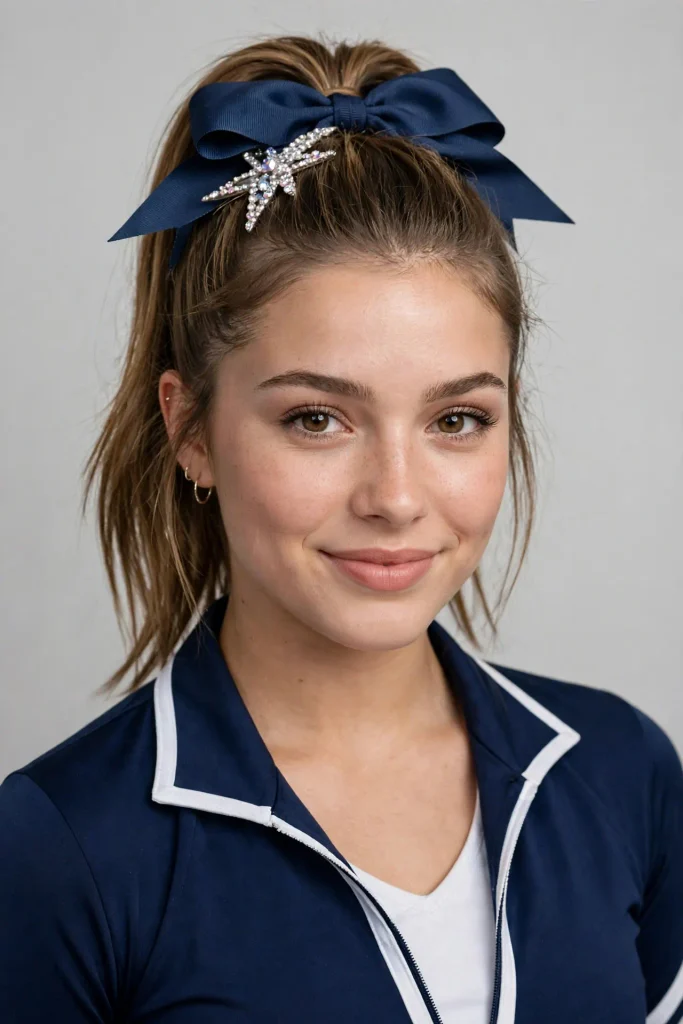
7. Thou Shalt Match Thy Bow
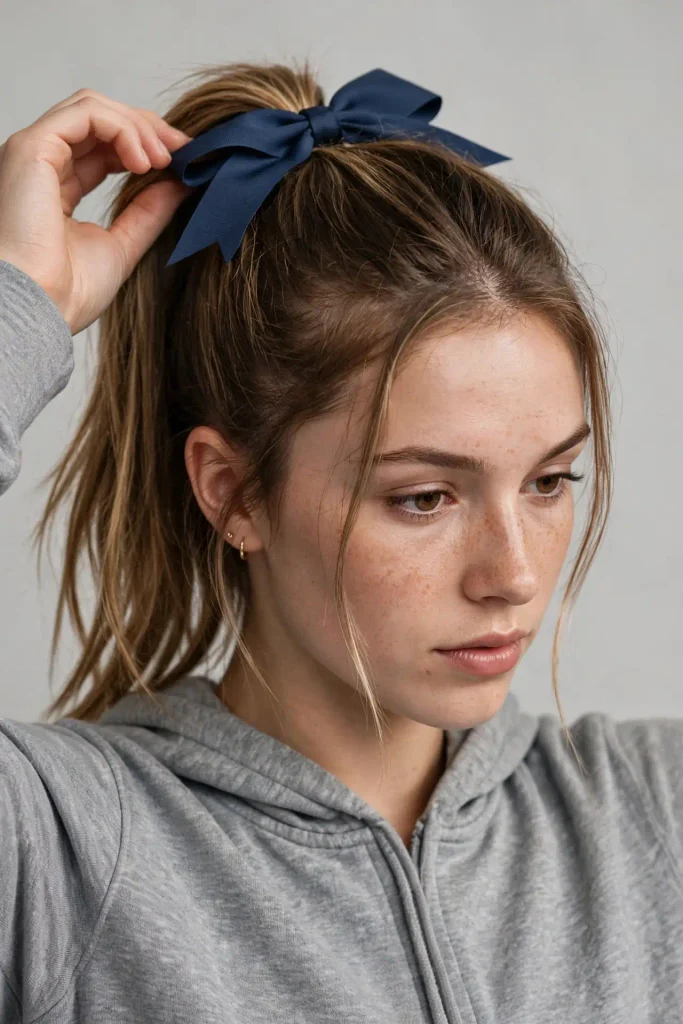
The bow is not an accessory. It is a uniform. Same bow, same placement, same angle, across the entire squad — because judges and photographers genuinely notice when one athlete’s bow sits differently. Our team mom ran an assembly line at every home competition for three years: same bow position measured by finger-widths from the ponytail base, same glitter pattern, athlete after athlete. It looked almost militaristic up close. From the judges’ table, it looked like perfection. Uniformity is the whole point of a team aesthetic. Match the bow.

8. Thou Shalt Honor Thy Seniors
Some teams build a small distinction into the uniform look for senior athletes — an extra rhinestone pin, a subtly different bow color, a slightly fancier accent. A graduating captain told me this tiny break from uniformity was the most meaningful tradition of her final season: a small visual detail that said she was individually recognized inside a fully matching team. The commandment is not about vanity. It is about honoring the athletes who carried the program. If your team does not have this tradition, start it. The seniors will remember it forever.
9. Thou Shalt Stress-Test Before Showtime
Before anyone leaves the locker room, every style gets the jump-and-shake: jump in place, shake the head firmly for several seconds, while the coach watches for movement. Styles that looked perfect standing still reveal their weaknesses the moment real movement arrives — and the competition floor demands far more intensity than a locker room. My coach caught three failing styles this way in a single season. Three routines saved. The commandment is simple: never trust a style that has not been shaken. Hope is not a strategy. The jump test is.

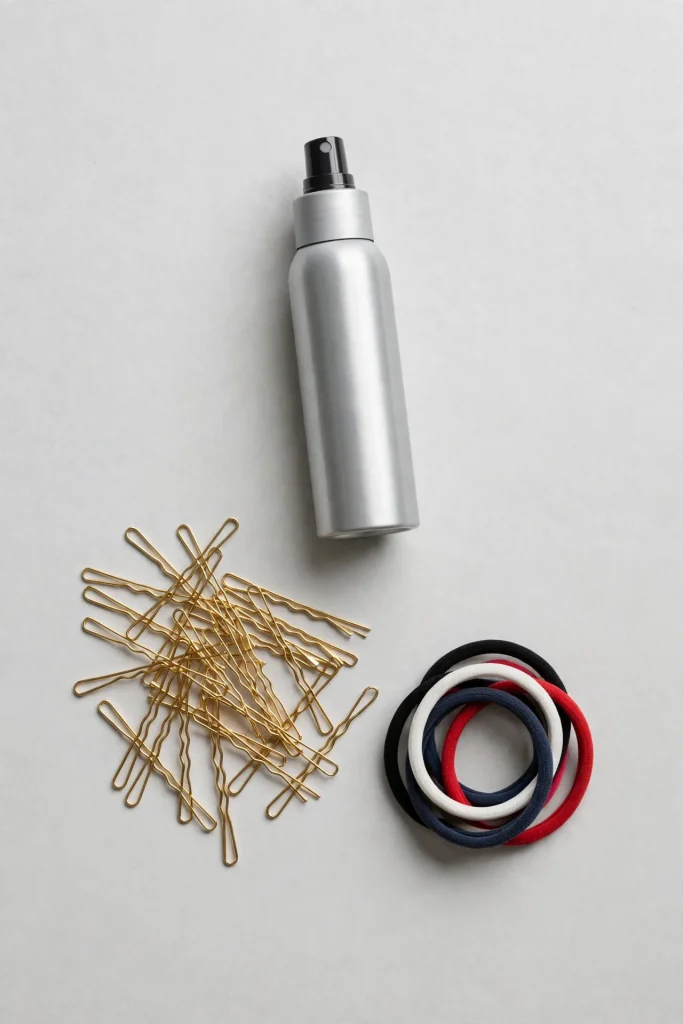
10. Thou Shalt Keep an Emergency Kit
Staged in the warm-up area, never in the locker room: spare elastics, bobby pins in your hair color, a travel hairspray, a small brush. The commandment exists because things go wrong in the final minutes and there is no time to run back. I have performed emergency surgery on teammates’ hair with ninety seconds on the clock — a re-pinned hairline, a re-wrapped elastic — using nothing but the kit. Pack it the night before. Check it before you leave. The kit you never need is the best kit you ever packed.
11. Thou Shalt Tame the Tumbling Ponytail
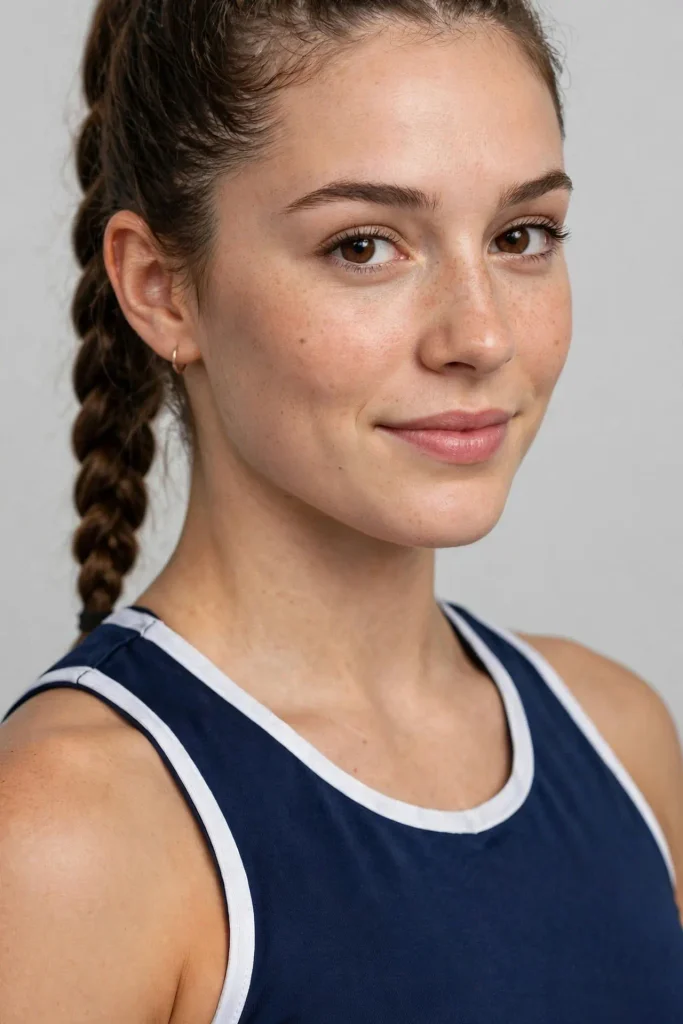
Tumblers live by an extra commandment: the ponytail itself must be tamed. A loose, swinging pony becomes a whip during back handsprings and tucks — it hits the face, distracts, and throws off spatial awareness mid-flip. The solution is the braided or wrapped ponytail: braid the length, or wrap sections around the base, so nothing swings free. A gymnast-turned-cheerleader on my team called this the single biggest adjustment of her transition — in gymnastics her bun never moved, but cheer demanded the pony, so she learned to braid it into submission. Tumble-tested, coach-approved.
12. Thou Shalt Never Debut on Game Day
No new style makes its first appearance at a competition. Ever. Every commandment on this list gets rehearsed at practice first — the double-wrap, the X-pins, the flyer half-up, the whole sequence. I once watched a freshman debut a brand-new braided style she had learned from a video the night before. It looked stunning in the locker room. It unraveled during warm-ups. She competed in a emergency bun and cried in the parking lot. Practice is the laboratory. Competition is the exam. Never take an exam you have not studied for.
13. Thou Shalt Respect the Sweat
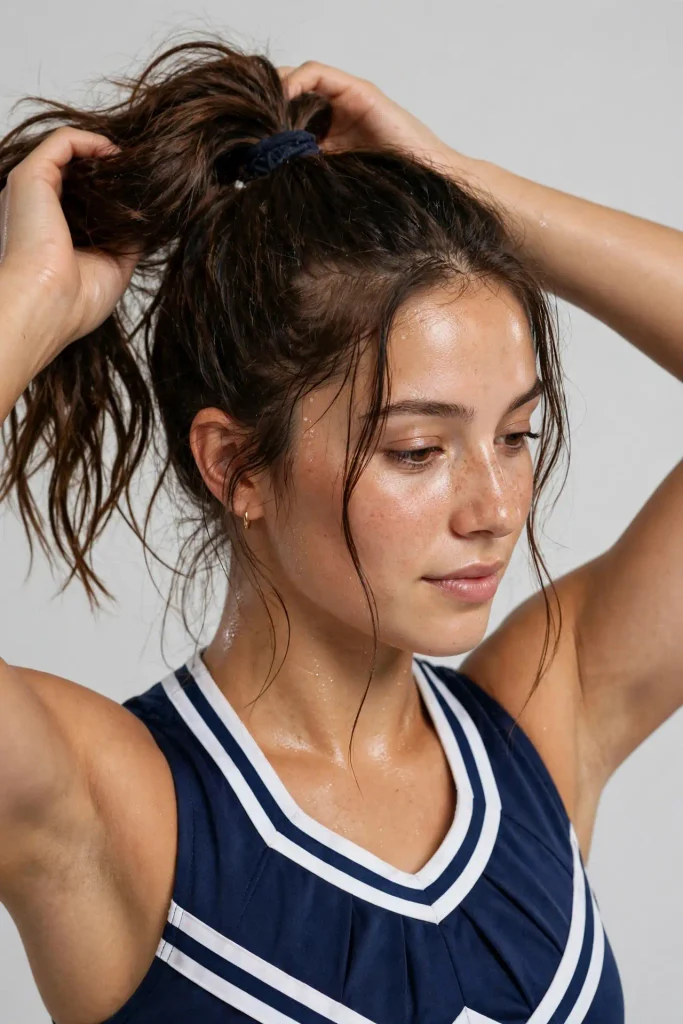
Cheer happens under hot gym lights, through hours of exertion. Sweat is the silent enemy that loosens pins, flattens volume, and turns sleek bases stringy. The commandment: plan for it. Dry shampoo at the roots between events absorbs sweat and restores grip. A sweat-wicking headband under the style (hidden by the hair) protects the hairline. And the gel base from Commandment One? It is also sweat armor. I learned to pack blotting papers alongside my bobby pins. Respect the sweat, and it stops being the thing that ruins your routine.
14. Thou Shalt Protect Thy Ends Between Battles
Competition hair is brutal on hair health — tight elastics, heavy product, constant heat and tension. The commandment covers the other six days: deep-condition weekly, vary your ponytail placement so the same spot does not take the stress every time, and give your hair full rest days with zero elastics. A multi-year captain told me her hair was healthier in her senior season than her freshman year, entirely because she learned recovery. The tight styles are the job. The recovery is what lets you keep the job. Protect the ends, protect the career.

15. Thou Shalt Debrief Every Routine
The final commandment happens after the music stops: the debrief. What held? What loosened? Which pin migrated, which elastic stretched, which section the sweat won? My team did this reflexively in the hallway after every routine, comparing notes while the adrenaline was still fresh. That information directly shaped the next competition’s prep — more pins here, a different elastic there, a tweak to the bow placement. A season of debriefs turns a good protocol into an unbeatable one. The commandments are not static. They evolve, one debrief at a time.
How to Teach These to Your Team
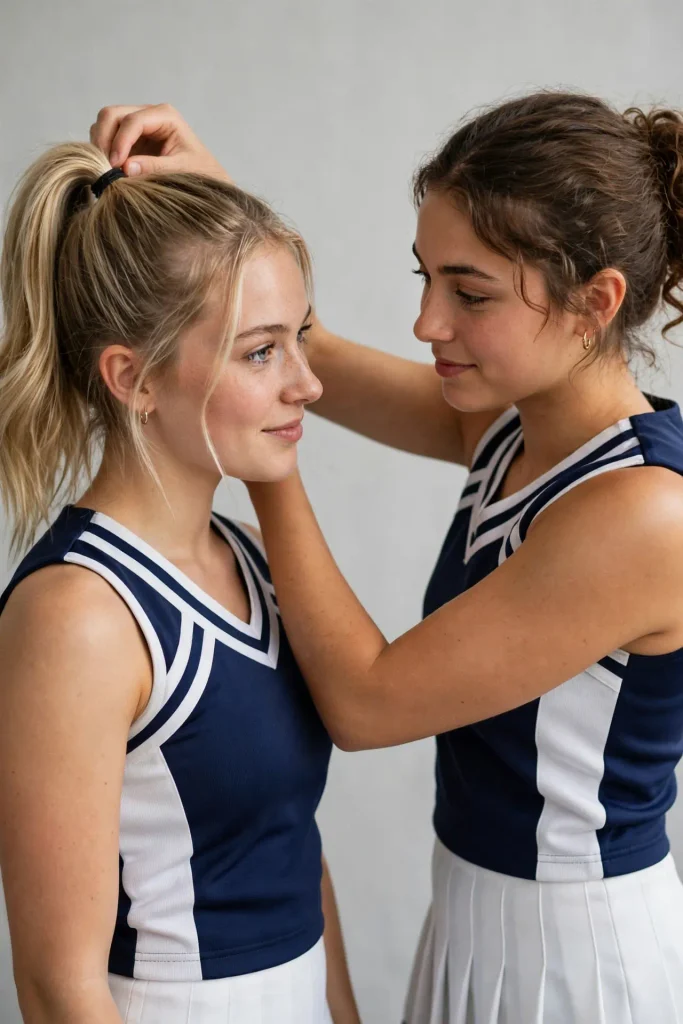
Commandments only work if the whole squad follows them, so here is how coaches actually install them. Print them. Tape the list inside the locker room door, exactly like the coach in the story that started this article. Athletes read what is in front of them every day. Drill the stress test. Make the jump-and-shake part of every practice’s final ten minutes until it is muscle memory. Assign a hair captain. One veteran athlete owns hairline checks and bow uniformity — it builds leadership and takes the load off the coach. Debrief out loud. After each competition, spend five minutes on what held and what did not, and update the printed list. The commandments are a living document. The teams that treat them that way are the teams whose hair never makes the blooper reel.
The One Commandment Above All
If you forget fourteen of these, remember this: cheer hair is not about looking pretty. It is about trust — trust that your style will survive everything the routine demands, so your mind stays on the performance and never once on your hair. Every pin, every wrap, every layer of spray is a promise you make to yourself and your team: I will not be the reason something goes wrong. Build it right, test it hard, and then forget about it completely. That is what the commandments are for. Print them, drill them, debrief them — and then walk onto that floor knowing your hair is the one thing you will not have to think about. Fifteen commandments, one promise, zero loose strands. Now go earn your bow. You have got this.