13 Locs Hairstyle Ideas, Journaled by Stage of Growth
A woman at my loc retwist appointment once told me she almost gave up in month four because nothing she tried looked like the styles she’d saved. What she didn’t know yet, and what her loctician gently explained, is that locs aren’t one hairstyle. They’re a years-long relationship, and what your locs can actually do changes dramatically between month one and year five. A style built for mature locs will frustrate anyone with starter locs, and a style suited to the earliest stage will look hesitant on locs that have been growing for a decade.
So this post is written like a growth journal, thirteen entries organized by stage, each one a style your locs are genuinely ready for at that point, with a note on what makes it possible at that stage specifically. The extras on retightening, products, and care follow the entries.
Stage One: Starter Locs (Months 0-6)
Still finding their shape, prone to unraveling, need gentle handling above all else.
Entry 1, The Flat-Twist Updo.

What your locs can do now: starter locs, whether palm-rolled, two-strand, or interlocked, are usually too short and too loose-rooted for intricate styling, but they can absolutely be flat-twisted close to the scalp and gathered into a low bun or puff. This protects the vulnerable roots while you wait out the early months. Journal note: be gentle at the nape, since starter locs there are often the last to establish fully.
Entry 2, The Simple Low Ponytail.

What your locs can do now: gathering all the starter locs into one low, loose ponytail secured with a soft fabric tie, no tension at the root. Journal note: avoid tight elastics entirely at this stage, since the roots need to lock without added pulling stress.
Entry 3, The Bandana Wrap.

What your locs can do now: a simple fabric wrap covering the crown while leaving the ends visible underneath, both stylish and genuinely practical for protecting fragile new growth while sleeping or during humid weather. Journal note: satin or silk-lined wraps specifically, since cotton can cause unwanted frizz at this stage.
Stage Two: Budding Locs (Months 6-12)
Starting to hold their shape independently, less prone to unraveling, still short.
Entry 4, The Pineapple Puff.

What your locs can do now: budding locs can finally be gathered high on the crown into a genuine puff shape rather than just a loose bundle, since they’ve begun to hold their individual form. Journal note: use a few bobby pins at the base rather than a tight band to avoid stress on roots that are still maturing.
Entry 5, The Two-Strand Updo Twist.

What your locs can do now: at this stage, locs are long enough to be gathered into two larger sections and twisted around each other into a simple updo, a step up from the flat-twist bun of Stage One. Journal note: this is a good stage to start experimenting with small accessories, like a wrapped cord, since the locs can now hold a shape through movement.
Stage Three: Teenage Locs (Years 1-2)
Longer, more defined, strong enough for genuine styling variety.
Entry 6, The Half-Up Half-Down.

What your locs can do now: teenage locs are typically long enough to gather the top half back while leaving the rest down, the first stage where a genuinely varied, layered look becomes possible. Journal note: this is also the stage where locs start to show real personality in thickness and texture, so lean into whatever your particular locs are doing naturally.
Entry 7, The Loc Bun with Wrapped Base.

What your locs can do now: full-length locs gathered into a proper bun, with a few of the locs themselves wrapped around the base rather than needing an external tie at all. Journal note: this wrapped-base trick only works once locs have enough length and flexibility to bend back on themselves without strain.
Entry 8, The Side-Swept Style.

What your locs can do now: enough length and weight has developed that locs can be swept dramatically to one side and held with a single decorative pin, a genuinely elegant option for a dressier occasion. Journal note: this is a good stage to introduce gold cuffs or beads on a few select locs, since they finally have the length to carry the weight without looking sparse.
Stage Four: Mature Locs (Years 2-5)
Fully locked, substantial length, capable of the most intricate styling.
Entry 9, The Loc Updo with Curls at the Ends.
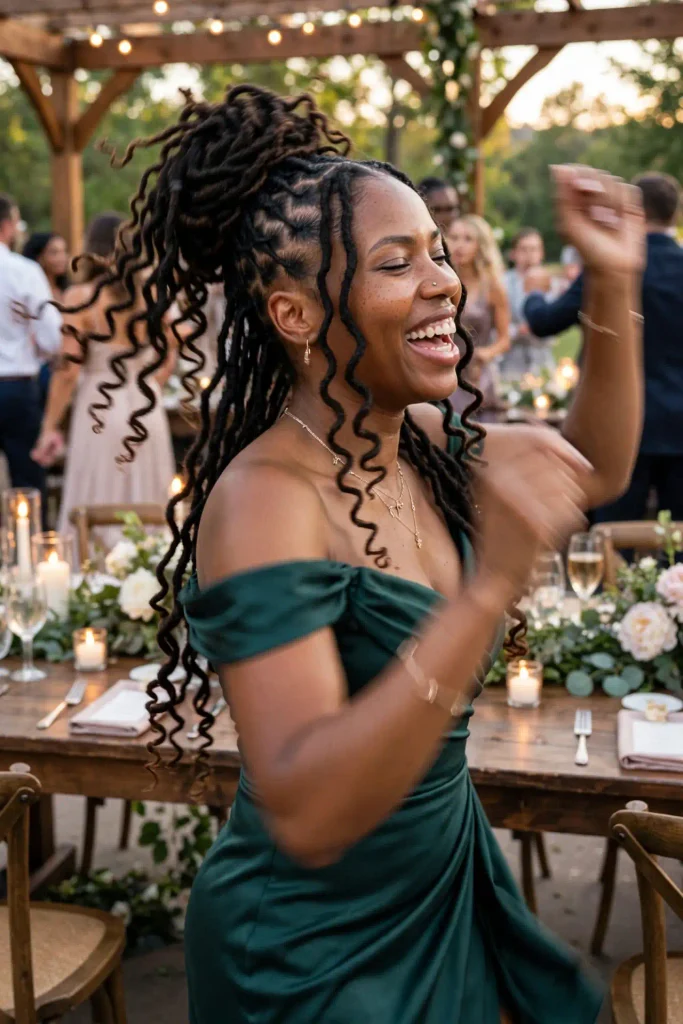
What your locs can do now: mature locs can be gathered into a sophisticated updo while the loose ends are curled with a flexi rod or perm rod for a soft, romantic finish, a style that genuinely requires the length and weight mature locs carry. Journal note: curl only the last few inches, since the body of the loc itself should stay smooth.
Entry 10, The Faux Hawk.

What your locs can do now: at this length, locs can be gathered and pinned along the center of the head while the sides are tucked close, a bold, architectural style only possible once there’s enough length to manipulate into a defined ridge. Journal note: this style photographs beautifully but needs secure pinning to last through a full day.
Entry 11, The Loc Bob Illusion.

What your locs can do now: mature locs can be folded and pinned under to create the illusion of a shorter bob length, a clever, reversible way to try a different silhouette without cutting anything. Journal note: this is purely temporary styling, undone at the end of the day or the next wash, which makes it a low-commitment way to experiment.
Stage Five: Established and Long Locs (5+ Years)
Full weight, maximum length, the widest styling range of any stage.
Entry 12, The Full Updo with Intricate Partings.
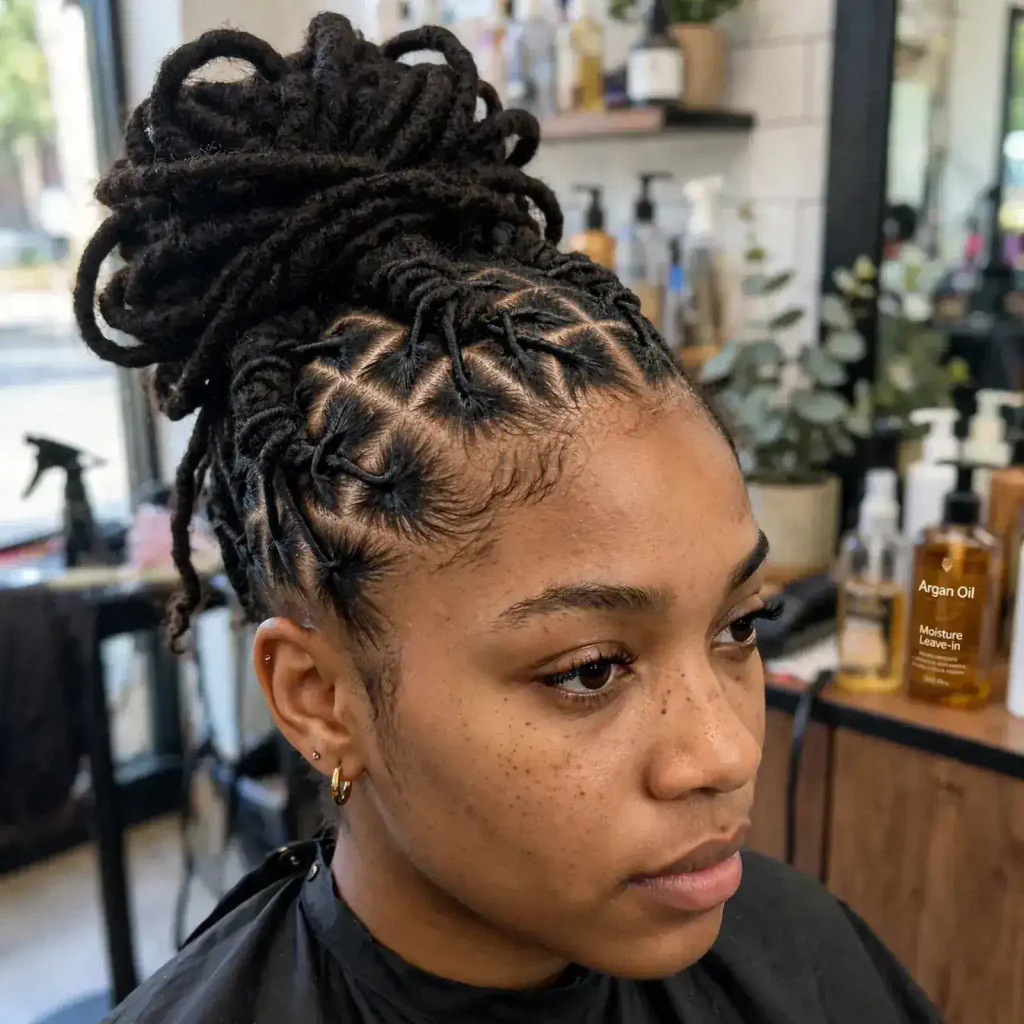
What your locs can do now: at this length and thickness, locs can be sectioned into deliberate, decorative partings and gathered into an elaborate updo with visible structure, the kind of style that genuinely needs years of growth to achieve. Journal note: this stage is when many people start working with a loctician specifically for special-occasion styling, since the sheer volume of hair benefits from a second pair of hands.
Entry 13, The Loose, Flowing Half-Up with Gold Accents.

What your locs can do now: established locs have enough weight and movement to be worn mostly down with just a small section pulled back, decorated with a scattering of gold cuffs along a few locs throughout, a style that celebrates the full journey of growth rather than trying to control it. Journal note: this is often the style people describe as finally feeling like “their” locs rather than a style borrowed from someone else’s journey.
Something New: The Retightening Rhythm Chart
How often you retighten changes by stage, and getting this wrong is one of the most common sources of frustration at every single stage of the journal above.
| Stage | Retightening Frequency | Why |
|---|---|---|
| Starter (0-6 months) | Every 6-8 weeks | Roots are still establishing; over-retightening causes thinning |
| Budding (6-12 months) | Every 6-8 weeks | Still building strength; consistency matters more than frequency |
| Teenage (1-2 years) | Every 8-10 weeks | Locs hold shape longer; stretching the interval reduces stress on roots |
| Mature (2-5 years) | Every 10-12 weeks | Fully locked hair tolerates longer intervals well |
| Established (5+ years) | Every 10-14 weeks, or as needed | Many people move to interval or freeform maintenance at this stage |
Retightening too frequently at any stage, especially the earliest ones, is one of the leading causes of thinning at the root, so resist the urge to over-maintain even when new growth looks a little wild.
The Product Shelf by Stage
What belongs on your shelf genuinely shifts as locs mature.
At the starter stage, keep it minimal: a locking gel or cream used sparingly, since product buildup is the enemy of young locs still trying to establish themselves, plus a light oil for the scalp. At the budding stage, introduce a residue-free shampoo specifically, since this is when buildup first becomes a real concern as the locs begin holding product inside them. At the teenage stage, a lightweight styling cream for the varied updos becomes useful, plus a proper satin scarf or bonnet for nightly protection. At the mature and established stages, the shelf can expand to include heavier oils and butters for the ends specifically, since mature locs often need more moisture at the tips than at the root, plus accessories like cuffs and wraps that only really suit locs with enough length to carry them.
The Protective Style Rotation
Regardless of stage, rotating between a few go-to protective options prevents repetitive strain on any one section of the scalp. Build a small rotation of three: one low-tension everyday style (Entries 1, 4, or 7 depending on your stage), one special-occasion style (Entries 8, 9, or 12), and one that gets locs fully off the neck and face for active days (Entries 2, 6, or 10). Rotating between three rather than wearing one style exclusively for weeks at a time is the single best habit for long-term scalp health.
The Loc Health Check
At any stage, run this quick check during your regular wash day. Look at the roots for any thinning, which shows up as a visibly narrower loc near the scalp compared to the rest of its length, a sign to extend your retightening interval. Smell the locs when slightly damp, since a persistent musty smell even after washing usually points to product buildup or incomplete drying rather than anything to worry about structurally, both fixable with a clarifying wash and more thorough air-drying time. Check for any unusual tenderness at specific roots, which can indicate a style was too tight or held too long. Gently test a few locs for flexibility, since healthy locs at any stage should bend without feeling brittle or overly stiff.
Choosing Your Entry by What You Have Right Now
If you’re newly starting out and feeling discouraged that your locs don’t look like the mature photos you saved, that’s completely expected, revisit Stage One and Two specifically, since those entries were written for exactly where you are. If you’re a year or two in and ready to experiment beyond the basics, Stage Three opens up real variety. If you’ve been growing for several years and have length to work with, Stages Four and Five are where the styling options genuinely expand.
Quick Answers
What can I actually do with very new starter locs?
Gentle, low-tension styles like the flat-twist updo or a loose ponytail, protecting the roots rather than attempting intricate styling too early.
How long until locs can hold an updo?
Most people find genuine updo versatility opens up around the one to two year mark, once locs have enough length and have stopped unraveling.
How often should I actually retighten?
It depends on stage, generally every six to eight weeks for newer locs and stretching to ten to fourteen weeks as locs mature, referencing the Retightening Rhythm Chart above.
When can I add beads or cuffs?
Once locs have enough length and strength to carry the added weight without strain, typically from the teenage stage onward.
One Last Thing
Locs were never meant to be judged against a single finished photo pulled from somewhere online. They’re a genuine, years-long journey, and what looks beautiful on locs with five years of growth simply isn’t available to locs with five months, and that’s not a failure, it’s just where you are in the timeline.
Find the entry that matches your actual stage, be patient with the roots at whichever point you’re at, and let the more elaborate styles wait for the length that makes them possible.
Which stage of the journal matches where your own locs are right now? Save this article for your next retightening appointment, and send it to a friend who’s a few months into her starter locs and feeling discouraged by photos that don’t match her reality yet.