17 Starfish Summer Nails: A Tide Pool on Your Fingertips
The starfish is the ocean’s quiet star — five arms, endless colors, and a shape so iconic that a child could draw it. On nails, it’s perfect: instantly recognizable, beautiful at any size, and versatile enough for seventeen completely different designs.
This list dives by depth — starting in the sunlit shallows, drifting through the reef, descending into the mysterious deep, and surfacing with artistic reimaginings. One creature, four habitats, seventeen ways to wear the sea.
The Shallows: Starfish in Sunlit Water
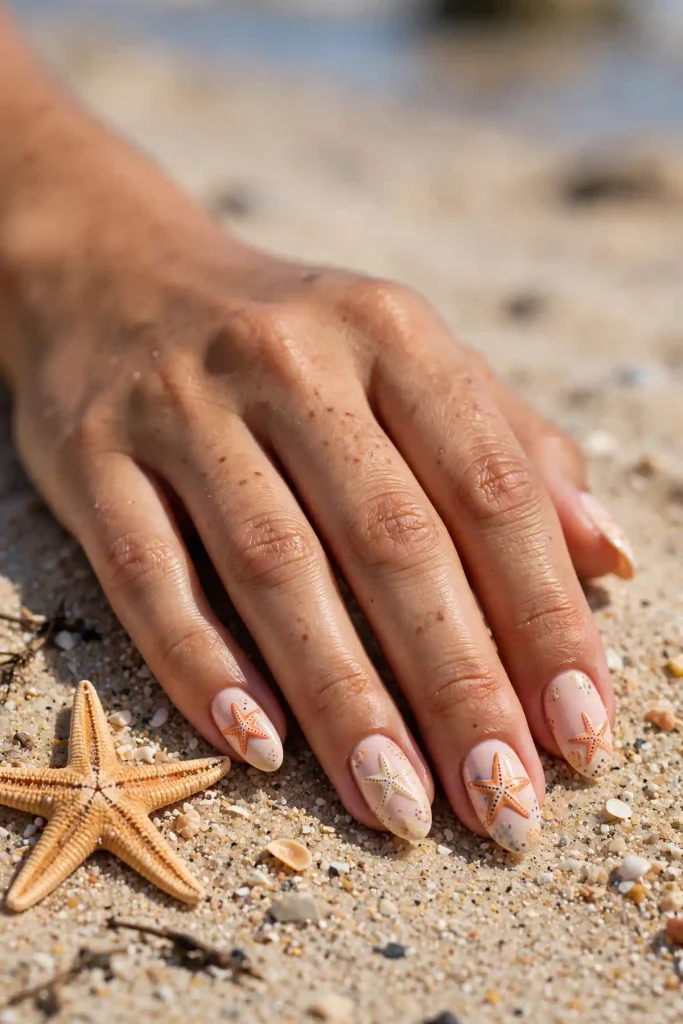
Bright, beachy, and full of daylight. These designs capture starfish where you’d actually find them — in warm, shallow tide pools.
1. The Classic Orange Starfish
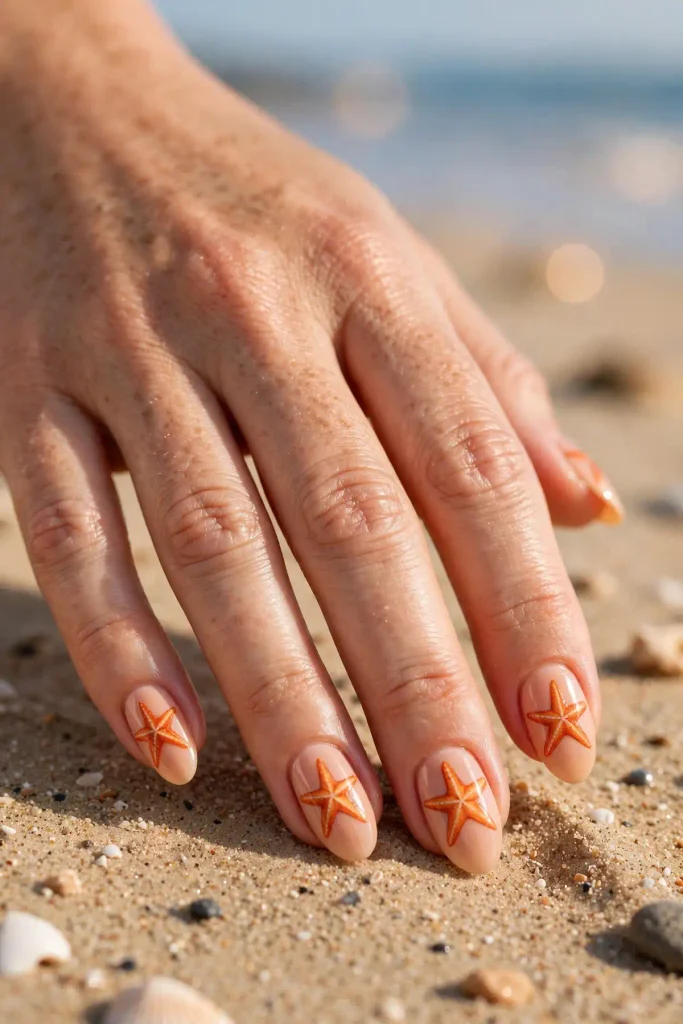
A realistic orange starfish with textured arms and tiny tube-feet dots, resting on a sandy beige base. It’s the definitive starfish: the one from postcards, aquariums, and childhood beach trips. The texture is everything — bumpy, organic, alive.
The key is the arm texture: real starfish aren’t smooth, so add tiny dots and bumps along each arm. The sandy base grounds the design and makes the orange pop.
The tide-pool truth: texture makes it real — smooth starfish look like cookies, bumpy ones look alive. Dive in when: you want the iconic beach nail, instantly recognizable.
2. Starfish + Seashells
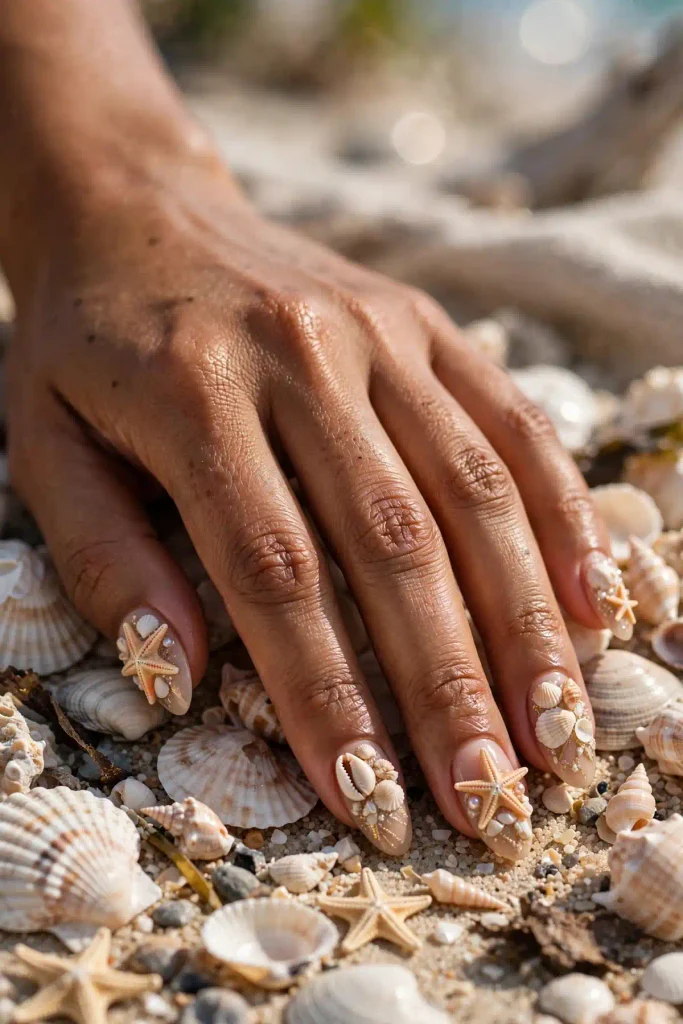
A starfish paired with small painted seashells — scallops, spirals, and clams — scattered across a soft blue or sandy base. The shells should vary in size and type, just like real finds.
The starfish stays the star; the shells are the supporting cast. A few tiny dots suggest sand or bubbles.
The tide-pool truth: variety reads as “collected” — matching shells look staged, mixed ones look found. Dive in when: beach vacations and anyone who brings home shells in their pockets.
3. Starfish in the Sand
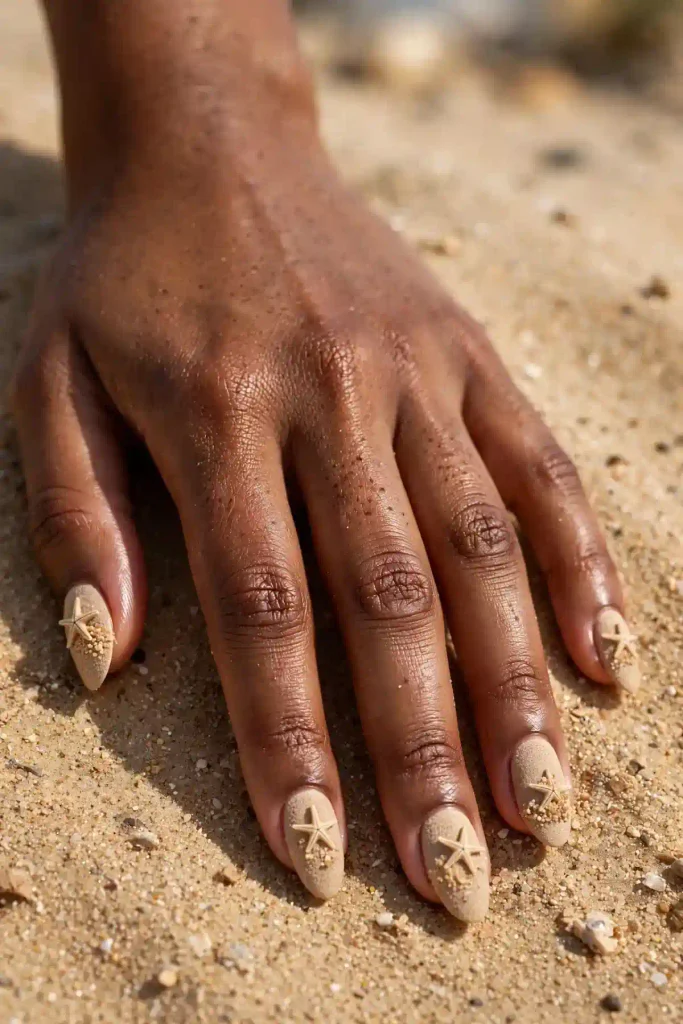
A starfish half-buried in textured sand — the base itself is the beach. Use a textured or sugared polish for the sand, then paint the starfish emerging from it. The dimension is striking: the design has actual depth.
This is tactile nail art — people will want to touch it. The contrast between the rough sand and the smoother starfish creates a sensory experience flat designs can’t match.
The tide-pool truth: let the base do half the work — a textured background makes simple art look complex. Dive in when: you want nails with dimension.
4. Blush Pink Starfish
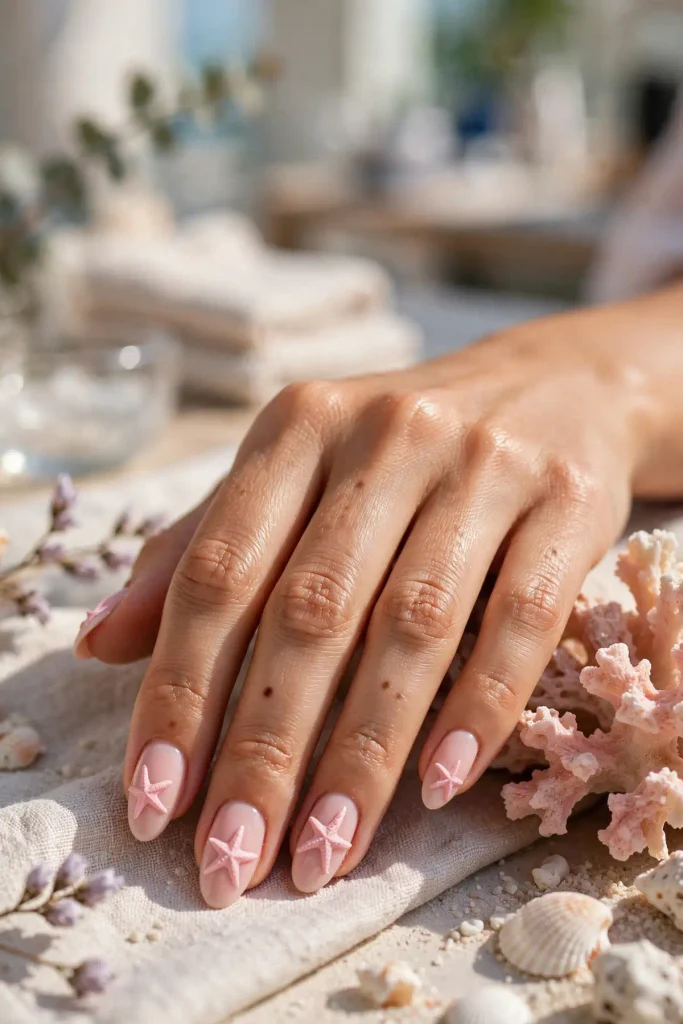
A soft pink starfish on a pale blue or white base — the delicate, dreamy take. Real pink starfish exist (the bat star comes in pink!), so it’s nature-accurate and gorgeous. The softness makes it wearable everywhere.
Pink starfish read as gentle and feminine without being childish — it’s a sophisticated pastel that happens to be a sea creature. The pale base keeps everything light and airy.
The tide-pool truth: real starfish come in pink — nature already did the pretty work, just copy it. Dive in when: you want marine with softness; this is the gentlest starfish here.
5. The Starfish Trail
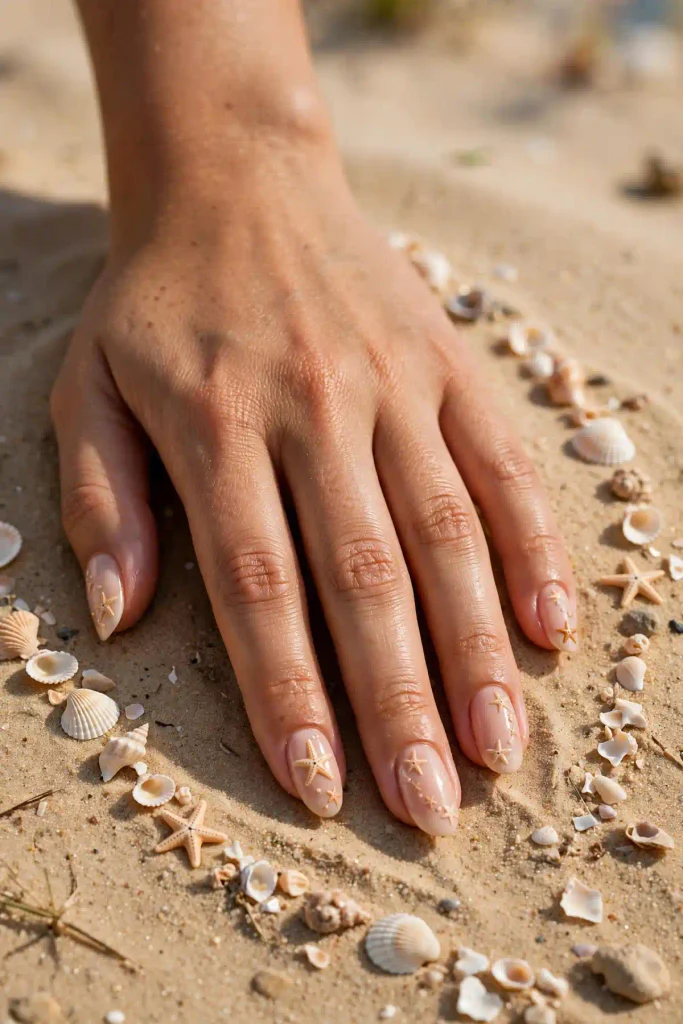
A trail of tiny starfish in decreasing sizes wandering across the nails — like they’re migrating. The largest leads, the smaller follow, curving with the nail’s shape. It’s whimsical, dynamic, and utterly charming.
The trail tells a story — movement, journey, adventure. Vary the tiny starfish slightly in color for a hand-drawn feel. It’s the design that makes people smile before they even process why.
The tide-pool truth: repetition with variation creates rhythm — identical copies look stamped, varied ones look alive. Dive in when: you want playful; this is the happiest design on the list.
The Reef: Starfish Among Coral
Deeper, lusher, more colorful. The reef is where starfish live their most vibrant lives — surrounded by coral and sea plants.
6. Starfish + Coral Garden

A bold starfish nestled among painted coral branches in pinks, oranges, and reds. The coral provides a lush, colorful backdrop; the starfish rests within it like it’s home. It’s the reef in miniature — abundant and alive.
Layer the design: coral in back, starfish in front, a few small fish or bubbles for depth. The layering creates a real sense of underwater space.
The tide-pool truth: layer back-to-front for depth — background, midground, starfish last. Dive in when: you want lush and abundant; this is maximalist marine.
7. Starfish + Seaweed Fronds
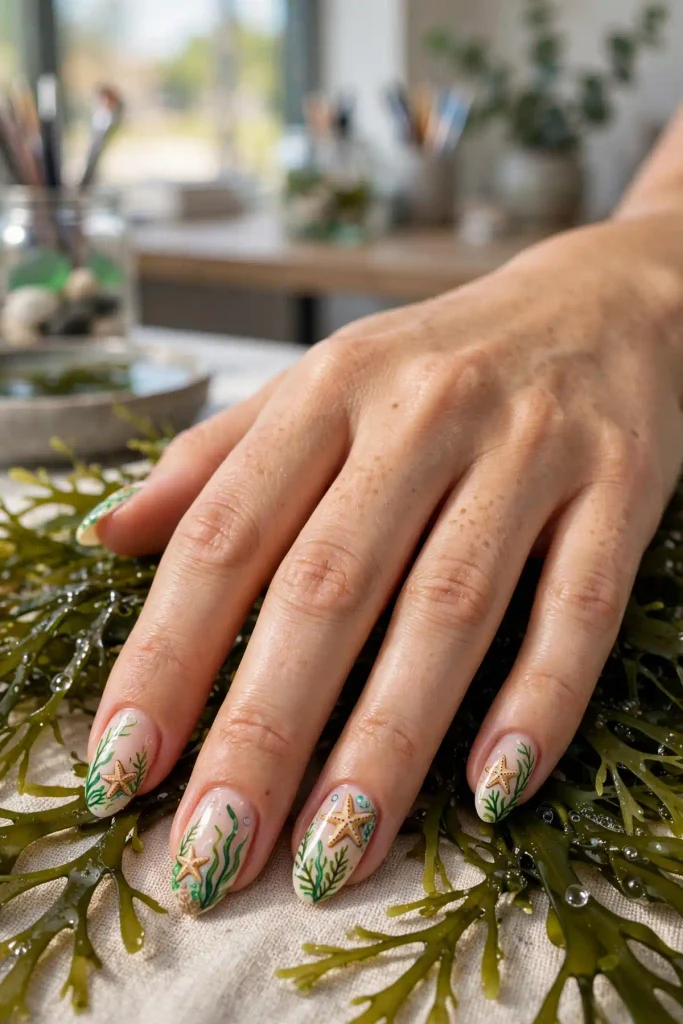
A starfish among flowing seaweed fronds in greens and teals — the elegant, swaying reef. The seaweed should curve and flow, giving the design movement; the starfish anchors it, resting calmly amid the motion.
The contrast between the seaweed’s fluid lines and the starfish’s solid form is beautiful — motion versus stillness. It’s the most graceful design here, all curves and calm.
The tide-pool truth: pair still with flowing — the starfish needs the seaweed’s movement the way a photo needs a frame. Dive in when: you want marine with elegance; this is the reef’s ballet.
8. Vivid Purple Starfish
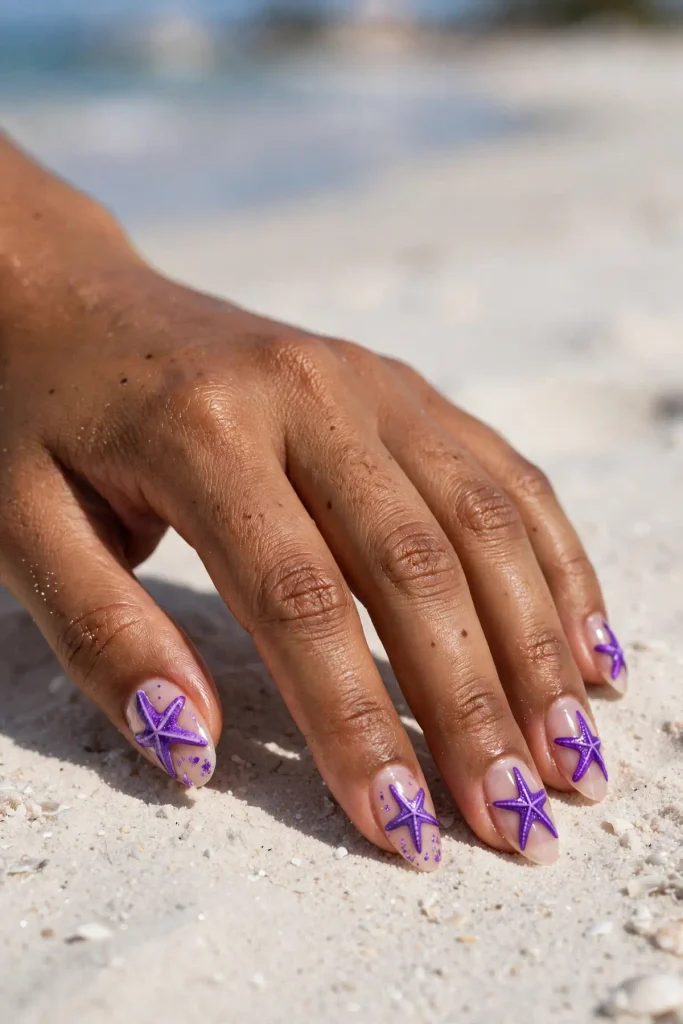
A vibrant purple starfish — the ochre star’s famous color — on a deep teal base. Real purple starfish are among nature’s most striking creatures, and this design honors them: bold, vivid, unapologetic color.
Purple and teal are neighbors on the color wheel, so the combination is harmonious but electric. The starfish should be richly colored — this is not a design for timidity.
The tide-pool truth: copy nature’s boldest — real purple starfish are more vivid than anything you’d invent. Dive in when: you want color with confidence.
9. Starfish Among Anemones
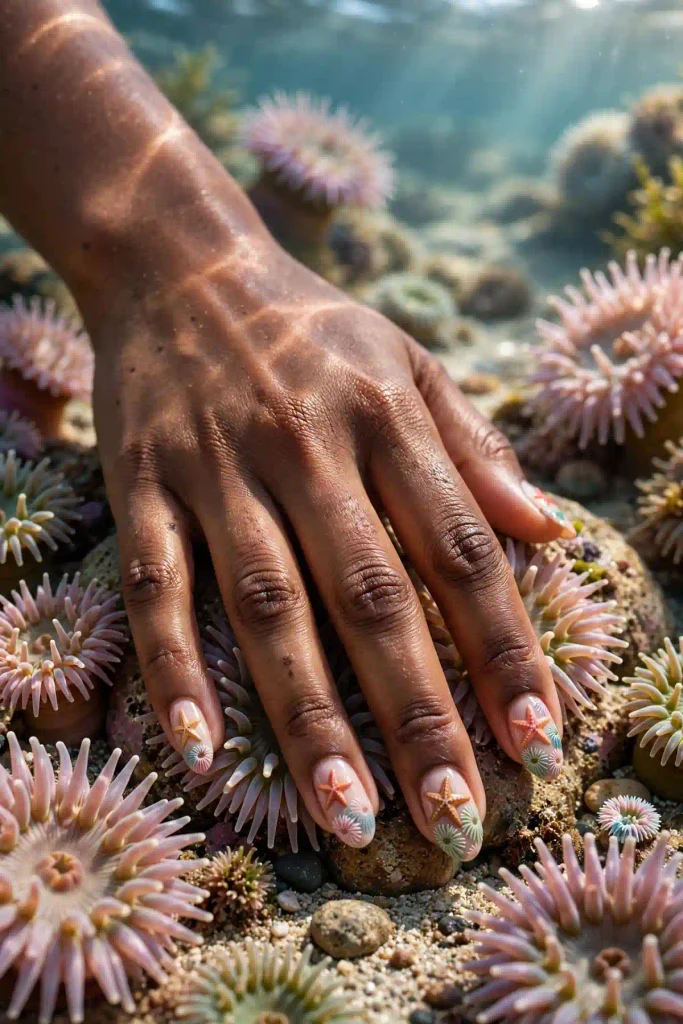
A starfish surrounded by sea anemones — those flower-like tentacled creatures — in soft pinks and greens. The anemones’ delicate tentacles contrast beautifully with the starfish’s solid arms. It’s an unusual pairing that shows real ocean knowledge.
The anemones are just clusters of fine lines radiating from a center — simpler to paint than they look. Their softness makes the starfish look strong by comparison.
The tide-pool truth: unusual pairings show expertise — anemones plus starfish says you know the ocean. Dive in when: you want marine with intellectual charm; this is the naturalist’s choice.
The Deep: Mysterious Starfish
Darker, moodier, more magical. The deep is where starfish become mysterious — glowing, metallic, silhouetted.
10. Midnight Starfish
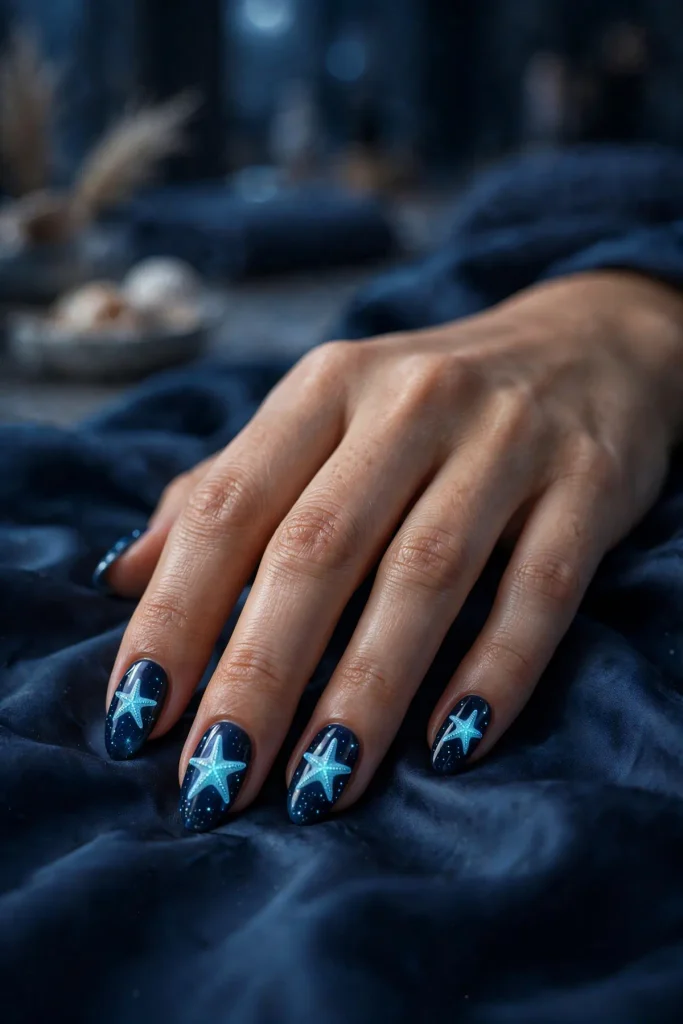
A starfish glowing softly on a deep midnight-blue base — like it’s bioluminescent in dark water. Paint the starfish in pale, luminous tones with a subtle glow effect around it. It’s haunting and beautiful.
The glow effect is the key: a soft halo around the starfish suggests light in darkness. This is the most atmospheric design here — it doesn’t just depict the deep, it feels like it.
The tide-pool truth: glow needs darkness — the deep base is what makes the starfish luminous. Dive in when: evenings, mystery lovers, and anyone drawn to the ocean’s dark side.
11. Golden Starfish
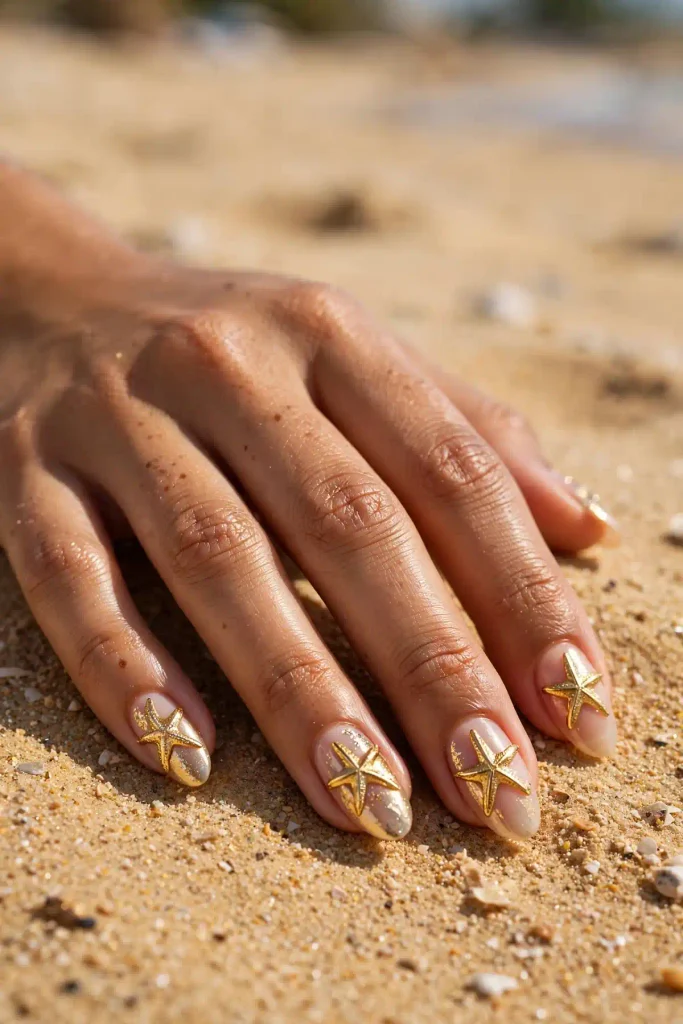
A metallic gold starfish on a deep teal or navy base — treasure from the sea floor. The gold should be rich and reflective: chrome, foil, or metallic polish. It’s luxurious marine — the ocean’s jewelry.
Gold starfish read as precious — it’s the Midas touch applied to marine life. The dark base makes the gold blaze. It’s the most glamorous design on this list by a mile.
The tide-pool truth: metallics need dark grounds — gold on pale looks washed out, gold on deep looks like treasure. Dive in when: you want marine with luxury; this is the ocean’s crown jewel.
12. Bioluminescent Starfish
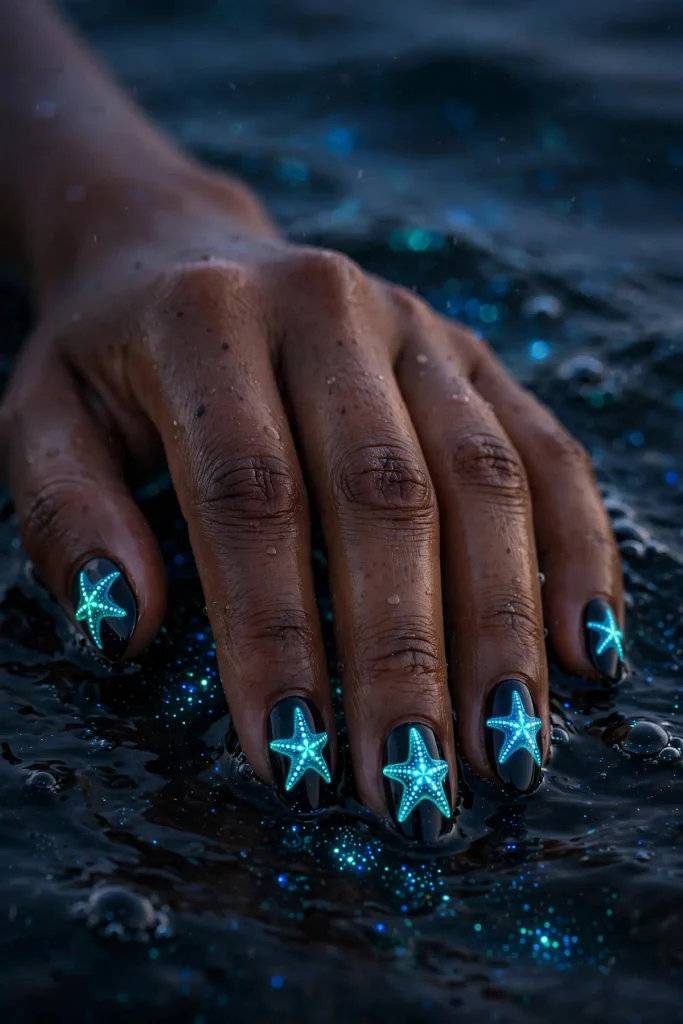
A starfish painted in glow-in-the-dark or neon-reactive polish — invisible magic by day, glowing wonder by night. Charge it in light, then watch it glow in the dark. It’s the only design here with a secret identity.
The daytime version should still look good — paint it in pale, pretty tones that happen to glow. The nighttime reveal is the payoff: a private light show on your fingertips.
The tide-pool truth: real deep-sea creatures glow — this is nature’s party trick, borrowed for nails. Dive in when: festivals, night swimming, and anyone who loves a secret.
13. Starfish Silhouette
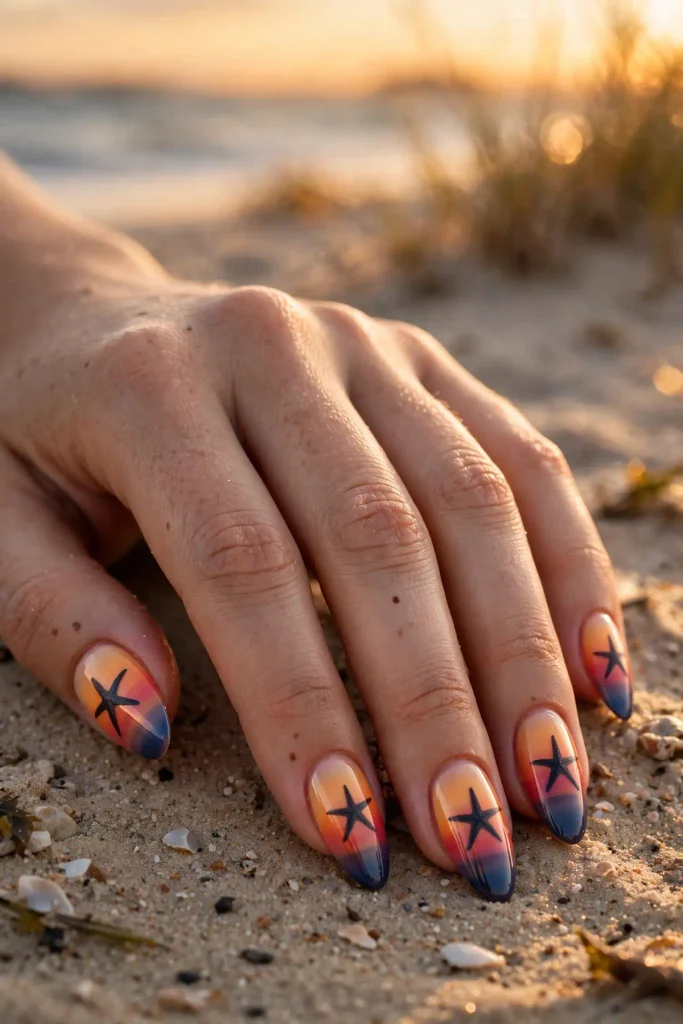
A black starfish silhouette against a sunset-gradient background — the ocean at dusk. The starfish is pure shape: no detail, just the iconic five-armed outline in black. The gradient behind it does all the colorful work.
Silhouettes are powerful because they reduce the subject to its essence — if it reads as starfish in pure black, the shape is truly iconic. The sunset gradient (pink to orange to gold) makes it breathtaking.
The tide-pool truth: silhouette tests the shape — if it reads without detail, the design is iconic. Dive in when: you want drama; this is marine minimalism at its most striking.
Starfish Reimagined: Beyond Nature
For artists who know the starfish so well they can take it apart. These deconstruct the shape into something new.
14. Geometric Starfish
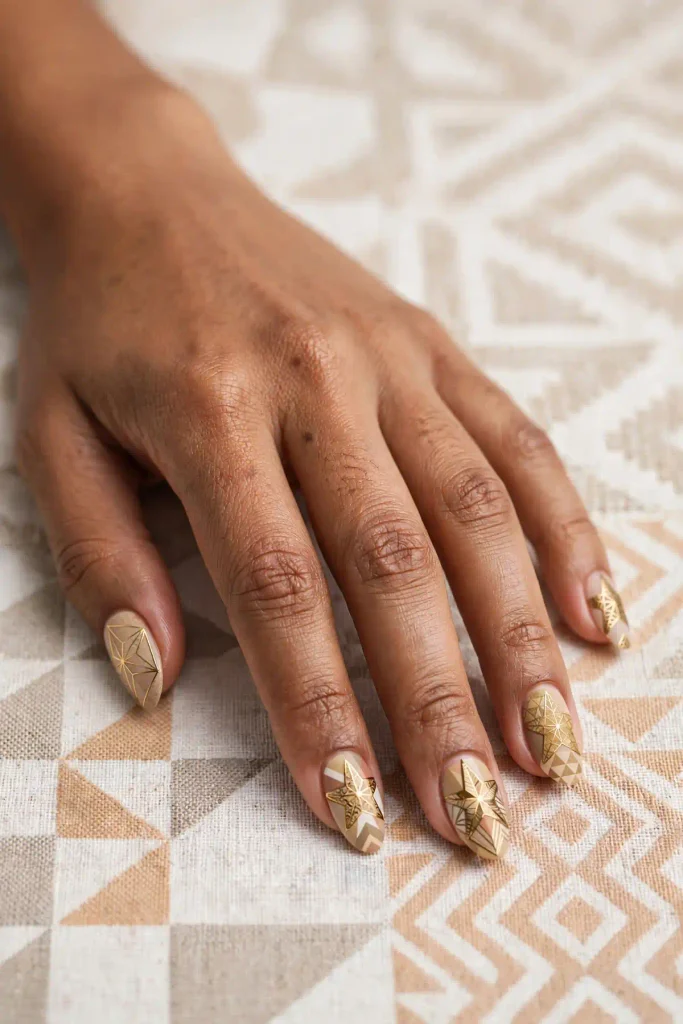
The starfish rebuilt from geometric shapes — triangular arms, faceted like a gemstone, angular and precise. It’s the creature through a cubist lens: recognizable but reconstructed. Shade the facets differently for a gemstone effect.
Keep the five-arm structure clear — that’s the anchor that makes the abstraction readable. Everything else can be angles and edges.
The tide-pool truth: keep one anchor to reality (the five arms) while abstracting everything else. Dive in when: you want nail art that’s genuinely art; this belongs in a gallery.
15. Starfish French Tips
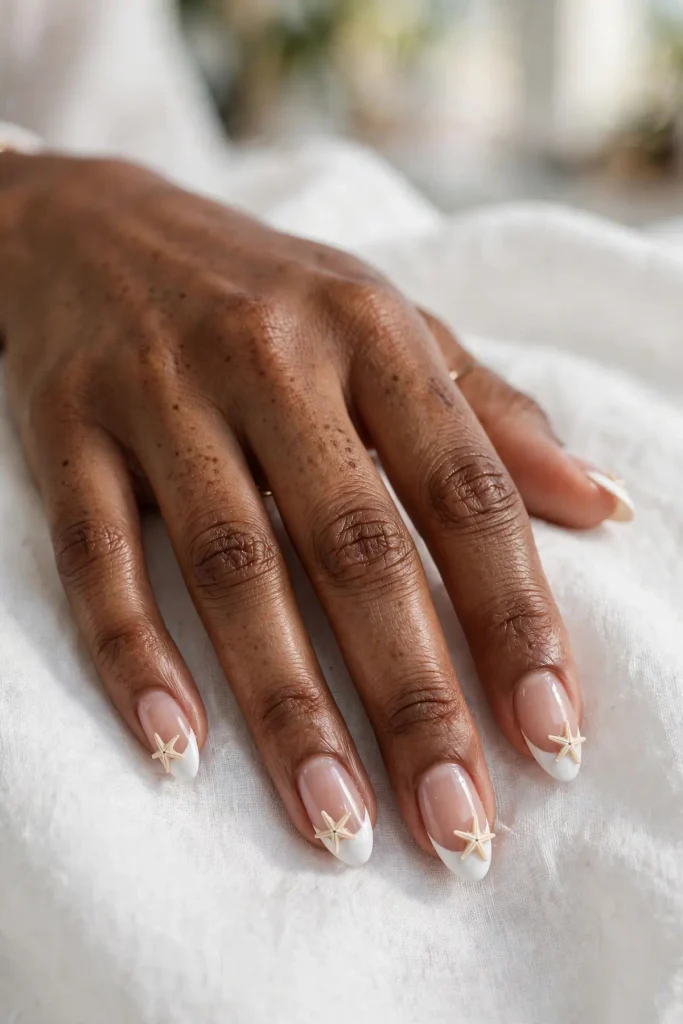
Starfish perched at the very tips of French-manicured nails — tiny starfish where the white tips would be, or starfish accenting colored tips. It’s the classic French structure with a marine twist.
The starfish should be small and simple — at tip scale, detail is impossible, so suggestion beats realism. It’s subtle marine: a secret for those who look closely.
The tide-pool truth: small scale demands simplicity — suggest the starfish, don’t illustrate it. Dive in when: you want marine that’s office-appropriate; this is the subtle choice.
16. Watercolor Starfish
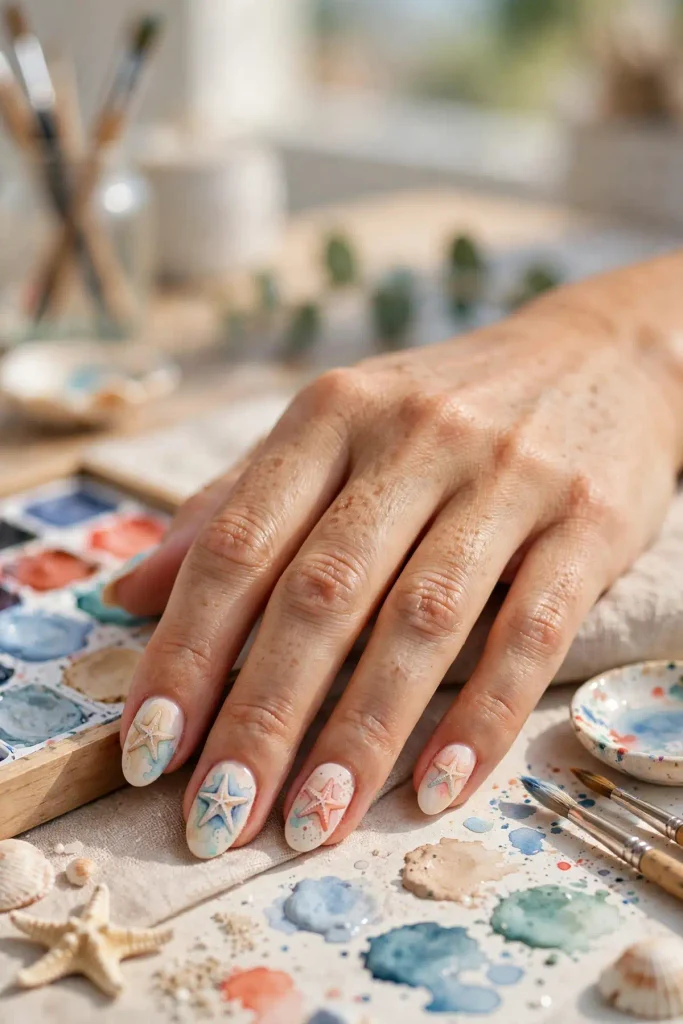
A starfish painted in soft watercolor washes — coral bleeding into peach, edges dissolving into a pale blue base. No hard outlines: just color blooming like ink in water. It’s the dreamiest starfish here.
The watercolor technique suits the starfish because real ones have soft, mottled coloring — the washes mimic nature. Work wet-on-wet for the most organic blends.
The tide-pool truth: soft edges read as organic — hard outlines read as clip art. Dive in when: you want romance without precision; the most forgiving realistic style.
17. Minimal Line Starfish
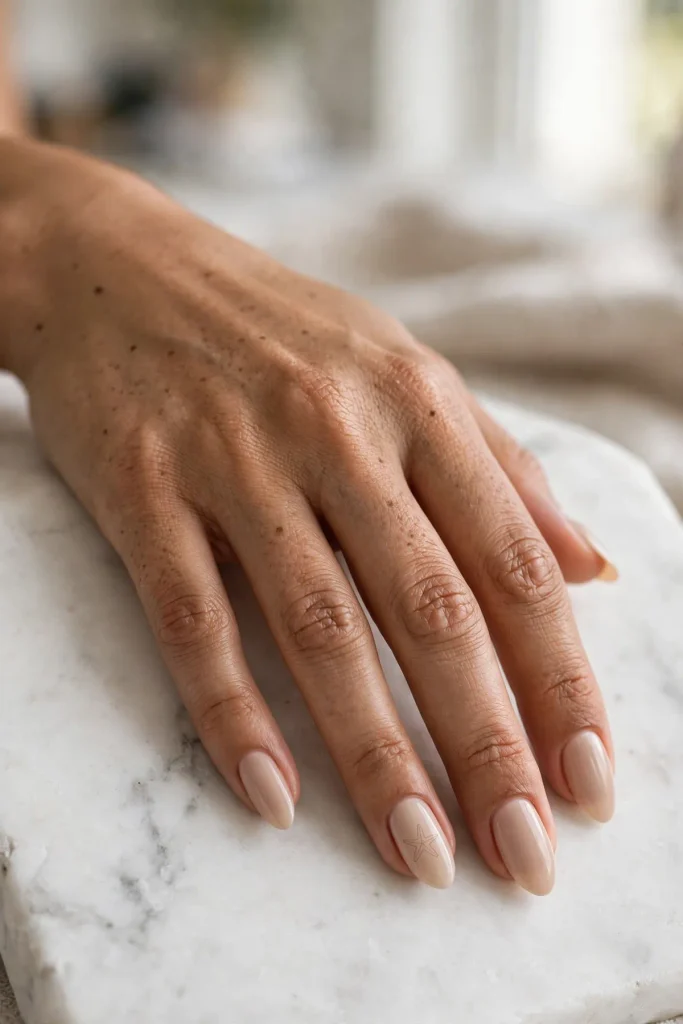
A starfish drawn in a single continuous line — one unbroken stroke forming all five arms. It’s the ultimate reduction: the creature as pure gesture. On a nude or white base, in black or navy, it’s effortlessly chic.
The continuous line must be confident — hesitation shows. But the result is stunning in its simplicity: proof that you understand the shape so deeply you can draw it without lifting the pen.
The tide-pool truth: the ultimate test of knowledge — if you can draw it in one line, you truly know it. Dive in when: minimalism is your religion; this is marine at its most refined.
Painting a Starfish: Anatomy Guide
The anatomy first, then the art. The five arms: starfish arms are thick, tapered, and slightly bumpy — paint them as plump rounded triangles radiating from a center, not thin lines. Start with the center disk, then add arms. The texture: real starfish are covered in tiny bumps and spines — dot the arms with a dotting tool or the tip of a brush for instant realism. The center: a slightly raised-looking disk where the arms meet — shade it a touch darker for dimension. Color zones: many starfish are darker on top and lighter underneath the arms — a subtle gradient along each arm adds realism. The brush: a medium round for arms, a dotting tool for texture, a fine liner for details. Practice order: draw ten starfish on paper first — arms, then texture, then full creatures. The shortcut: quality starfish stickers and stamping plates exist — modern ones are detailed and beautiful, no shame in them. Sealing: two top coats over textured art — the bumps need protection, and gloss unifies the design.
Real Starfish Colors
Nature’s palette is wilder than you’d guess. Orange: the classic ochre star — bright orange to deep rust, the postcard starfish. Purple: the ochre star also comes in vivid purple — one of nature’s most striking colors. Red: the common starfish ranges from red to orange-red. Pink: the bat star comes in pink and mottled patterns — delicate and real. Yellow: the sunflower star comes in yellow and orange — spectacular. Blue: the blue sea star is vivid cobalt — the most electric starfish on Earth. Choosing: you can’t go wrong copying nature — but you’re also free to invent; fantasy colors (gold, neon, pastel) are all fair game on nails. The shape is the star; the color is your choice.
Making Marine Art Last
Ocean art deserves ocean-proofing. Seal generously: two coats of top coat over detailed marine art — the layers of paint need armor against summer life. Gel for longevity: hand-painted starfish last 2–3 weeks in gel versus days in regular polish; for art this detailed, gel is worth it. Texture care: textured designs (sand, bumps) wear faster — an extra top coat layer protects the dimension. Sun and salt: UV fades oranges and reds; salt water is harsh on polish — rinse with fresh water after swimming and reapply top coat weekly. The touch-up: keep your base color for edge fixes; the starfish itself rarely chips (it’s usually centered). Refresh the gloss: a fresh top coat weekly revives vibrancy — dull top coat makes even perfect art look tired.
Starfish Nail Questions
How hard is it to paint a starfish?
Easier than you’d think — five tapered arms from a center disk is one of the simplest creature shapes. The texture dots are forgiving (imperfection looks natural). Ten practice starfish on paper and you’ll have it.
Can I do starfish nails at home?
Yes — ideas 1, 4, 5, 13, 15, and 17 are very DIY-able with basic tools. The detailed reef scenes (6–9) benefit from professional skill, but stickers and stamping plates make even those achievable at home.
What base colors work best with starfish?
Sandy beige and soft blue are the naturals; deep teal and navy create drama; white makes colors pop. Match the base to your habitat — shallows get light bases, the deep gets dark ones.
Do starfish designs suit short nails?
Perfectly — the starfish’s compact five-arm shape fits small nails beautifully. Ideas 4, 5, 15, and 17 are especially good on short nails; the trail (5) and minimal line (17) were practically made for them.
Wish Upon a Starfish
Seventeen ideas, four habitats, one unforgettable creature. Whether you’re painting a classic orange in the shallows, a purple showstopper on the reef, a glowing mystery in the deep, or a single-line abstraction — the starfish rewards everyone who attempts it.
Which habitat is yours — the sunlit shallows, the vibrant reef, the mysterious deep, or the artist’s reimagining? Save this list for your next beach-season appointment, and send it to the friend who thinks marine nails are “just for kids” — she’s never met a proper starfish.