17 Business Casual Outfits (That Actually Look Polished)
Business casual is the most misunderstood dress code in existence. Too casual and you look like you got lost on the way to brunch; too formal and you look like you’re interviewing at your own job. The sweet spot — polished, comfortable, intentional — is narrower than it looks, but once you learn the formula, it’s effortless.
I spent eight years in business-casual offices, and I cracked it by year two: every outfit below follows one formula, and each ends with a different kind of insider note. Seventeen outfits, zero dress-code anxiety. Let’s get to work.
The Business Casual Formula: Polished + Comfortable + Intentional
Every outfit here combines three things: one polished piece (blazer, tailored trousers, structured dress — the item that says “professional”), comfort built in (stretch fabrics, sane shoes, nothing that fights you through a workday), and intention (tucked, pressed, accessorized — the details that separate “outfit” from “clothes”). Miss the polish and it’s casual; miss the comfort and you won’t survive the day; miss the intention and it all falls apart. Get all three and you’re bulletproof.
1. Blazer + Dark Jeans + Blouse

Structured blazer, dark indigo jeans (no distressing), silk or silky blouse tucked in, loafers or low heels. The blazer does the professional heavy lifting; the jeans keep it modern and comfortable.
This was my Friday uniform for years. The blouse — not a tee — is what makes the jeans office-appropriate; it’s the line between “casual Friday” and “just casual.”
Best for: creative offices, casual Fridays, and client meetings where you want to look sharp without a suit.
2. Midi Dress + Cardigan + Loafers
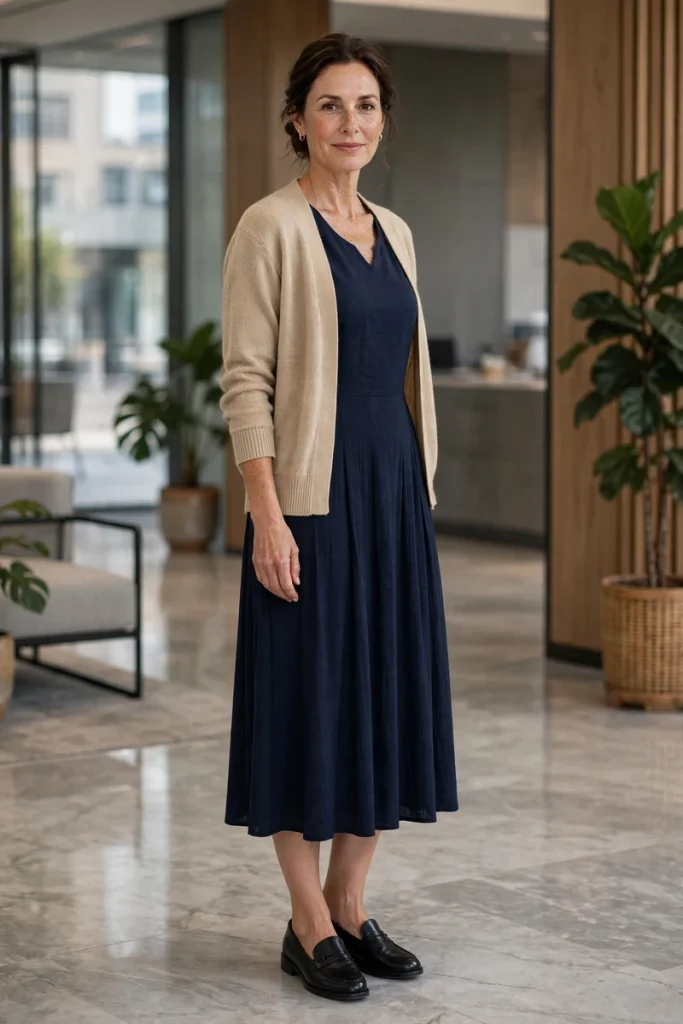
Solid or subtly printed midi dress, structured cardigan over it, loafers, simple jewelry. One piece does the work; the cardigan adds polish and handles cold offices.
The midi dress is the business-casual cheat code: it’s a complete outfit in one decision, always appropriate, and comfortable for ten-hour days. I owned five and rotated them endlessly.
The detail: the cardigan should be structured (not slouchy) — a lady-jacket style or fine-knit buttoned cardigan reads as intentional, while an oversized chunky knit reads as weekend.
3. Tailored Trousers + Sweater + Flats
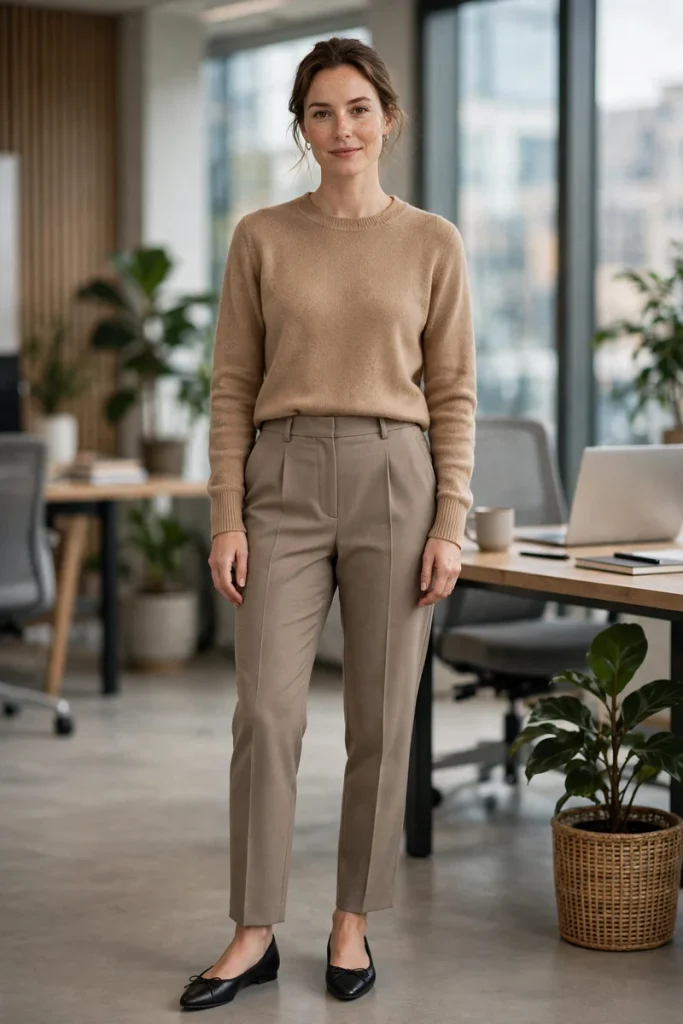
Well-fitted trousers in navy, black, or grey, a fine-gauge sweater half-tucked, pointed flats, minimal jewelry. Understated, comfortable, and quietly authoritative.
This is the outfit I wore when I wanted to be taken seriously without a blazer. The trousers’ tailoring is the entire message: precise, professional, in control.
Try with: a blazer thrown over for important meetings, or swap the flats for low heels when the day runs into evening.
4. Pencil Midi Skirt + Button-Down + Heels
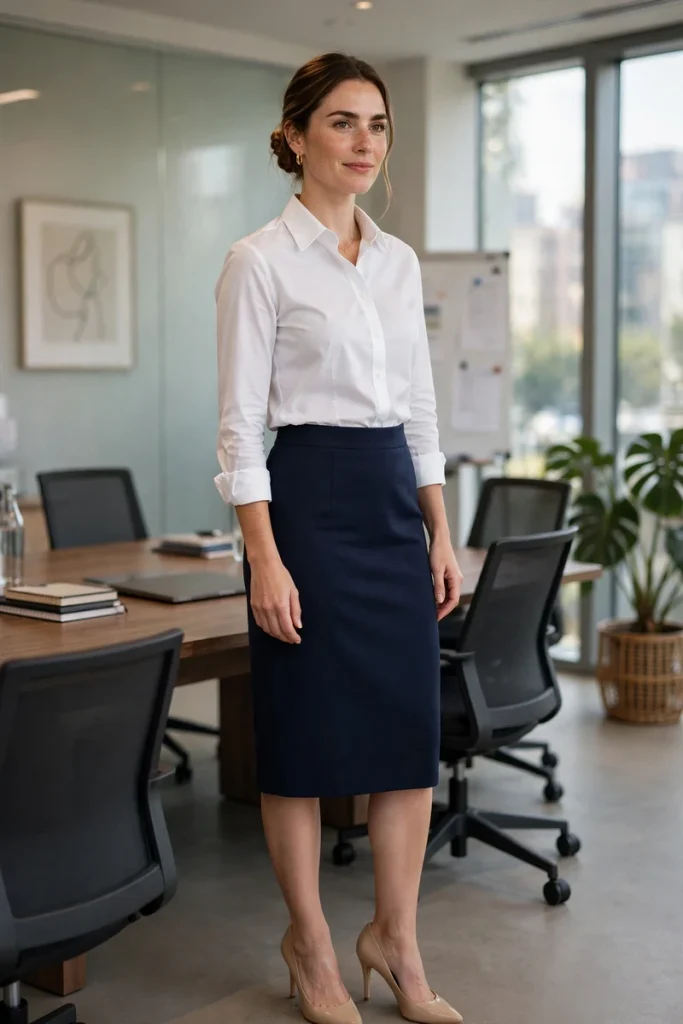
Knee-length pencil or straight midi skirt, crisp button-down tucked in, low block heels, structured tote. Classic office polish — the uniform that never fails.
Some call it boring; I call it bulletproof. When I had a big presentation, this is what I reached for — zero decisions, maximum authority.
Avoid if: your office involves lots of movement, stairs, or floor-sitting — pencil skirts restrict stride. Swap to an A-line midi for the same polish with mobility.
5. Ponte Pants + Tunic + Ankle Boots
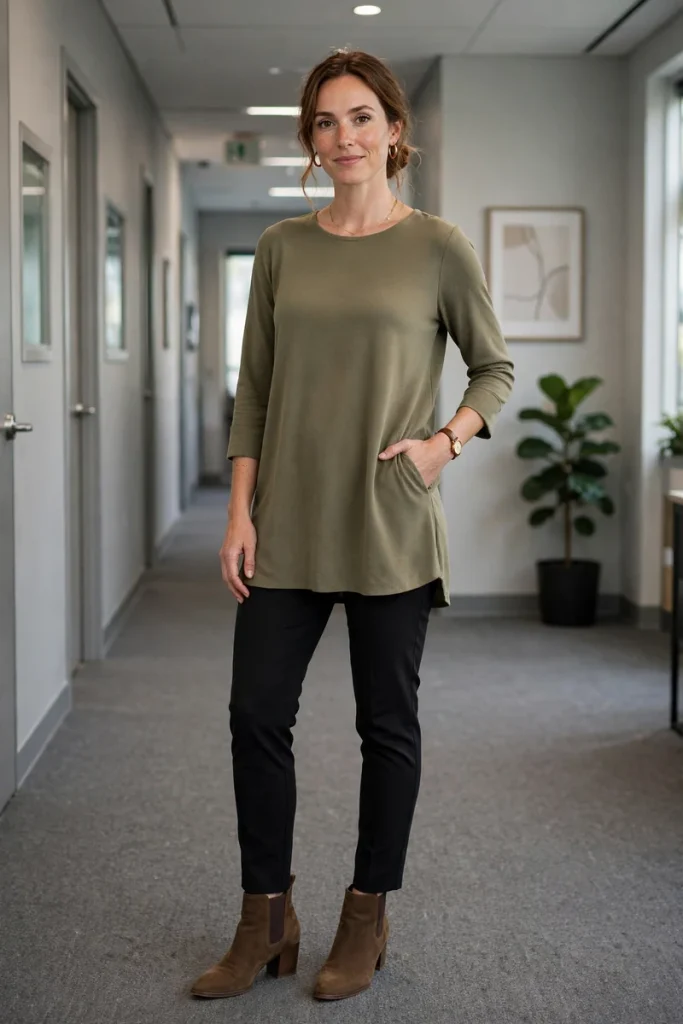
Black ponte pants, tunic-length top covering the hip, ankle boots, long necklace. The comfort-maximum professional outfit — ponte feels like leggings and looks like tailoring.
Ponte pants carried me through my busiest work years. They’re machine washable, wrinkle-proof, and structured enough for any business-casual room.
Pro tip: the tunic must cover the front and back fully — ponte pants are fitted, so the top’s length is what keeps the proportions professional. This is non-negotiable.
6. Sleeveless Shell + Cardigan + Trousers

Sleeveless shell top, structured cardigan over it, tailored trousers, flats or low heels. The classic layering formula — the shell is the base, the cardigan is the polish.
This combination survived every office temperature war I ever fought: cardigan on for the freezing AC, off for the commute. Practical and perpetually appropriate.
Budget pick: sleeveless shells are thrift-store gold — silk ones for a few dollars. Buy the cardigan new (fit matters), thrift the shells in every color.
7. Wrap Dress + Blazer

Solid wrap midi dress, blazer over it, pointed flats or low heels. The wrap dress flatters every figure; the blazer adds boardroom authority.
The wrap dress is the hardest-working dress in business casual: adjustable, forgiving, feminine, and professional. Adding the blazer takes it from “nice dress” to “she means business.”
Dress it up: swap flats for heels and add statement earrings — the same dress handles after-work events without a change.
8. Chinos + Knit Polo + Loafers
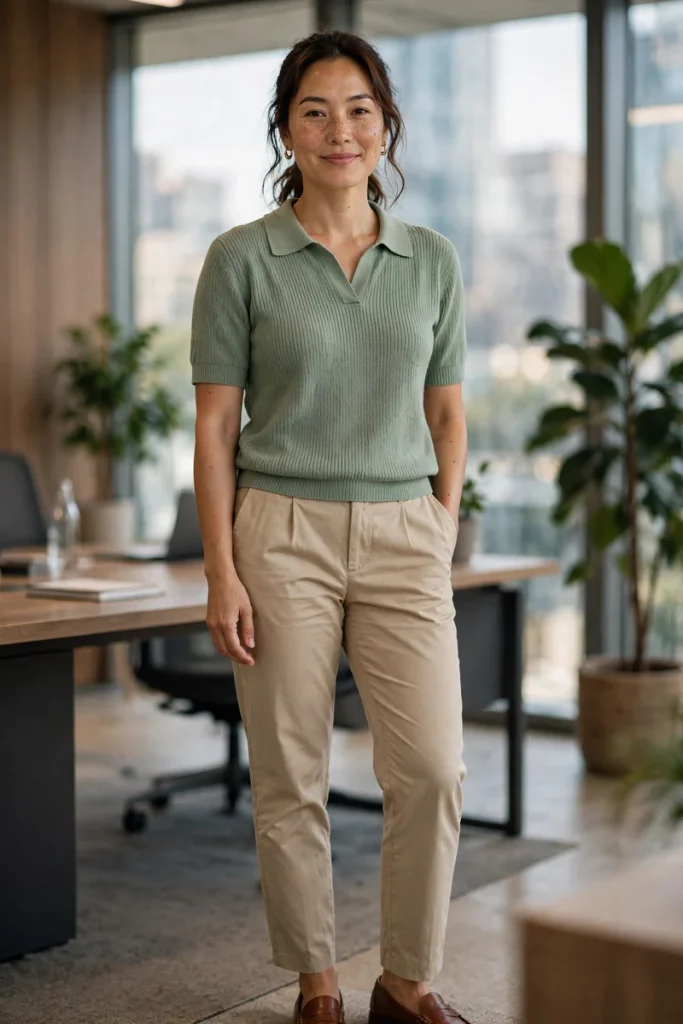
Tailored chinos (navy, khaki, or black), fine-knit polo shirt tucked in, leather loafers, simple watch. Preppy-professional — neat, modern, and comfortable.
The knit polo is the button-down’s relaxed cousin: the collar keeps it professional, the knit keeps it comfortable. I wore this on days with no external meetings and felt perfectly calibrated.
Best for: business-casual offices with a modern culture, team offsites, and days when you want polish without stiffness.
9. Sweater + Pleated Trousers
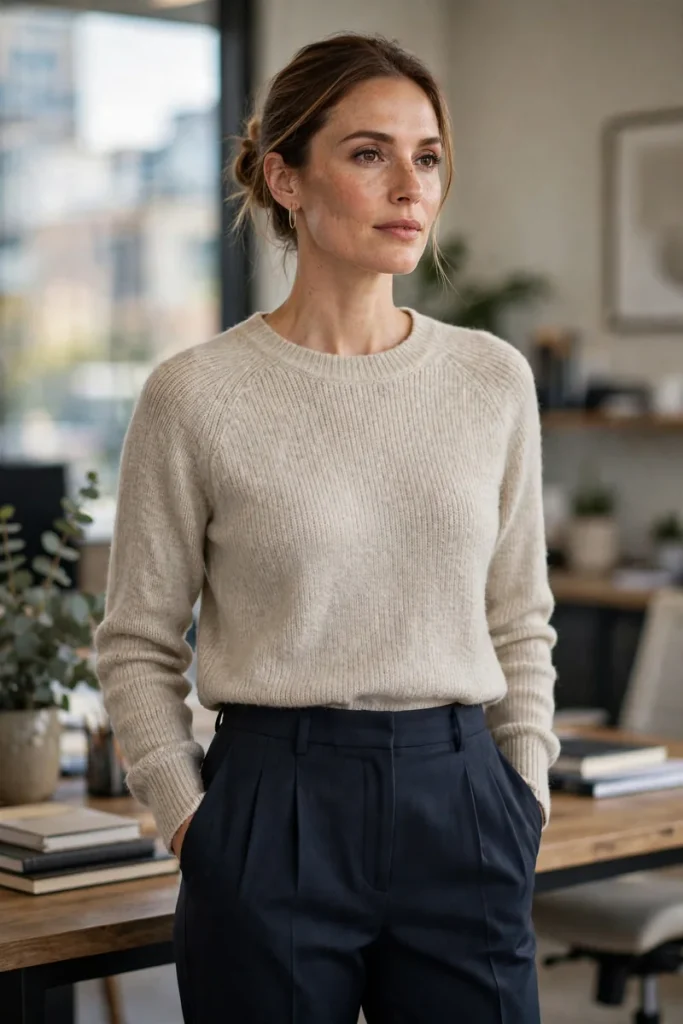
Fine-gauge sweater half-tucked into pleated wide-leg trousers, loafers or pointed flats, delicate jewelry. Soft tailoring — the pleats bring elegance, the sweater brings ease.
Pleated trousers are having a moment, and they’re a gift to business casual: they look tailored while feeling relaxed. The half-tuck shows the waistband’s detail.
The detail: the half-tuck is essential — a fully untucked sweater hides the trousers’ pleats, which are the entire point. Front-tuck, back loose, done.
10. Jumpsuit + Blazer

Tailored jumpsuit in black, navy, or olive, blazer over it, pointed flats or low heels. One piece, zero morning decisions — the jumpsuit is the outfit, the blazer is the authority.
The jumpsuit was my secret weapon for chaotic mornings: one item, fully dressed. The blazer makes it office; without it, it’s weekend. That one layer is the whole dress code.
Try with: the blazer off and sneakers on for the commute, then blazer on at the desk — the easiest day-to-evening transition in this list.
11. Dark Jeans + Knit Blazer + Loafers
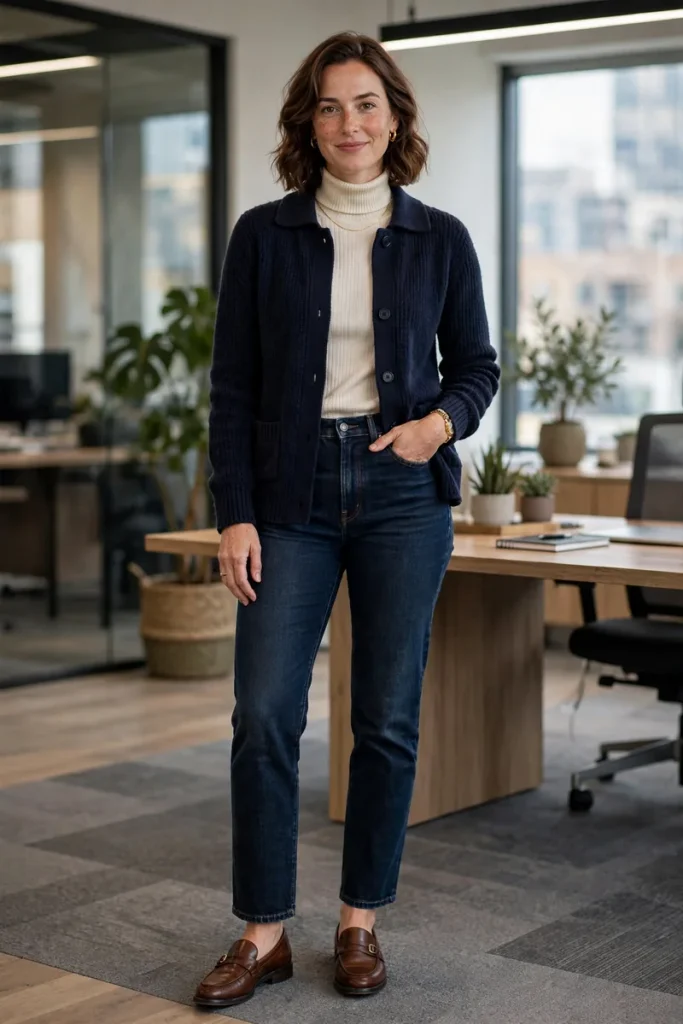
Dark jeans, knit blazer (structured shoulders, stretchy body), simple top, loafers. All the authority of tailoring with the comfort of knitwear — the modern office uniform.
I discovered knit blazers in my third work year and never looked back. They survive long days, commutes, and office chairs without a single wrinkle of complaint.
Avoid if: your office is formal business (suits expected) — knit blazers are business casual’s ceiling, not formal’s floor. Know which room you’re dressing for.
12. A-Line Skirt + Fitted Sweater + Boots
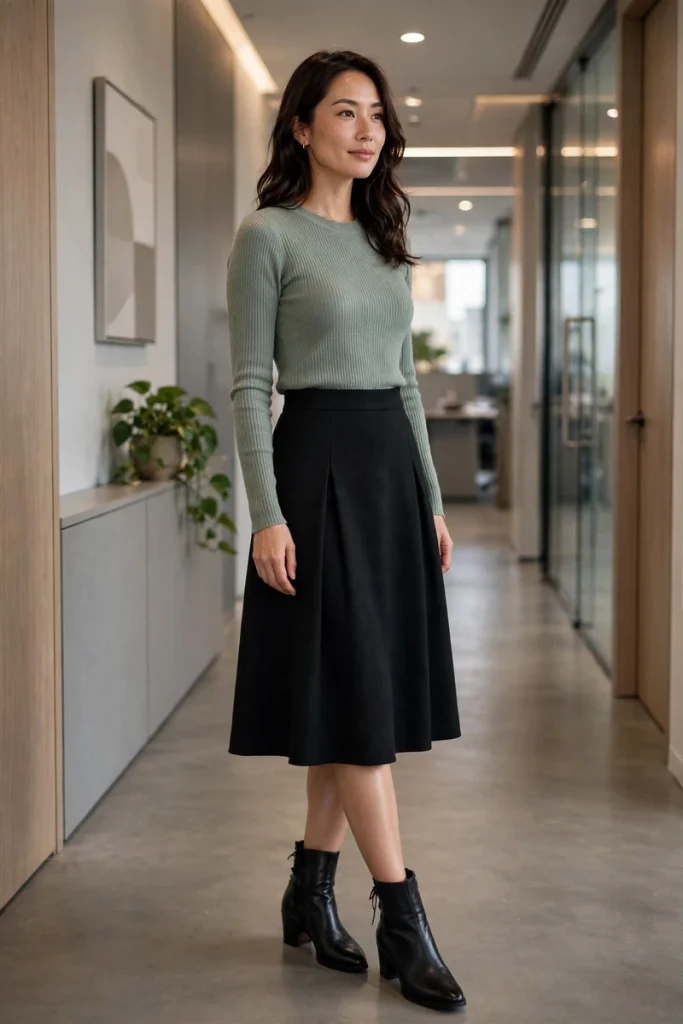
A-line midi skirt, fitted sweater tucked in, knee-high or ankle boots, simple earrings. Fall-office perfection — the A-line moves beautifully and the boots ground it.
This was my October-through-December uniform. The A-line skirt is the pencil skirt’s comfortable sister: same polish, full mobility, and it looks better in motion.
Pro tip: match the boot color to the skirt’s darkest tone for a seamless leg line. The sweater should be fitted — volume on top plus volume below overwhelms.
13. White Shirt + Wide-Leg Trousers + Heels
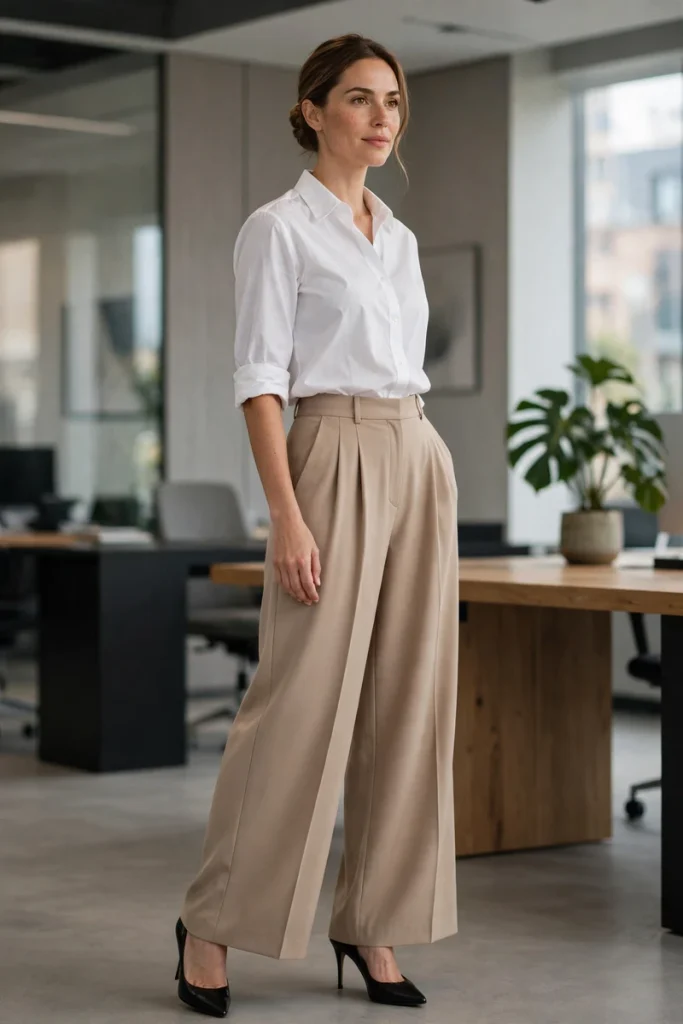
Crisp white shirt, high-waisted wide-leg trousers in black or navy, pointed heels, gold hoops. High-contrast, high-impact minimalism — the trousers are the statement.
This outfit makes you look like you have a personal stylist. The wide leg brings drama; the white shirt keeps it classic; the heels add the final polish.
Budget pick: white shirts are everywhere secondhand in great condition — people donate them barely worn. Invest new in the trousers (fit is everything there).
14. Cardigan-as-Top + High-Waist Trousers
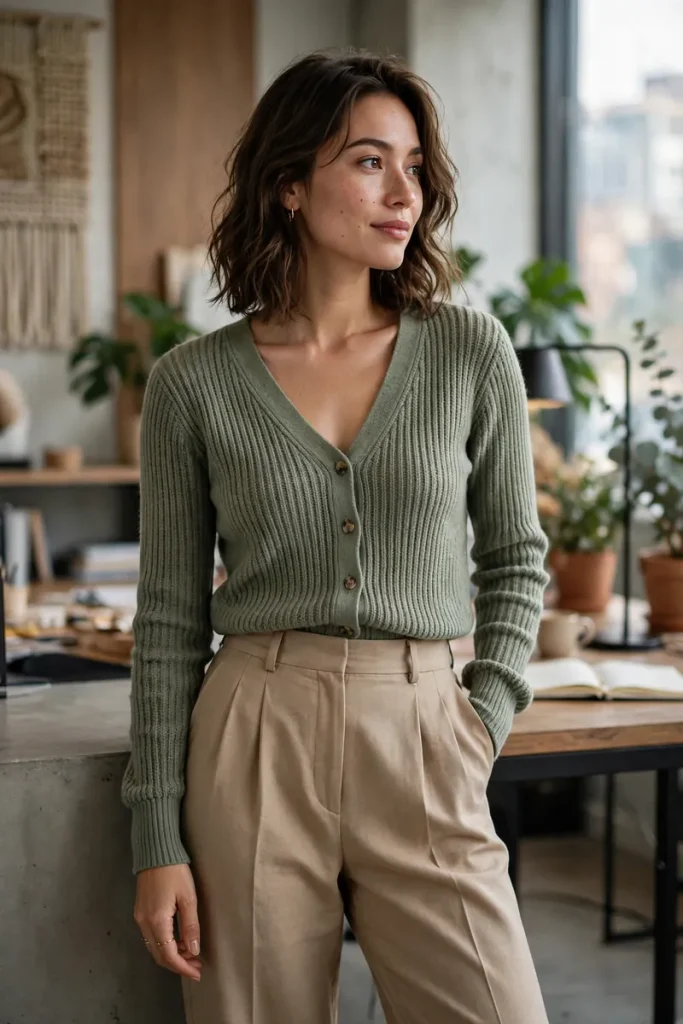
Buttoned cardigan worn as a top, high-waisted tailored trousers, pointed flats, delicate necklace. Soft, feminine, and modern — the cardigan-as-top trick is endlessly chic.
This is the outfit that gets “where is that from?” — it’s just a cardigan and trousers, but the styling makes it look designed. The high waist is non-negotiable for the proportions.
Dress it up: add a blazer over it for formal meetings, or swap flats for heels — the base handles both directions effortlessly.
15. Shift Dress + Structured Jacket

Simple shift dress (knee-length), structured jacket or blazer over it, low heels or pointed flats. Clean lines, zero fuss — the shift dress is business casual’s blank canvas.
Shift dresses are the introvert’s office outfit: no clinging, no adjusting, just clean lines that look professional from every angle. The jacket adds the authority.
Best for: job interviews at business-casual companies, big presentations, and days when you need to look authoritative with zero effort.
16. Turtleneck + Midi Skirt + Knee Boots
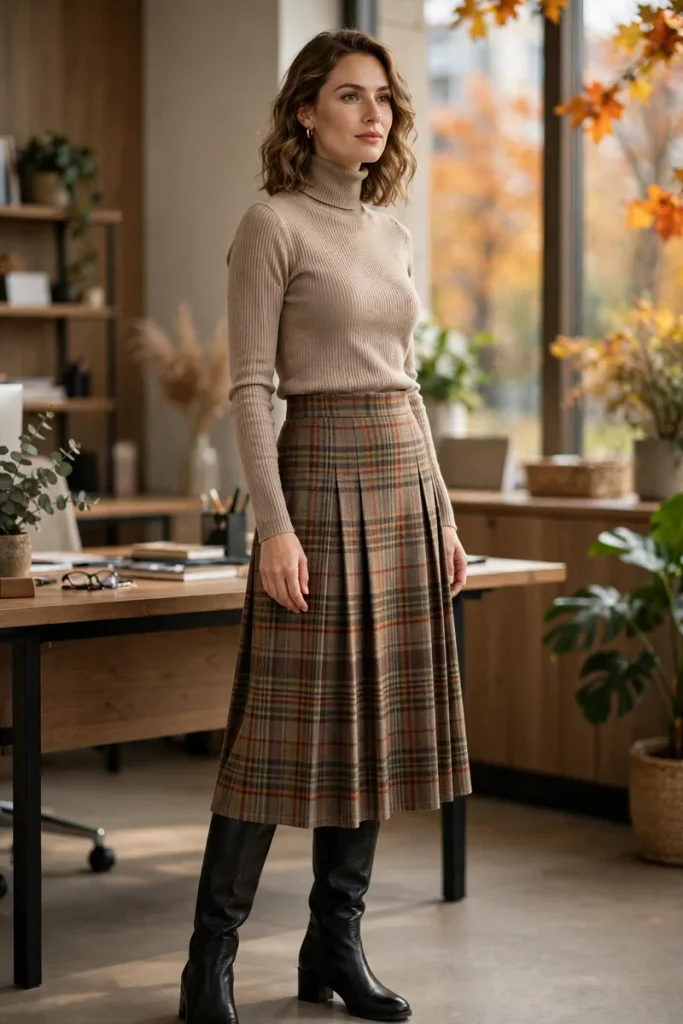
Fitted turtleneck tucked into a pleated or A-line midi skirt, knee-high boots, minimal jewelry. Winter-office elegance — the turtleneck is sleek, the boots are powerful.
This carried me through three winters of office life. The turtleneck-plus-skirt combination is endlessly refinable: change the colors, change the textures, same perfect formula.
The detail: the boots should disappear under the skirt’s hem — that continuous line is what makes this elegant rather than busy. Match tights to the boots for extra seamlessness.
17. Relaxed Suit (Soft Tailoring)

Unstructured blazer and matching trousers in a soft fabric (no shoulder pads, no stiffness), simple top underneath, loafers or low heels. The suit, but comfortable — modern business casual’s power move.
The relaxed suit is the final boss of business casual: it reads as “I dressed up” while feeling like pajamas. I wore mine to every important meeting in my last two work years.
Try with: sneakers for creative offices, heels for formal days — the relaxed suit is the rare outfit that handles both extremes with a shoe swap.
FAQs
What exactly counts as business casual? The zone between formal business (suits) and casual (jeans and tees): polished pieces worn with comfort and personality. Think blazers with dark jeans, dresses with cardigans, tailored trousers with sweaters. The test: would you be comfortable if your CEO walked in? If yes — and you’re not in a suit — that’s business casual.
Are jeans ever business casual? Yes, with rules: dark wash, no distressing, no skinny-legging hybrids — and always paired with polished pieces (blazer, blouse, structured sweater, loafers). Jeans plus blazer reads as business casual; jeans plus tee reads as weekend, even on Friday. When in doubt, check what the best-dressed person in your office wears on Fridays.
What should you never wear as business casual? Anything you’d wear to the gym, the beach, or a nightclub — that’s the bright line. Specifically: athletic wear, flip-flops, shorts, graphic tees, club dresses, and anything wrinkled or stained. Business casual is still business; comfort is allowed, sloppiness isn’t. When in doubt, overdress slightly — nobody ever got in trouble for looking too polished.
How do I build a business casual wardrobe on a budget? Start with the workhorses: dark jeans, black trousers, a blazer, two blouses, a midi dress, and good flats. Thrift the blouses, shells, and blazers (they’re abundant secondhand); buy trousers and shoes new (fit matters most there). Ten great pieces beat thirty mediocre ones — and everything should match everything.
What’s the difference between business casual and smart casual? Business casual leans professional (blazers, trousers, dresses — office-appropriate); smart casual leans social (dark jeans, nice tops, stylish sneakers — dinner-appropriate). The overlap is large, but the test differs: business casual asks “would the CEO approve?” while smart casual asks “would this work at a nice restaurant?” When an invitation is ambiguous, business casual is the safer choice.
Conclusion
Seventeen outfits, one formula: polished, comfortable, intentional. Business casual isn’t a puzzle to solve every morning — it’s a uniform to build once and rotate forever. The women who nail it aren’t thinking harder about getting dressed; they built the wardrobe that thinks for them.
So start with the workhorses: the blazer, the dark jeans, the midi dress, the good trousers. Add the pieces that make you feel like yourself, and wear it all like the professional you are. The dress code was never the enemy — it was just waiting for you to crack it. Now you have.